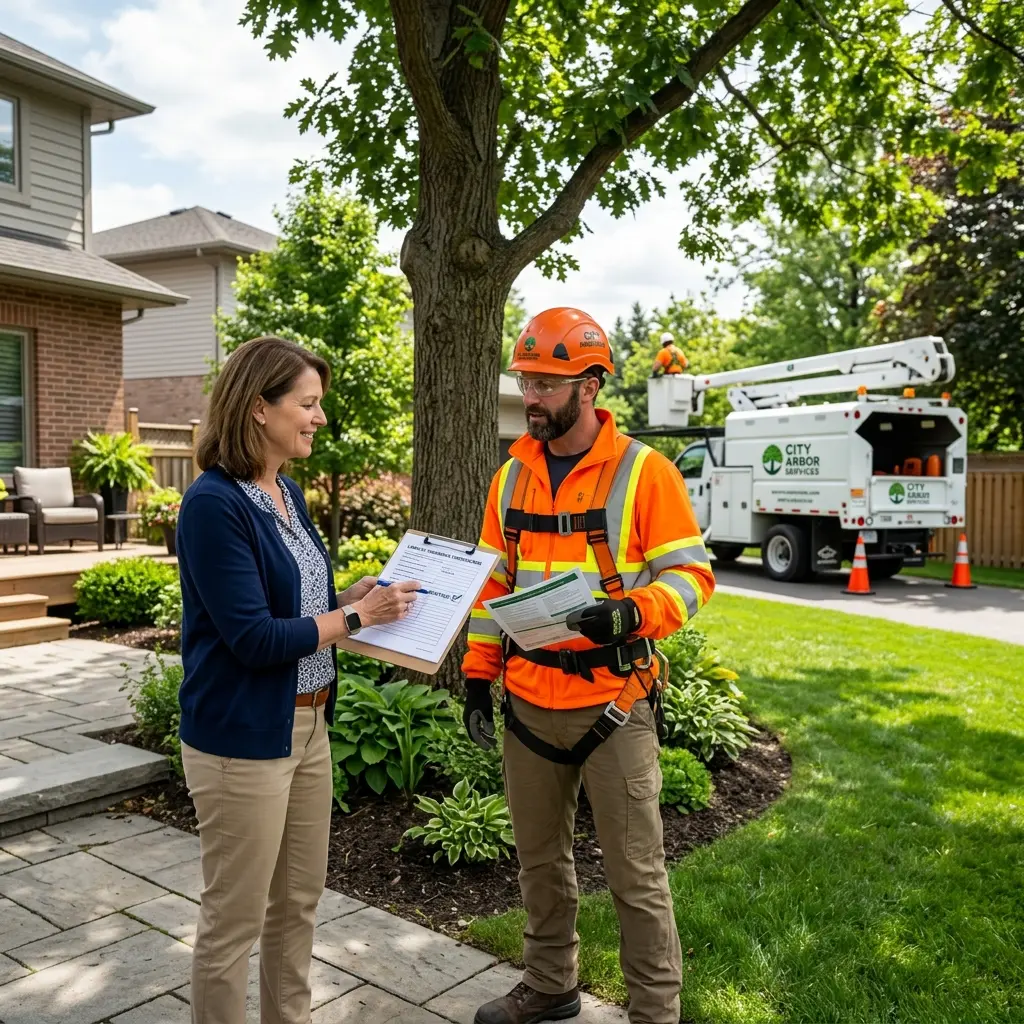

1. The Reality of Residential Tree Hazards
Residential tree care is statistically one of the most hazardous professions in the United States, ranking alongside commercial fishing and structural steelwork in occupational fatality rates. When a crew operates multi-ton cranes, 100-horsepower wood chippers, and industrial chainsaws in close proximity to power lines and residential roofs, any minor failure can lead to catastrophic property damage or fatal injuries.
If you hire a tree care company that does not carry active, verified liability and workers' compensation coverage, you are exposing yourself to profound personal liability. Under premises liability laws, if an uninsured worker falls from a tree on your property, your standard homeowner's insurance policy may deny coverage due to unpermitted or unlicensed labor, leaving you personally responsible for their medical expenses and lost wages.
---
2. Spotting Contractor Red Flags
Before signing any arborist contract, perform a comprehensive visual and behavioral audit of the company:
- Demanding Cash-Only or Large Upfront Deposits: Reputable tree care firms have the capital to mobilize equipment, fuel, and labor without requiring your money beforehand. Except for major commercial crane hire, never pay more than 10% upfront.
- Lack of Safety Gear (ANSI Z133 Standards): Walk away if you see ground crew or climbers without protective helmets (ANSI Z89.1), eye shields (ANSI Z87.1), or chainsaw-resistant leg protection (chaps or pants). A professional crew takes pride in strict safety compliance.
- Climbing with Spikes on a Pruning Job: Spikes (gaffs) puncture the bark and the cambium, creating wounds that invite wood-boring insects and fungal decay. Climbers should only use spikes if they are performing a complete removal.
- Aggressive Door-to-Door Solicitation: Professional arborists are highly scheduled. Storm-chasers who knock on your door claiming they "just finished a job down the street and have a special rate" are rarely licensed, insured, or properly trained.
---
3. The Certificate of Insurance (COI) Direct Verification Protocol
Never accept a printed PDF copy of insurance from a contractor's hand. These are easily forged or can be canceled immediately after printing.
Follow the Direct Verification Protocol:
1. Request a COI: Ask the contractor to have their insurance agency mail or email a Certificate of Insurance (COI) directly to you.
2. Audit the Coverage Limits: Ensure the COI displays:
- General Liability: Minimum of $1,000,000 per occurrence / $2,000,000 aggregate.
- Workers' Compensation: Statutory limits (must cover every climber and ground worker on your site).
- Commercial Auto: Coverage for heavy trucks and trailers.
3. Call the Underwriter Directly: Locate the insurance agent/broker's phone number listed at the top of the COI. Call them directly to verify:
- Is the policy currently active?
- Does the policy cover "Tree Removal" and "Tree Pruning at Height"? (Many companies buy cheaper landscaping policies that explicitly exclude tree climbing, rendering the coverage void if a worker falls from a tree).
---
4. ANSI Z133 Safety Standards: Ground Crew & Climber Rules
The ANSI Z133 standard is the national safety standard for arboricultural operations. Ensure your chosen company strictly adheres to these requirements:
- The Two-Point Rule: Climbers must be secured to the tree by at least two points (e.g., a climbing line and a steel-core work-positioning lanyard) whenever they are cutting.
- Drop Zones: The ground crew must establish a clear drop zone with orange cones and ground markers. No ground worker should enter the drop zone until the climber has acknowledged them and paused cutting operations.
- Chainsaw Operation: Arborists must never use a chainsaw one-handed. A chainsaw must be controlled with both hands at all times, except in rare canopy rigging exceptions where a second hand is physically required for climber stabilization.
---
5. Credentials: What Actually Means Something
Tree care is not licensed at the federal level and only some states license it at all, so credentials do most of the filtering. Three are worth knowing, and they are not equivalent.
| Credential | Who issues it | What it actually tells you |
|---|---|---|
| ISA Certified Arborist | International Society of Arboriculture | An individual passed a written exam on tree biology, diagnosis, pruning, and safety, and maintains continuing education. Verify the person, not the company, at the ISA's public directory. |
| ISA TRAQ | International Society of Arboriculture | Tree Risk Assessment Qualification — the credential that matters if you need a defensible written hazard rating for an insurer, permit exemption, or lawsuit. |
| TCIA Accreditation | Tree Care Industry Association | Audits the company: safety programme, insurance, employee training, business practices. Far rarer than individual certification and a strong signal. |
| State contractor licence | Varies by state | Required in California (C-61/D-49), Louisiana, Maryland, Connecticut, Rhode Island, and others. Many states require nothing at all, which is exactly why the insurance check matters more than the licence check. |
A crew can be entirely competent without an ISA certification, and a certification does not make an uninsured company safe to hire. Credentials narrow the field; the certificate of insurance is what protects you.
---
6. The Exact Script for the Insurance Call
Most homeowners never make this call because they do not know what to say. It takes four minutes.
> "Hello, I'm calling to verify a certificate of insurance. The insured is [company name], policy number [number from the COI]. I'm a homeowner and they've quoted me for tree removal at my property.
>
> 1. Is that policy active today?
> 2. Does the general liability policy cover tree removal and pruning at height, or is it written as a landscaping policy?
> 3. Is there an active workers' compensation policy, and does it cover all employees including ground crew?
> 4. Are there any exclusions I should know about — climbing, chainsaw operation, crane work?
> 5. Can you add me as a certificate holder so I'm notified if the policy lapses?"
Question 2 is the one that catches people out. A general landscaping policy is significantly cheaper than a tree care policy and frequently excludes work above ground level. A contractor holding one has a genuine, verifiable certificate that will not pay a cent when a climber falls out of your oak.
Question 5 costs nothing and means the insurer notifies you directly if coverage lapses between the quote and the work.
---
7. What the Written Contract Must Contain
Verbal agreements are where tree work disputes are born. Before any work begins, get all of this in writing:
- Scope, by tree. Which specific trees, identified by location, and what is being done to each — removal, pruning, or crown reduction. "Trim trees in back yard" is not a scope.
- Stump treatment. Whether stumps are ground, to what depth in inches, and whether surface roots are included. This is the single most common source of post-job argument.
- Debris. Whether wood, brush, and chips are hauled away or left, and if left, where and in what form. Firewood-length rounds and a chip pile are very different outcomes.
- Property protection and restoration. Who is responsible for lawn ruts, damaged irrigation heads, and driveway cracking from equipment, and what "restoration" means in practice.
- Payment schedule. Nothing above 10% before work starts, balance on completion after your inspection.
- Permit responsibility. Who pulls the permit where one is required, and who pays the fine if it turns out one was needed. See our permit rules by city.
- Cleanup standard and timeline. Including a date, because the gap between "the tree is down" and "the yard is usable" can be weeks with an overcommitted crew.
---
8. If Something Goes Wrong Anyway
Damage happens even with good contractors. What determines your outcome is what you do in the first 48 hours.
1. Photograph everything before anyone tidies up — the damage, the equipment position, the site conditions. Timestamps matter.
2. Do not accept a cash settlement on the spot. An offer to "take care of it" without paperwork is an attempt to keep the claim off their loss history, and it leaves you with no recourse when the repair costs more than the cash.
3. Notify their insurer directly, using the certificate you obtained before work started. This is the entire reason you asked for it.
4. Notify your own insurer even if you expect the contractor's policy to pay. Late notice can prejudice your own coverage if the contractor's carrier denies.
5. Get an independent repair quote rather than accepting the contractor's preferred repair firm.
If the contractor turns out to be uninsured after all, your recovery route is small claims court against a business that may have no assets. That is the scenario the four-minute phone call exists to prevent.
---
9. What Verification Costs You
Nothing, in money. The certificate is free, the insurance call is free, the ISA directory lookup is free, and the 811 locate is free. The entire process costs about 30 minutes.
Set that against the alternative. An uninsured climber injured on your property can generate a six-figure medical claim, and a homeowner's policy that excludes unlicensed labour will not absorb it. Damage to a roof from a mis-rigged limb is routinely $8,000 to $25,000. Neither figure appears anywhere in a tree removal quote, which is precisely why the cheapest bid so often comes from the company carrying the least coverage.
Price the work itself with the tree removal cost calculator, and read the tree removal estimates guide for what a properly itemised bid should look like.
Frequently Asked Questions About Verifying a Tree Service
Is a tree service required to be licensed?
It depends entirely on the state. California, Louisiana, Maryland, Connecticut, and Rhode Island license tree work; many states require nothing beyond a general business registration. Because licensing is so inconsistent, insurance verification is the more reliable filter everywhere.
What insurance limits should a tree service carry?
General liability of at least $1,000,000 per occurrence and $2,000,000 aggregate, workers' compensation at statutory limits covering every worker on site, and commercial auto for trucks and trailers. Crane work should carry higher limits.
Can I just look at the certificate they hand me?
No. A printed or emailed certificate proves only that a policy existed when the document was generated. Policies get cancelled for non-payment, and certificates are trivially edited. Call the agent listed on it.
Is an ISA Certified Arborist the same as an insured company?
No, and conflating the two is a common mistake. ISA certification is held by an individual and attests to knowledge. Insurance is held by the company and is what pays when something goes wrong. Check both separately.
What if the contractor refuses to provide a certificate of insurance?
End the conversation. A properly insured company has their agent send certificates routinely and will not find the request unusual. Refusal, delay, or annoyance at being asked is the clearest signal available to you.