Scenario 1: Small Single Stump (12 in)
Inputs: diameter 12, count 1, standard wood, no toggles, national pricing. Note how little of this is grinding — $90 of wood against a $95 trip charge. This is the case where waiting for a second stump pays.
Estimate stump grinding and stump removal cost by diameter, stump count, wood type, root complexity, grind depth, hauling, and access.
Free Estimate Tool
Estimated Range
$230 - $330
Confidence: High
Stump grinding cost is mostly driven by diameter, number of stumps, grind depth, root flare, hauling, and access.
Quick Answer
Stump grinding commonly costs $100 to $500 for a standard residential stump. Large stumps, multiple stumps, deep grinding, root removal, and chip hauling can raise the total.
Updated July 2026 for US homeowner planning estimates.

This tool does not look your price up in a table. It rebuilds the quote the way a contractor does: a fixed charge for showing up, a variable charge for the wood that has to be turned into chips, then a series of add-ons for the things that make the job slower than a clean stump in an open lawn.
The two constants are a $95 crew mobilization floor and a $7.50 per diameter-inch, per stump grinding rate. Everything else is a modifier on top: dense hardwood multiplies the grinding line by 1.16, a palm stump by 1.22, a deep grind adds $2.50 per inch, surface roots add $2 per inch (minimum $65), chip hauling adds $45 per stump (minimum $85), and a narrow gate or slope adds 18% to the whole running subtotal before your regional multiplier is applied.
The number you see is a point estimate wrapped in a 0.84× to 1.20× band, because two crews pricing the same stump on the same day routinely land 30% apart. Treat the low end as the figure a contractor with a light schedule might quote, and the high end as the one you will see in peak storm season.
Load this page and the calculator starts on a single 24-inch standard stump at national pricing. That resolves to $95 mobilization plus $180 of grinding, or $275, shown as a $230–$330 band. We use that as the default because a 24-inch stump is the most common residential case, and it gives you a fixed reference point: every change you make to the inputs below reads as a movement away from $275, which makes the model easy to reason about. For the market-wide picture — national averages, contractor pricing conventions, and regional survey data — see the stump grinding cost guide.
Diameter is the input that moves this calculator most, so getting it right matters more than anything else on the form. The number the tool wants is the width of the root flare — the flared base where the trunk meets the soil — not the cut face on top. On a mature tree those two measurements can differ by eight inches or more, which at $7.50 per inch is a $60 error before any add-ons.
Measure with a tape across the widest point at ground level. If the flare is buried under turf or mulch, scrape it clear first — the contractor has to grind what is under there whether or not you measured it. If the stump is irregular or has fused twin trunks, measure the longest span and round up; the tool's lower band still covers you if the crew finds it easier than expected. The table below shows the bands the calculator produces across the common size classes.
| Diameter | Typical Cost | Notes |
|---|---|---|
| Under 12 in | $75 - $150 | Often minimum-service pricing |
| 12 - 24 in | $120 - $300 | Common residential stump size |
| 24 - 36 in | $200 - $450 | Large stump or dense hardwood |
| 36+ in | $350 - $700+ | May need more time or larger industrial grinder |
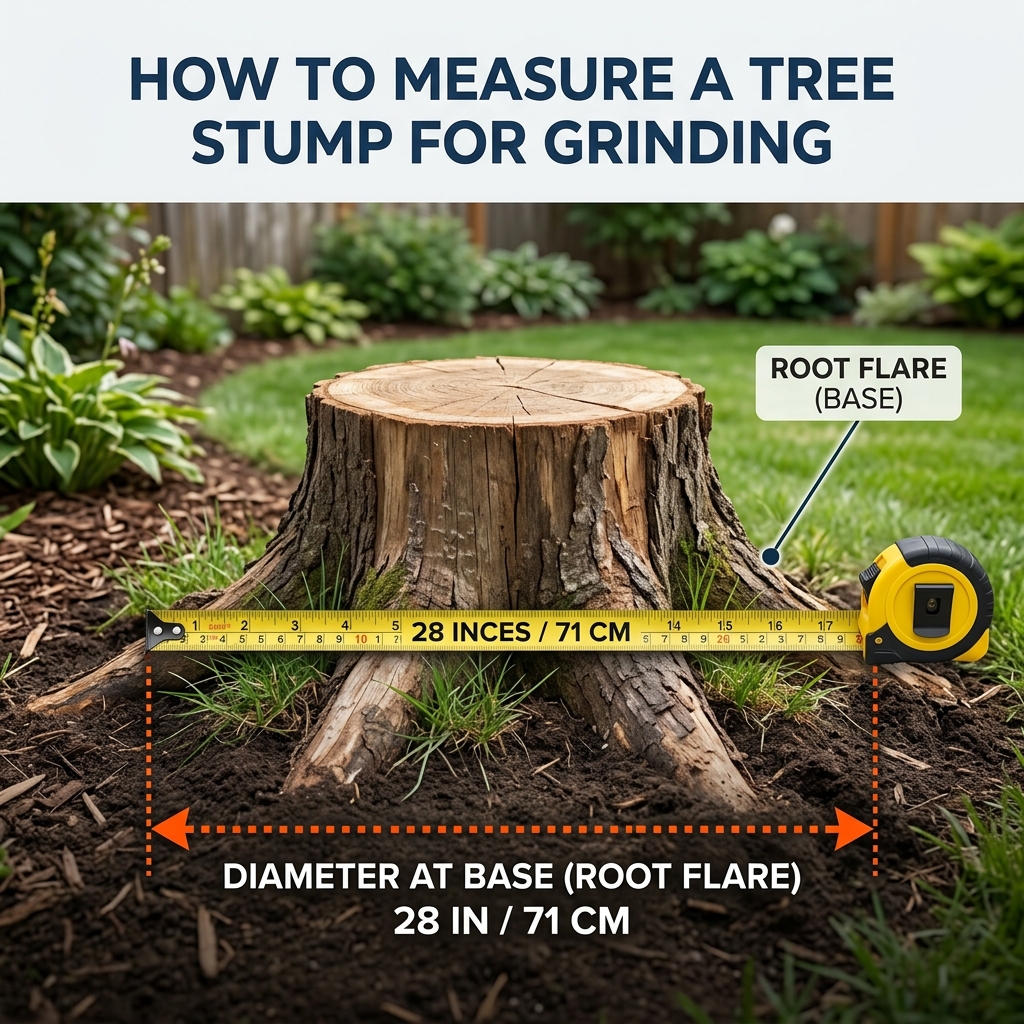
Always measure the full width of the root flare (base) at soil level, rather than just the cut top surface.
When a contractor quotes you “five dollars an inch,” ask immediately whether that rate includes the trip. This is the most common source of confusion in stump pricing, and it is why comparing per-inch rates between two companies is close to meaningless on its own.
Work the arithmetic on a 20-inch stump. A $5-per-inch quote that excludes mobilization is $100 of grinding plus a $95–$150 trip charge: call it $195–$250. The same $5-per-inch quote with the trip bundled in is $100 flat. Same words, 2.5× difference in what you pay. This calculator always separates the two, which is why the itemized breakdown shows mobilization on its own line — you can add or remove it to match however the contractor in front of you has structured their number.
One consequence worth internalizing: the effective per-inch rate on a small stump is always poor. Run a 10-inch stump through the tool and you get $170, an effective $17 per inch, because a $95 trip charge does not care how small your stump is. Run a 40-inch stump and the effective rate falls to $9.88. If you are grinding anything under about 14 inches, the honest advice is to wait until you have a second stump, a neighbour's stump, or another reason for the truck to come out.
The “number of stumps” field is where this calculator will reliably save you real money, because it models the thing homeowners most often get wrong: booking two visits instead of one.
Mechanically, the tool charges mobilization once and grinding per stump. Three 18-inch stumps in one visit come to $95 + (18 × 3 × $7.50) = $500, or $167 each. Book those same three stumps as three separate callouts and you pay $230 apiece — $690 total, a $190 penalty for scheduling alone. The saving is entirely the two trip charges you avoided, which is also why it is worth asking a neighbour with a stump whether they want to split a visit. The table below shows how the per-stump average falls as the trip charge spreads.
| Stump Quantity | Typical Cost Range | Average Cost per Stump | Key Factors |
|---|---|---|---|
| 1 Stump | $150 - $350 | $250 | Includes full mobilization fee of $95+ |
| 2 Stumps | $200 - $450 | $162 | Second stump shares mobilization cost |
| 3 Stumps | $250 - $550 | $133 | Subsequent stumps ground at a discount |
| 4+ Stumps | $300 - $800+ | $90 - $125 | Volume discount applies; flat rates common |
Every control on the form maps to a specific term in the model. Below is what each one actually does, and what it costs on the default 24-inch single stump, so you can decide which toggles are worth flipping before you call anyone.
Linear, not exponential: every extra inch of root flare adds exactly $7.50 to the grinding line. Going from 24 to 36 inches takes the default $275 to $365. This is the only input with no ceiling, which is why an accurate flare measurement is worth more than every other field combined.
Each additional stump adds only its own grinding, never a second $95 trip charge. A second 24-inch stump takes the total from $275 to $455 — $180, not $275. The per-stump average keeps falling for as long as you keep adding.
Adds $65 on the default stump. Flip this on only if you can see roots radiating across the lawn that you want gone; roots hidden under soil are not part of a standard grind and the crew will not chase them unless asked. Selecting it also drops the estimate's confidence rating, because root spread is the hardest thing to judge from a photo.
The only percentage-based modifier, and it compounds: it is applied to the running subtotal after your add-ons, so it costs more on a loaded job than a bare one. Measure your narrowest gate before ticking it — most ride-on grinders need 36 inches, and anything wider than that is standard access, not tight.
Grinding produces three to four times the stump's original volume in chips. Leave this off and that pile stays in your yard as free mulch and backfill; turn it on and the default estimate goes from $275 to $360. It is the cheapest add-on to decline and the one homeowners most often pay for without needing to.
Deep grind adds $60 on the default stump; dense hardwood adds $29 and a palm stump $40. These stack, so a 24-inch oak needing a deep grind for replanting lands at $364 before access or hauling. Both are cheap relative to diameter — do not agonise over them.
This calculator prices grinding — chewing the stump down below grade and leaving the root ball in the soil to rot. It does not price full extraction, which means excavating the root plate with a backhoe and typically runs two to four times higher. If the comparison below points you toward extraction, the number this tool gives you is a floor, not an estimate.
| Feature | Stump Grinding | Full Stump Removal |
|---|---|---|
| Method | Shaves stump 4-18" below grade; roots remain | Excavates entire root ball out of ground |
| Cost Range | $100 - $500 per stump | $500 - $1,500+ per stump |
| Equipment | High-speed rotary grinding machine | Excavator, backhoe, or heavy winch |
| Yard Impact | Minimal; leaves a pile of chips and soil | Significant; leaves a large open crater |
| Replanting | Suitable for grass; requires deep grind for trees | Ideal for construction, paving, or direct replanting |
The break-even is easier to see once you have a number from the calculator above. An all-in DIY day — rental, fuel, trailer or truck, and safety gear — lands around $200 to $300. So the question is simply whether your estimate clears that, and by enough to be worth a Saturday.
Run your stump through the tool. Under roughly $250 and DIY is a wash at best, because you are paying rental-day money to do a job the crew prices at one trip charge plus an hour. Over roughly $450 — a large stump, several stumps, or a hardwood needing a deep grind — the gap becomes real money. Weigh it against the fact that a 13–25 HP rental machine does in two to three hours what a contractor's 75–100 HP rig does in fifteen minutes.
We break the rental economics down properly, including day-rate tables and the multi-stump crossover, in stump grinder rental cost vs. hiring a pro.
⚠️ Crucial Safety Warning
Before you price a DIY day against the estimate above, price the downside. A grinding wheel turning at full speed does not distinguish between wood and a buried rock, a cast-iron cleanout, or an irrigation line — it converts them into projectiles or throws the machine back at the operator. Steel-toed boots, wrap-around eye protection, and hearing protection are the minimum, and the 811 locate is not optional just because you are the one holding the controls.
Leave the deep-grind toggle off if you are putting grass back. The calculator's baseline assumes a standard 4 to 8 inch grind, which is below the depth topsoil and seed need, and it is where the large majority of residential jobs stop.
Turn it on for exactly three situations: replanting a tree in the same hole, pouring a concrete pad or footing, or laying pavers. Those need 12 to 18 inches, roughly 30–50% more machine time. In the model that is $2.50 per diameter-inch per stump, so about $60 on the default 24-inch stump and $150 on three 20-inch stumps.
Whichever you pick, write the depth into the quote as a number of inches. Some crews default to a two-inch cosmetic grind unless told otherwise, and stump material surfaces again once the soil settles — a dispute that is trivial to prevent in the quote and expensive to resolve afterwards.
The “pricing market” dropdown applies a single multiplier to your whole subtotal — it is the last thing the model does, after every add-on. That means region scales your add-ons too, so a loaded job in a high-cost metro diverges from the national figure much faster than a bare one. The table below shows what each option in that dropdown does to the default 24-inch stump.
| Region | Multiplier | 24-Inch Stump Estimate | Why It Differs |
|---|---|---|---|
| National Average | 1.00x | $230 - $330 | Baseline suburban labor and fuel rates |
| California | 1.24x | $290 - $410 | Organic-waste disposal rules and workers' comp premiums both sit well above national norms |
| Florida | 1.08x | $250 - $360 | Sandy soils dull teeth faster; high concentration of fibrous palm stumps |
| Texas | 0.96x | $220 - $320 | Crowded contractor market pulls prices down; rocky soils push grinding time up |
| New Jersey | 1.18x | $270 - $390 | Street-level staging, municipal permitting, and metro labor rates compound here |
| Northeast Metro | 1.16x | $270 - $380 | Small lots and dense utility routing mean more locates and slower machine setup |
Use the "pricing market" dropdown in the calculator above to apply the correct regional multiplier. The estimates in the table represent a single 24-inch standard stump with no add-ons — actual costs shift further if you add root grinding, deep grind, or chip hauling.
Each scenario below is the calculator's own output for a specific combination of inputs. Set the form to match one and you will get the same band — they are useful as sanity checks when a contractor's quote looks far from what you expected.
Inputs: diameter 12, count 1, standard wood, no toggles, national pricing. Note how little of this is grinding — $90 of wood against a $95 trip charge. This is the case where waiting for a second stump pays.
Inputs: the page defaults, unchanged. $95 mobilization plus $180 grinding. Use this as your reference point — every other scenario here is this one with something switched on.
Inputs: diameter 36, dense hardwood, surface roots on. The 1.16 density multiplier adds $43 and the root work adds $72, but the real driver is the extra twelve inches of flare — $90 on its own.
Inputs: diameter 18, count 3, chip hauling on. Grinding is $405 across all three stumps and the trip charge is still $95. Booked as three separate visits this same work costs $825.
Inputs: diameter 30, dense hardwood, deep grind, surface roots, tight access, California pricing. Everything stacks: $356 of grinding becomes $496 with add-ons, the 18% access premium takes it to $585, and the regional multiplier does the rest. This is roughly the ceiling for a single residential stump.
Three checks matter before anyone starts a machine in your yard. Work through them with your estimate in hand, so you are comparing quotes against a number rather than against each other.
Ask for the certificate of insurance directly from the insurer, not a PDF the contractor emails you, and check that tree care operations are actually a covered class on it. Workers' comp matters just as much: if an uninsured groundsman is hurt grinding your stump, the claim can land on your homeowner's policy.
Underground lines are a major hazard. A reputable contractor will refuse to grind until utility lines are marked by calling 811. Striking a gas line or high-voltage electric conduit is catastrophic and highly expensive.
Every toggle in the calculator above should appear as a line on the written quote: depth in inches, whether surface roots are in scope, whether chips are being hauled or left, and the gate width their machine needs. If a quote is a single number with no line items, you have nothing to compare against the estimate you generated here.
These cover how the tool works and how to read its output. For general stump grinding questions — averages, contractor pricing conventions, chip disposal, timelines — see the stump grinding cost guide.
The estimate covers crew mobilization, diameter-based grinding for every stump you enter, plus whichever add-ons you toggle on: deep grinding, surface root work, chip hauling, and a tight-access premium. It does not include felling or removing a standing tree, hauling the trunk and branches, permits, utility locating, topsoil or sod to fill the hole, or replanting. If the tree is still standing, price the removal first and treat this figure as the stump line item on top.
Because two crews pricing the same stump on the same day routinely land 30 percent apart, depending on how full their schedule is, how far they are travelling, and whether they need the work. The tool computes a point estimate and then shows it as a band from 0.84x to 1.20x of that figure. If every quote you receive sits above the high end, something on site is different from what you entered, most often the root flare width or the access route.
Measure the longest span across the base at ground level and enter that, rounded up to the nearest inch. The grinder has to clear the widest dimension regardless of how narrow the stump is in the other direction, and a crew quoting from a photo will do the same. Rounding up costs you a few dollars in the estimate and prevents the far more annoying surprise of a quote that comes in above your expected range.
Because the 95 dollar mobilization charge is fixed. It buys the truck, trailer, grinder, and crew arriving at your address, and it does not shrink for a 10-inch stump. That stump estimates at 170 dollars, an effective 17 dollars per inch, while a 40-inch stump works out at 9.88. Small single stumps are the worst value in this entire pricing model, which is the main argument for batching them.
Yes, as long as the crew can reach them in one visit. The calculator charges mobilization once and grinding per stump, which mirrors how contractors price a single callout. Walking a machine to the far corner of a large lot adds minutes, not another trip charge. The exception is a stump that needs a genuinely different access route, such as one behind a locked gate on a separate parcel, which is effectively a second job.
Grinding only. It models chewing the stump down below grade and leaving the root plate to decay in place. Full extraction, where a backhoe pulls the root ball out and leaves a crater to backfill, generally runs two to four times higher and is priced by excavation hours rather than stump diameter. If you need extraction for a foundation, driveway, or pool, treat this estimate as a floor.
It is a state-and-metro-level adjustment, not a local quote. It captures the broad differences in labor, fuel, and disposal costs between markets, but it cannot see that your suburb has three competing tree services while the next town has one. Use it to set expectations before you call, then let the actual quotes tell you where your local market really sits.
No, and it does not need to, because calling 811 is free in every US state. What it does cost you is time: the locate has to be requested a few business days before grinding starts. Any contractor who offers to skip it should be declined on the spot. Striking a buried gas line or electrical conduit with a grinding wheel is the single most expensive mistake available on a job this size.
Yes. The copy-link button encodes every input you have set into the URL, so the person you send it to opens the calculator with your exact stump configuration already loaded. It is the fastest way to make sure a contractor, a spouse, or a neighbour splitting the visit with you is looking at the same assumptions rather than a screenshot of a number.
Our stump grinding estimates are generated algorithmically using a base mobilization rate of $95 combined with diameter-based cutting metrics at $7.50 per inch, adjusted by species density multipliers (standard 1.0x, dense hardwood 1.16x, palm 1.22x), access limitations (+18% for tight access), and regional labor costs (six market zones from 0.96x to 1.24x).
We update our model inputs periodically to reflect shifts in equipment rental prices, fuel surcharges, and local labor rates. Our estimate model combines published rental prices from national home improvement retailers, regional labor-cost differences, equipment depreciation, and observed contractor pricing patterns across multiple markets. We review these inputs regularly and update the model when market conditions change.
For industry-verified tree care standards, safety protocols, and utility guidelines, we recommend these authoritative external sources:
Estimate full tree removal costs including rigging hazards, cutting labor, trunk hauling, and location adjustments.
Open ResourceCalculate specific rates for palm clearing, trunk hauling, fibrous palm stump grinding, and bucket lift requirements.
Open ResourceDetermine estimates for linear hedge removal, individual bush extraction, thorny growth, and full root-ball excavation.
Open ResourceCheck state-by-state permit requirements, HOA rules, and municipal laws for tree clearing and public utility safety.
Open ResourceCompare wood-specific density multipliers and heights for pine, oak, maple, cedar, fir, willow, and walnut.
Open ResourceUse our sample arborist contract template to compare bids, verify insurance clauses, and itemize stump additions.
Open Resource