Does homeowners insurance cover fallen tree removal?
Homeowners insurance typically covers fallen tree removal only when a covered peril (wind, lightning, hail, weight of ice/snow) causes the tree to fall and it damages a covered structure like your house, garage, or fence. If the tree falls in the open yard without hitting anything, removal is usually not covered unless you have a specific debris-removal endorsement.
Who pays if a tree falls on my neighbor's property?
In most states, liability follows negligence, not tree ownership. If a healthy tree falls in a storm (an "act of God"), your neighbor files on their own policy. If the tree was known to be dead, diseased, or leaning dangerously and you did nothing, your insurer may be liable for their damages.
Is it cheaper to remove a tree that has already fallen than a standing one?
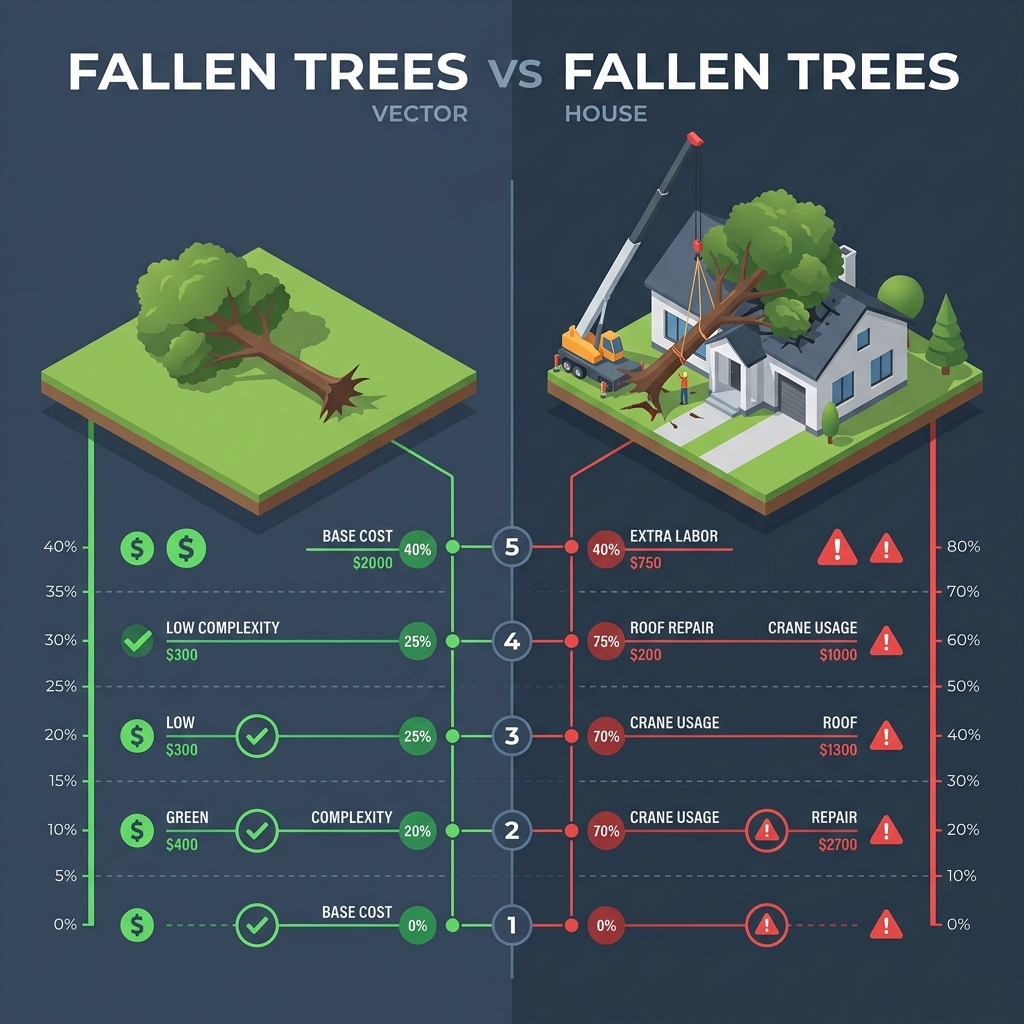
Yes, usually. A fallen tree skips the felling step — the most dangerous and time-consuming part of a standing-tree removal. Open-yard fallen trees often cost 30–50% less than standing removals of the same size. The exception is when the tree lands on a structure, vehicle, or power lines, where rigging and extraction make it more expensive.
Will insurance cover removal if the tree fell but didn't damage anything?
Generally no. Most standard HO-3 policies only pay for tree removal when a covered structure is damaged. Some carriers offer a small debris-removal sub-limit ($500–$1,000) after a named storm, but this is an endorsement, not standard coverage. Check your policy or ask your agent.
How much does emergency tree removal cost after a storm?
Emergency or after-hours tree removal typically carries a 20–100% premium over standard rates. Our calculator applies a 38% emergency surcharge. Post-storm regional demand can keep prices elevated for weeks. If the situation is not an immediate hazard (no structure contact, no wires), waiting for normal business hours can save significantly.
How much does it cost to remove a tree that fell on my house?
A tree on a roof or house typically costs $1,000 to $5,000+. The price reflects controlled sectional removal, rigging, roof protection (plywood/tarping), potential crane rental ($950–$1,600), and insurance documentation. The calculator's "On roof or house" scenario models this at a $1,300 base plus length/diameter cutting labor.
How much does it cost to remove a tree that fell on my car?
Expect $800 to $2,500. The tree must be lifted off the vehicle carefully — usually requiring a crane or hi-ab truck ($950–$1,600). Your comprehensive auto insurance (not collision) typically covers both the vehicle damage and the removal cost, minus your deductible.
Do I need a permit to remove a fallen tree?
Usually no. Most municipalities exempt emergency hazard removal and storm-damage cleanup from permitting. Exceptions: protected/heritage/specimen species, conservation overlays, historic districts, HOAs with strict canopy rules, or if heavy equipment must operate on public right-of-way. Photograph the hazard before removal and keep the invoice as proof.
What should I do immediately after a tree falls on my property?
1) Check for downed power lines — stay 30+ feet away and call 911. 2) If you smell gas, evacuate and call the utility. 3) Photograph the scene widely and close-up BEFORE any cutting. 4) Tarp roof punctures if safe. 5) Call a licensed, insured tree service (verify $1M+ GL and workers' comp). 6) Do not cut tensioned limbs — they can kick back violently.
How long does emergency tree removal take?
A crew can often clear a driveway-blocking tree in 1–3 hours. A tree on a roof with crane extraction may take 4–8 hours or a full day. Storm backlog can delay dispatch by 24–72 hours. Booking early (even if work happens later) secures your place in the queue.
What's included in a fallen tree removal quote?
A proper quote should itemize: cutting/sectioning labor, rigging or crane if needed, log and brush hauling, chip disposal, stump grinding (if requested), and any insurance documentation fees. Verify whether stump removal is included — it often is not. Ask for the grind depth if it is (standard 4–8" vs. deep 12–18").
Does it matter if the tree was dead before it fell?
Yes, critically. A dead or diseased tree that falls shifts liability toward the tree owner's insurance due to negligence. A healthy tree falling in a storm is typically an "act of God" — the damaged party's own policy responds. Document the tree's condition with photos if you suspect negligence.
Can I remove a fallen tree myself?
Only if the tree is small (<12" diameter), fully on the ground in an open area, not under tension, and far from structures/wires. Chainsaws kick back; loaded limbs release energy unpredictably. Rental grinders for the stump are separate. For anything on a roof, wires, or a car — hire a pro. The liability risk outweighs the savings.
How is fallen tree removal priced differently from cutting down a standing tree?
Standing tree quotes include felling (notching, back-cut, wedge, directional control), which is the highest-risk, highest-skill phase. Fallen tree pricing starts after the tree is down: it's based on scenario (where it landed), total length, trunk diameter, urgency, crane/rigging needs, and hauling. The felling cost is simply removed from the equation — unless the tree is partially standing and requires a hybrid approach.