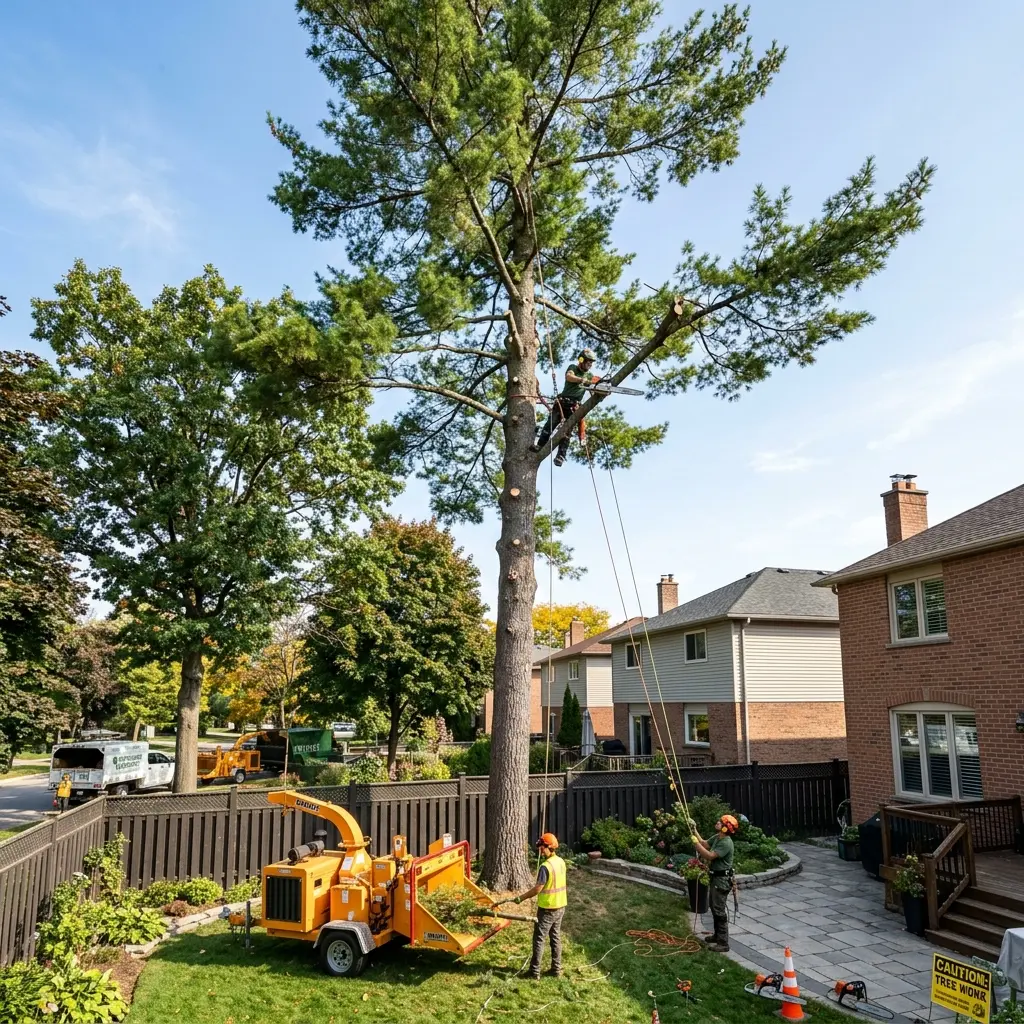

Quick Answer
Tree removal cost by height ranges from $150 for trees under 30 feet to $5,000+ for trees over 100 feet. However, arborists don't price purely by the foot — they price by the equipment required. The critical threshold is 60 feet: above this height, climbing becomes hazardous and OSHA/TCIA standards mandate bucket trucks or cranes, adding $800–$2,500 in mobilization and rigging costs. Use the Tree Removal Cost Calculator above for an instant estimate tailored to your tree's height, diameter, species, and access.
Average Tree Removal Cost by Height Bracket (2026)
| Height Bracket | Typical Cost Range | Equipment Required | Primary Cost Driver |
|---|---|---|---|
| Under 30 ft | $150 – $500 | Ground felling / Light climbing | Simple drop zone, minimal rigging |
| 30 – 40 ft | $400 – $900 | Climbing gear / Small bucket truck | Piece-out rigging over structures |
| 40 – 50 ft | $700 – $1,500 | Bucket truck (45–60 ft reach) | Bucket mobilization, chipper volume |
| 50 – 60 ft | $1,000 – $2,200 | Large bucket truck (60+ ft) | Heavy rigging, extended chipper time |
| 60 – 80 ft | $1,800 – $3,500+ | Crane / Heavy bucket truck (80 ft) | Crane rental ($1,500+), traffic control, permits |
| 80 – 100 ft | $3,000 – $5,500+ | 50–80 ton crane | Crane setup, counterweights, rigging blocks |
| 100+ ft | $4,500 – $8,000+ | 100+ ton crane / Helicopter (rare) | Specialized rigging, engineering review |
> Critical Note: These ranges assume a single-trunk tree with standard access. A 50-ft Oak (DBH 30") costs 2–3× more than a 50-ft Pine (DBH 14") due to wood weight, rigging complexity, and chipper throughput. The calculator accounts for species, diameter, and access.
Small Trees (Under 30 Feet) — $150 to $500
Trees under 30 feet are typically ornamental, young, or species that naturally stay small (Japanese Maple, Crape Myrtle, Dogwood, Redbud).
Logistics: These can often be felled in one piece from the ground if the drop zone is clear — no climbing, the fastest and cheapest method. If structures, fences, or utilities prevent a straight drop, the climber ties in and pieces the tree down from the top.
Cost drivers:
- Single-piece felling: $150–$300 (fastest, lowest risk)
- Piece-out rigging: $250–$500 (adds 1–2 hours for rope setting and controlled lowering)
- Stump grinding: +$100–$200 if requested
- Species exception: A 25-ft Bradford Pear with brittle wood and included bark may cost more than a 25-ft Dogwood due to unpredictable breakage requiring more rigging points.
Medium Trees (30 to 60 Feet) — $400 to $2,200
This is the most common residential range. The 30-ft to 60-ft bracket covers the vast majority of mature shade trees: Maples, Oaks, Pines, Elms, Locusts, and Sweetgums.
30–40 ft ($400–$900)
Climber ties in, sets a rigging point, and pieces the canopy down. A small bucket truck (45-ft reach) may be used if access allows. Key cost adder: piece-out over a roof, pool, or fence line requires a "negative rigging" system — lowering limbs away from the target — adding 30–50% labor time.
40–50 ft ($700–$1,500)
Standard bucket truck (55-ft reach) becomes efficient here. The operator lifts the climber or works from the bucket. Debris volume scales cubically — a 45-ft Oak produces 3–4× the chip volume of a 25-ft tree. Chipper throughput and haul-away trips become a meaningful cost component.
50–60 ft ($1,000–$2,200)
Requires a 60-ft+ bucket truck or large climber crew. At this height, wood section weight exceeds safe manual lowering limits for large limbs. Rigging blocks rated for 5,000+ lbs are mandatory. If the tree leans over a structure, a "speed line" or "zip line" system is rigged to slide sections laterally to a safe landing zone — adding $300–$600 in gear and setup time.
The 60-Foot Threshold: Why Prices Jump
At ~60 feet, the economics of tree removal fundamentally change. This is not an arbitrary number — it is driven by three hard constraints:
1. OSHA / TCIA Climbing Limits: Working at heights above 60 ft on a single rope system significantly increases fall risk and fatigue. Most reputable companies policy-limit climbing to 60 ft unless a bucket truck is unavailable. The "climber-only" approach above 60 ft adds 2–3× labor hours for the same work.
2. Bucket Truck Reach Limit: Standard forestry bucket trucks max out at 60–65 ft working height. Above this, you need a heavy-duty 80-ft+ bucket truck (rare, $300–$500/hr more) or a mobile crane.
3. Crane Mobilization Floor: A 40-ton crane rental starts at $1,500–$2,500/day including operator, delivery, and setup. This cost is fixed regardless of whether the job takes 2 hours or 8. This is why a 65-ft tree can cost more than a 55-ft tree even if the work is similar — you've crossed the crane threshold.
Practical implication: If your tree is 58–62 ft, ask the contractor: "Are you climbing this or using a bucket/crane?" A climbing bid at 62 ft should raise safety concerns; a crane bid at 58 ft may be overkill. The sweet spot is matching equipment to actual height.
Bucket Trucks, Cranes, and Mobilization Fees
| Equipment | Typical Reach | Hourly Rate (incl. operator) | Mobilization Floor | Best For |
|---|---|---|---|---|
| Climber + Ground Crew | Unlimited (rope) | $150–$250/hr crew | $300–$500 | Trees < 60 ft, tight access, no drop zone |
| Small Bucket Truck (45 ft) | 45 ft | $180–$250/hr | $400–$600 | 30–45 ft trees, open access |
| Large Bucket Truck (60–75 ft) | 75 ft | $220–$350/hr | $600–$1,000 | 45–60 ft trees, piece-out over structures |
| 40–50 Ton Crane | 100+ ft (with jib) | $250–$400/hr | $1,500–$2,500 | 60–100 ft trees, heavy wood, no drop zone |
| 80–100 Ton Crane | 150+ ft | $400–$700/hr | $3,000–$5,000+ | 100+ ft, massive DBH, critical rigging |
Mobilization fee covers: equipment transport, setup time (stabilizers, outriggers, counterweights), traffic cones/signage, and tear-down. It is non-negotiable and applies even if the job takes 30 minutes.
Once your tree crosses into the 60–100 ft brackets, crane economics take over the whole quote — see the dedicated crane-assisted tree removal cost guide for pricing by crane size, job type, and setup difficulty, plus the real crane job dataset.
Height vs. Diameter: The Metric Arborists Actually Use
Height is a proxy. Diameter at Breast Height (DBH) is the reality.
A 50-ft Pine (DBH 14") weighs ~1,200 lbs total. A 50-ft White Oak (DBH 30") weighs ~8,000 lbs. The Oak requires:
- 6× the rigging force capacity
- 4× the chipper throughput time
- 3× the log truck weight/hauls
- Possibly a larger crane class
Our calculator weights DBH at ~60% and height at ~40% in the base labor formula. Always measure diameter at 4.5 ft above grade (standard DBH). If the tree forks below 4.5 ft, measure each stem and sum the cross-sectional areas.
Species x Height: Real-World Examples
| Scenario | Height | Species / DBH | Equipment | Est. Range | Why |
|---|---|---|---|---|---|
| Backyard Maple | 35 ft | Red Maple, 18" DBH | Climber + chipper | $550 – $900 | Standard piece-out, open drop zone |
| Poolside Pine | 45 ft | White Pine, 22" DBH | 55-ft bucket truck | $1,100 – $1,600 | No-drop zone over pool = negative rigging |
| Street Oak | 55 ft | Pin Oak, 28" DBH | 70-ft bucket truck | $1,800 – $2,600 | Traffic control, heavy wood, chipper volume |
| Yard Giant | 75 ft | White Oak, 36" DBH | 50-ton crane | $3,500 – $5,200 | Crane rental floor, rigging blocks, log trucks |
| Eucalyptus | 85 ft | Blue Gum, 30" DBH | 60-ton crane + jib | $4,200 – $6,500 | Extreme height, brittle wood, heavy sections |
| Cottonwood | 60 ft | Eastern Cottonwood, 40" DBH | 50-ton crane | $2,800 – $4,000 | Massive DBH, high moisture = extreme weight |
How Tree Height Impacts Debris Volume & Chipping Time
Debris volume scales roughly with the cube of height (allometric scaling). A 60-ft tree doesn't produce 2× the chips of a 30-ft tree — it produces 6–8×.
| Height | Est. Chip Volume (cubic yards) | Chipper Time | Haul Trips (12-yd truck) |
|---|---|---|---|
| 25 ft | 1–2 yd³ | 15–20 min | 1 (partial) |
| 40 ft | 4–6 yd³ | 30–45 min | 1 |
| 55 ft | 10–15 yd³ | 60–90 min | 1–2 |
| 75 ft | 25–40 yd³ | 2–4 hrs | 2–4 |
| 100 ft | 60–100+ yd³ | 4–8 hrs | 5–8 |
Cost implication: Chipper time is billed at crew hourly rate. A 75-ft Oak can tie up a 12" drum chipper for half a day. Some contractors bring a second chipper or a whole-tree chipper (18"+ capacity) — adding $400–$800 to the line item.
How Arborists Measure Tree Height
You don't need a laser rangefinder, but understanding the methods helps you verify contractor assessments:
1. Stick Method (Clinometer): Hold a stick at arm's length, align top/bottom with tree top/base. Measure distance. Height = (stick length / arm length) × distance. Accurate to ±5%.
2. Laser Rangefinder + Inclinometer: Professional standard. Measures slope distance and angle, calculates vertical height. ±1–2% accuracy.
3. Drone Photogrammetry: For tall/clustered trees. 3D model gives canopy height, spread, and DBH estimates. Used for crane lift planning on 80+ ft trees.
Pro tip: If a contractor gives a round number ("about 60 feet") without a measurement tool, ask how they measured. Estimates based on "eyeballing" are often off by 10–15 ft — enough to cross the crane threshold.
Frequently Asked Questions
How much does it cost to cut down a 30-foot tree?
A 30-ft tree typically costs $300–$700. If it's a narrow-trunk species (Birch, Crape Myrtle) with open access, expect the low end. A 30-ft Oak with rigging over a shed runs $600–$900.
How much does it cost to remove a 50-foot tree?
A 50-ft tree costs $700–$1,500 for standard species with bucket truck access. Heavy hardwoods (Oak, Hickory) or tight access (fence, pool) push it to $1,300–$2,000. Crane is rarely needed at 50 ft unless the tree is massive (DBH > 30").
Is a 60-foot tree expensive to remove?
Yes. The 60-ft threshold triggers crane/large-bucket pricing. Expect $1,800–$3,500+. The jump from 55 ft to 65 ft often adds $800–$1,500 purely from equipment escalation.
Can I save money by having the tree "topped" instead of removed?
No. Topping (cutting the main leader) destroys the tree's structure, creates hazardous regrowth, and violates ANSI A300 standards. It often costs 80% of removal but leaves a dying liability. Municipalities may fine you for topping protected trees.
Does tree height affect stump grinding cost?
Indirectly. Taller trees usually have larger trunk diameters at the base. Stump grinding is priced by stump diameter at grade, not tree height. A 60-ft Pine might have a 16" stump ($150–$250); a 40-ft Oak might have a 28" stump ($300–$500).
What's the tallest tree a bucket truck can reach?
Standard forestry buckets: 60–75 ft working height. Specialized 80-ft+ units exist but are rare ($300–$500/hr premium). Above 80 ft, cranes are standard.
Do I need a permit to remove a tall tree?
Many municipalities require permits for trees > 60 ft, > 24" DBH, or species on a protected list. Check your city's "Heritage Tree" or "Significant Tree" ordinance. Contractor should handle permitting; verify it's in the quote.
How long does it take to remove a 70-foot tree?
With a crane: 4–8 hours (setup + lift + chip). With climbers only: 1–2 days. Crane is faster but has a higher floor cost. For a single 70-ft tree, climber time × hourly rate often exceeds crane mobilization.
Why do two 50-foot trees cost different amounts?
Species (wood density), DBH (rigging weight), lean (rigging complexity), access (equipment choice), and obstacles (structures, utilities). Height is only one variable.
Can I remove a 100-foot tree myself?
Absolutely not. A 100-ft tree sections weigh 1,000–3,000+ lbs each. Falling sections generate lethal kinetic energy. Crane rigging requires certified operators, signal persons, and engineered lift plans. DIY attempts on trees > 30 ft regularly result in fatalities.
What's the cheapest way to remove a tall tree?
There is no "cheap" way for trees > 50 ft. The lowest legitimate bid will use the smallest adequate equipment (bucket truck over crane, climber over bucket if < 60 ft). Beware bids 30% below market — they often skip insurance, permits, or safe rigging.
Methodology & Sources
Our cost model uses:
- Base labor: Height-banded piece-out time curves (ISA/TCIA time studies)
- DBH weight multiplier: Allometric equations (Jenkins et al., USDA Forest Service) converting DBH × species density → section weight → rigging class
- Equipment selection logic: Height → min equipment class → mobilization floor + hourly rate
- Debris volume: Cubic scaling (height³) × species form factor → chipper hours × crew rate
- Regional multipliers: 6 market zones (0.92x–1.22x) from BLS OES tree trimmer wages + fuel indices
Sources:
- ISA Best Management Practices: Tree Risk Assessment & Pruning — treesaregood.org
- TCIA ANSI A300 Standards (Parts 1, 2, 5, 6, 9) — tcia.org
- OSHA 29 CFR 1910.269 (Electric Power Generation, Transmission, Distribution) & 1910.266 (Logging Operations) — osha.gov
- USDA Forest Service General Technical Reports on biomass equations — fs.usda.gov
- BLS Occupational Employment Statistics (Tree Trimmer wages by MSA) — bls.gov
Related Cost Resources
Tree Removal Cost Calculator — Enter height, diameter, species, and access for instant pricing.
Stump Grinding Cost Calculator — Stump diameter pricing after removal.
Fallen Tree Removal Calculator — Storm cleanup for downed trees.
Palm Tree Removal Calculator — Palm-specific biology and disposal.
Tree Types Cost Comparison — Species density multipliers: Pine vs. Oak vs. Maple.