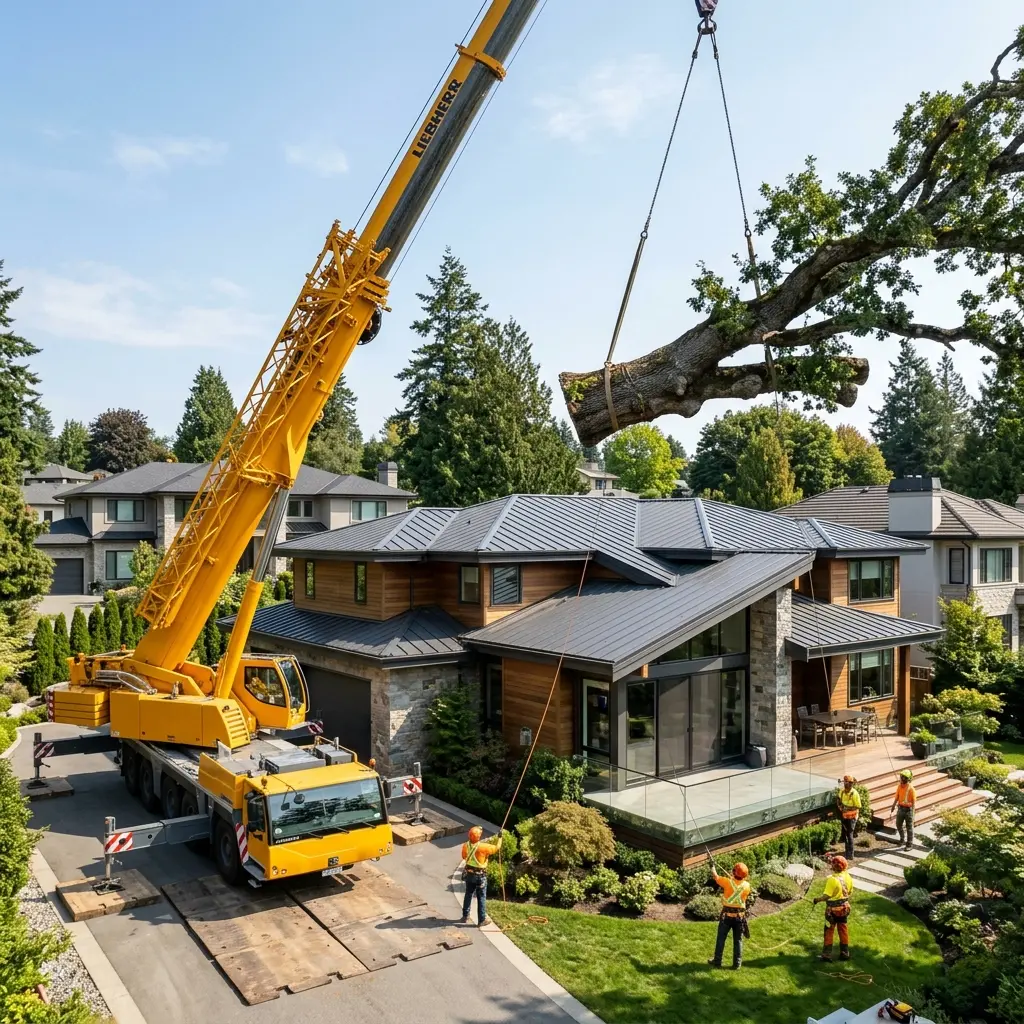

1. Crane Tree Removal Cost Calculator
Use the tree removal cost calculator to estimate crane-assisted removal. Select Complex access, add Near House/Fence, and add the largest trunk diameter and height options. The calculator provides a baseline, but crane jobs have unique cost factors detailed below.
2. Crane-Assisted Tree Removal Cost Range
Crane-assisted tree removal usually costs $2,000 to $6,000+ for residential jobs, but difficult projects can run higher. The crane is not priced only by tree height. Contractors also price crane mobilization, setup space, lift distance, traffic control, crew size, and how many trunk or limb sections must be lifted.
3. Crane Cost by Job Type
| Crane job type | Typical cost range | What affects pricing |
|---|---|---|
| Tree over house or roof | $2,500-$6,000+ | Roof protection, slow precision lifting |
| Tree over pool or spa | $3,000-$7,000+ | Pool protection covers, no-drop zone |
| Tree in backyard with no access | $2,000-$5,500 | Crane reach over house, street closure |
| Tree near power lines | $2,500-$5,000+ | Utility coordination, safety buffer |
| Large hardwood over driveway | $1,800-$4,000 | Sectional cutting, traffic control |
| Multiple trees with one crane setup | $3,500-$8,000+ | Mobilization shared across trees |
4. Crane Cost by Crane Size and Reach
| Crane size | Typical reach | Typical cost per job |
|---|---|---|
| 15-ton crane | 40-60 ft reach | $1,500-$3,000 |
| 25-ton crane | 60-80 ft reach | $2,500-$4,500 |
| 40-ton crane | 80-100+ ft reach | $3,500-$7,000+ |
| 60+ ton crane | 100-140+ ft reach | $5,000-$12,000+ |
5. Crane Cost by Setup Difficulty
Setup difficulty can add significant cost to crane-assisted removal:
- Easy setup (open driveway, flat ground): standard mobilization fee included
- Moderate setup (street parking, traffic cones): may add $200-$500 for traffic control
- Difficult setup (crane mats required, tight quarters): can add $500-$1,500 for mat placement and extended setup time
- Extreme setup (crane over house, utility coordination): can add $1,000-$3,000+ for planning, permits, and utility liaison
6. Crane Job Examples
- Tree over roof: A large oak leaning over a two-story house. Requires a 40-ton crane, roof protection, and slow sectional lifting. Estimated cost: $3,000-$5,500.
- Backyard with no access: A 60 ft pine behind a fence with a narrow gate. The crane must reach over the house. Estimated cost: $2,500-$5,000.
- Tree near pool: A palm or hardwood over an in-ground pool. Pool must be covered and protected. Estimated cost: $2,000-$4,500.
- Tree near power lines with crane: Utility company may need to de-energize lines. Crane operator works with strict clearance rules. Estimated cost: $2,500-$5,000+.
7. What Real Crane Removals Cost (Job Data)
We maintain a dedicated crane tree removal cost dataset with benchmark tables by job scenario and crane class — the same numbers other publishers cite. The pattern that emerges from the data:
- The crane is a fixed cost; the tree is a variable cost. Mobilization + setup runs $500–$2,000 before a single cut, which is why one crane visit for multiple trees ($3,500–$8,000+) is dramatically cheaper per tree than separate visits.
- Reach drives class, class drives price. Jobs cluster at $1,500–$3,000 (15-ton, 40–60 ft reach), $2,500–$4,500 (25-ton, 60–80 ft), and $3,500–$7,000+ (40-ton, 80–100+ ft). If your tree needs the next crane class, expect a $1,000+ step, not a smooth increase.
- Setup difficulty is the silent third factor — crane mats, street closures, and utility coordination add $500–$3,000 independent of the tree itself.
Use the dataset to benchmark any crane line item on a quote, and see the fallen tree scenario data for storm-specific extractions.
8. Cost Factors To Compare In Quotes
Ask whether the quote includes crane mobilization, climber labor, ground crew, debris hauling, stump grinding, permits, and street closure costs. A cheaper quote may exclude hauling or charge separately for stump grinding.
9. How To Lower Crane Removal Cost
Get at least three quotes, send clear photos before scheduling, ask whether smaller equipment can reach the tree, and compare the price with and without hauling. If the tree is not urgent, scheduling outside storm season can reduce emergency premiums. Bundle neighbors' crane-worthy trees into one mobilization when possible — shared setup is the single biggest saver in the job data.
Frequently Asked Questions About Crane Tree Removal
How much does it cost to remove a tree with a crane?
Crane tree removal typically costs $2,000 to $6,000+ for residential jobs depending on tree size, crane reach, and setup difficulty.
How much does crane-assisted tree removal cost?
Crane-assisted tree removal costs $2,000–$6,000+ for most residential jobs: roughly $1,500–$3,000 with a 15-ton crane (40–60 ft reach), $2,500–$4,500 with a 25-ton crane, and $3,500–$7,000+ when an 80–100 ft tree demands a 40-ton class. Setup difficulty (mats, street closure, utility coordination) adds $500–$3,000 on top.
When is a crane needed for tree removal?
A crane is needed when the tree cannot be safely dropped or lowered due to proximity to houses, pools, power lines, or when there is no ground access for bucket trucks.
Does crane tree removal cost include stump grinding?
Not usually. Stump grinding is typically a separate add-on. Confirm whether the quote includes stump removal or if it is charged separately.
How much does crane setup cost?
Crane mobilization and setup typically adds $500 to $2,000 to the job depending on the crane size and setup complexity.
Can a crane remove a tree over a house?
Yes, this is one of the most common crane applications. The crane lifts sections of the tree over the house while the crew cuts from above.