
Quick Answer
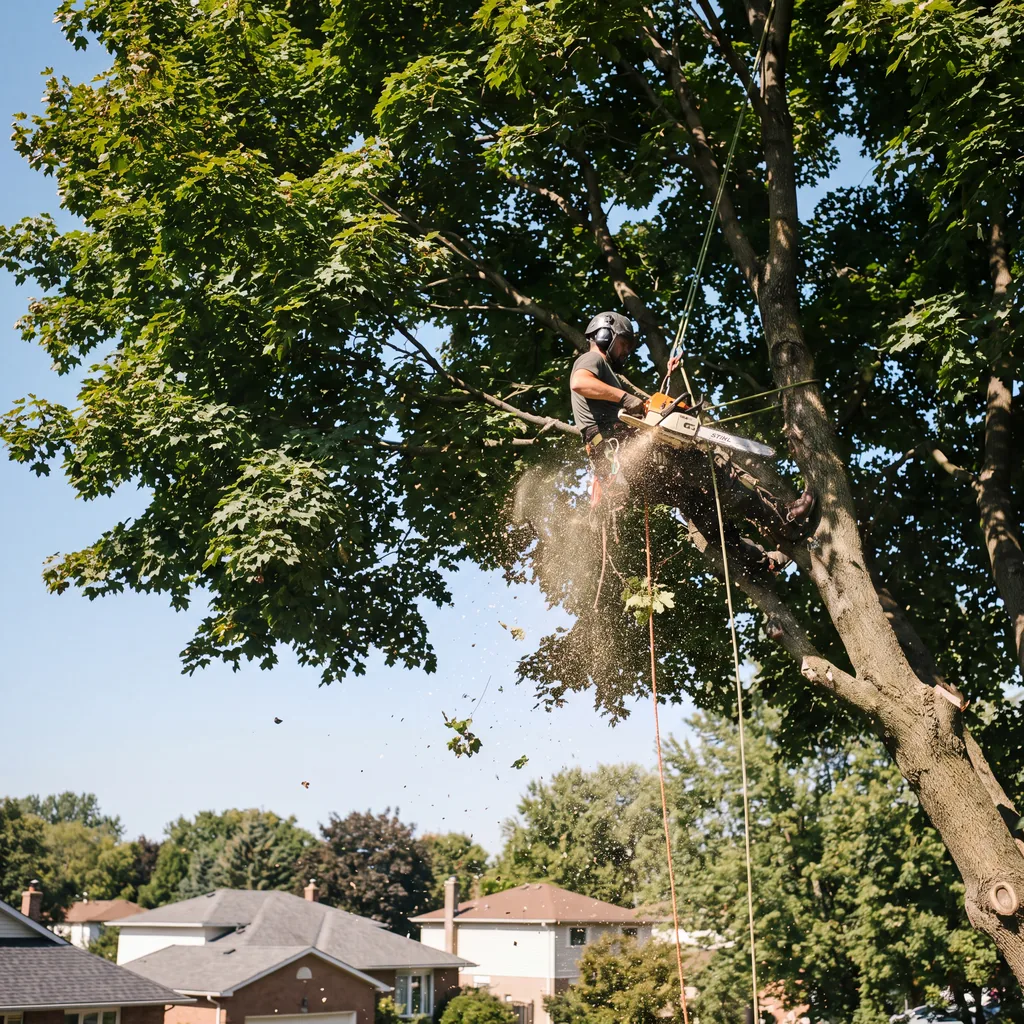
Tree trimming costs $80 to $2,500 per tree, and most homeowners pay $250–$900 for a professionally maintained medium tree. Height sets the base price, the trim type moves it (a light crown clean costs a fraction of a structural crown reduction), and the tree's maintenance history quietly doubles it — an overgrown, never-trimmed tree costs roughly 2× a maintained one. Most crews carry a $100–$300 minimum call-out. This guide prices every variable; if the honest math says the tree is past trimming, get the removal number from the tree removal cost calculator before you spend another trimming cycle on it. Palm trimming is its own discipline (fronds, skinning, no canopy shaping) — see the palm tree removal & trimming guide for palms.
Tree Trimming Cost by Height (2026)
| Tree height | Typical trimming cost | Equipment & method | What drives the range |
|---|---|---|---|
| Under 30 ft (ornamental, young shade) | $80–$450 | Ground tools, pole saw, light climbing | Count of cuts; shape goals |
| 30–50 ft (mature suburban tree) | $250–$900 | Climber or bucket truck | Canopy density, structure work |
| 50–80 ft (large shade tree) | $600–$1,800 | Bucket truck, full rigging | Limbs over roof, rigged lowering |
| 80+ ft (very large hardwood/conifer) | $1,200–$2,500+ | Large bucket or crane assist | Crane share, traffic control |
Two structural rules explain most quotes: debris volume scales with the cube of height (a 60 ft canopy produces 6–8× the brush of a 30 ft one), and the same 60-foot equipment threshold that governs removal governs trimming — above it, bucket trucks and premium rigging enter the price. Those mechanics are unpacked in the tree removal cost by height guide; they apply to trimming at roughly 30–60% of removal rates for the same tree.
Tree Trimming Cost by Trim Type (ANSI A300)
"Trim my tree" is not a scope. Professional pruning is specified in ANSI A300 terms, and each service has its own price band:
| Trim type | Typical cost per tree | What it is | When you need it |
|---|---|---|---|
| Crown cleaning | $100–$700 | Remove dead, dying, broken, rubbing limbs | Routine maintenance; storm-season prep |
| Crown thinning | $100–$1,000 | Selective interior cuts for light/wind flow | Dense canopies, wind-sail reduction, lawn dying below |
| Crown raising | $150–$850 | Lift the bottom of the canopy | Clearance over roofs, driveways, sidewalks, views |
| Crown reduction | $250–$2,200 | Reduce overall height/spread to lateral leaders | Tree outgrowing its space, utility conflicts, storm risk |
| Structural/formative pruning | $80–$400 (young trees) | Set one dominant leader early | The cheapest money in arboriculture — prevents future co-dominant failures |
Crown reduction is the expensive one for a reason: every cut must land at a lateral branch large enough to take over (ANSI A300 reduction standard), which is slow, skilled work. If a bid proposes "topping" instead — flat cuts across the canopy — walk away. Topping is the discount imitation of reduction: it violates A300, triggers weakly-attached regrowth, and usually costs 80% of a proper job while creating a hazard you'll pay to fix later.
The Neglect Premium: Why "Never Trimmed" Costs Double
Trimming is the one tree service where procrastination has a published price:
| Maintenance state | Cost vs. maintained | Why |
|---|---|---|
| Maintained (trimmed every 2–3 yrs) | 1.0× baseline | Small cuts, predictable structure, fast work |
| Overgrown (5+ years untrimmed) | 1.5–2× | Heavy deadwood, rubbing limbs, double the brush |
| Neglected + storm-damaged | 2–3× | Hazard rigging, hangers, structural triage |
A $400 maintenance trim skipped for six years routinely returns as an $800–$1,200 restoration trim — or as a storm-damage emergency call at surge pricing. The cheapest schedule for a mature shade tree is a crown clean every 2–3 years.
Trim or Remove? The Break-Even Nobody Runs
When a tree needs a $900 reduction every three years and it's declining, trimming becomes a subscription to a failing asset. Run both numbers:
1. Price the honest trimming cycle (this guide): cost × frequency over 10 years.
2. Price removal once with the tree removal cost calculator — height, diameter, access.
3. A declining tree whose 10-year trimming spend exceeds ~70% of removal cost is usually a remove-and-replant decision — especially if it stands within falling distance of the house, where its failure becomes an insurance problem, not a maintenance one.
Trees worth real money get a third option: a formal appraisal before you remove a specimen that turns out to be worth five figures.
What Moves a Trimming Quote (Beyond Height & Type)
- Access: tight backyards force climbing over bucket work — add 25–50%. Same multiplier logic as removal.
- Power lines: limbs within 10 ft of primary lines are not a tree-service job — the utility (or its line-clearance contractor) handles those, often free. Never let a landscaper quote it.
- Count discounts: the first tree absorbs the call-out minimum; additional trees on the same visit commonly run 15–25% less each.
- Timing: dormant-season (late fall–winter) trimming books at 10–25% below spring peak — and for oaks it's mandatory anyway: never prune oaks April 1–July 15 (oak wilt transmission window — see the tree disease guide).
- Cleanup scope: chip-and-haul vs. leave-brush changes bids by $75–$300. Get it itemized on the estimate template — it now includes a trimming-specific variant.
- Per-hour bids: same red flag as removal — residential trimming should be priced per tree with a written cut spec, not per hour. The reasoning is in the estimates guide.
DIY Trimming: The Narrow Green Zone
DIY is defensible for: cuts reachable from the ground with a pole saw (under ~15 ft), branches under 2 inches, formative pruning on young trees, and deadwood snapping. It is not defensible for: ladders + chainsaws (the classic ER combination), anything over a roof or line, reduction cuts on mature trees (you will top it), or climbing. A $250 professional visit is cheap against the alternative — tree work is consistently among the most dangerous jobs in America, and homeowners doing it without rigging training are the casualty statistics.
Frequently Asked Questions
How much does it cost to trim a tree?
Tree trimming costs $80–$2,500 per tree depending on height, trim type, and condition. Typical jobs: $80–$450 for small trees under 30 ft, $250–$900 for mature 30–50 ft trees, and $600–$2,500+ for large trees needing bucket trucks or crane assistance. Most companies carry a $100–$300 minimum call-out.
How much does crown reduction cost?
Crown reduction costs $250–$2,200 per tree: roughly $250–$525 for small trees (20–30 ft), $600–$1,300 for medium (30–50 ft), and $1,300–$2,200 for large trees. It's the most expensive trim type because every cut must land at a viable lateral branch — and any bid offering cheap "topping" instead should be rejected outright.
How often should trees be trimmed?
Mature shade trees: a crown clean every 2–3 years. Young trees: structural pruning every 2 years for the first decade (the cheapest, highest-return pruning there is). Fast growers near structures (silver maple, willow): closer to every 2 years. Letting a tree go 5+ years typically doubles the eventual bill.
Is it cheaper to trim a tree or cut it down?
Per event, trimming is cheaper — usually 30–60% of removal cost for the same tree. Over a decade, a declining tree needing frequent heavy trims can cost more than removal. Run the 10-year comparison: if cumulative trimming exceeds about 70% of the removal price on a declining tree, removal-and-replant usually wins.
When is the cheapest time of year to trim trees?
Late fall through winter (dormant season) — demand drops and crews discount 10–25%. Dormant trimming is also better arboriculture: structure is visible, disease vectors are inactive, and for oaks it's the only safe window (never prune oaks April 1–July 15 due to oak wilt).
Why is tree trimming so expensive?
You're buying risk management, not cutting: trained climbers or bucket operators, rigging every limb away from your roof, chipper crews, disposal, and $1M+ liability insurance. Cube-scaling debris volume and the 60-ft equipment threshold do the rest. An uninsured $150 "deal" transfers all of that risk to your homeowners policy.
Methodology & Sources
Ranges synthesized from 2026 published market guides (HomeGuide, LawnStarter, LawnLove cost surveys), ANSI A300 pruning-type definitions, and this site's height/equipment cost model (see the height guide methodology).
Sources:
- ANSI A300 (Part 1) Pruning Standard — tcia.org
- ISA — pruning best practices and "why topping hurts trees" — treesaregood.org
- OSHA — tree care operations hazards — osha.gov
Related Cost Resources
Tree Removal Cost Calculator — Run the trim-vs-remove break-even with your tree's real numbers.
Tree Removal Cost by Height — The equipment-threshold mechanics behind both trimming and removal prices.
Palm Tree Removal & Trimming Guide — Palms are trimmed by skinning, priced separately.
Tree Removal Estimate Template — Printable template with the tree trimming estimate variant.
Tree Disease & Diagnosis Guide — Oak-wilt pruning windows and sanitation rules.
Storm Damage & Emergency Costs — What deferred trimming costs when the storm arrives first.