
Quick Answer
Homeowners insurance covers tree removal only in specific situations: a covered peril (wind, lightning, hail, snow/ice weight) caused the tree to damage a covered structure — your house, garage, fence, or shed — or to block your driveway. When it applies, the structure damage is paid under your dwelling coverage (minus deductible), while the removal and debris hauling is typically capped by a sublimit of about $500 per tree and $1,000 per storm event on standard HO-3 policies. Routine removal, preventive removal, and trees that fall harmlessly in the yard are not covered. Policies genuinely vary — the only authoritative answers for your home are your policy documents and your adjuster.
The Two-Part Test: Covered Peril + Covered Structure
Every tree-removal claim decision walks through the same two questions:
Part 1 — Was the cause a covered peril?
| Cause of tree failure | Covered? |
|---|---|
| Windstorm, hurricane, tornado | Yes — standard covered peril |
| Lightning strike | Yes |
| Hail, weight of snow/ice | Yes |
| Fire | Yes |
| Vehicle impact (not your vehicle) | Yes |
| Rot, disease, insect kill | No — gradual damage / maintenance |
| Old age, visible decline you ignored | No — neglect exclusion |
| Flood or earthquake felling the tree | No under standard HO-3 — needs separate flood/quake coverage |
Part 2 — Did the tree hit something the policy covers?
- Hit house / garage / fence / shed → structure repair covered under dwelling or other-structures coverage, removal covered up to the debris sublimit.
- Blocked the driveway (or a ramp used by a disabled resident) → removal commonly covered even with no structure damage — this exception is written into many standard policies and people routinely miss it.
- Fell harmlessly in the yard → not covered, no matter how expensive the cleanup. A $2,000 oak flat on the lawn is your bill.
- Hit your car → that's your auto policy's comprehensive coverage, not homeowners — a separate claim with a separate deductible.
Both parts must pass. A rotten tree that hits the house fails Part 1 (insurers investigate tree condition). A storm-felled tree in the open yard fails Part 2.
The Debris-Removal Sublimit: Why Payouts Feel Small
Standard HO-3 policies carry a debris-removal sublimit for trees: typically up to $500 for any one tree, with a $1,000 cap per occurrence (some carriers use $500/$1,500 or higher; premium policies differ). Two things follow:
1. A $2,800 crane extraction is not fully reimbursed as "removal." The lift-off-the-roof portion tied to repairing the structure is generally part of the structure claim; the cutting/hauling of the tree itself sits under the sublimit. Ask the adjuster to allocate the invoice across both buckets — a properly itemized contractor invoice (get one using our estimate template) materially changes the math.
2. Multiple trees in one storm share the occurrence cap. Five downed trees do not mean five × $500.
Some carriers offer landscaping/tree endorsements that raise these limits; if your property's value lives in its trees, that rider is worth a call. For what mature trees are actually worth — often $5,000–$50,000+ for specimen hardwoods — see the specimen tree valuation guide.
Should You Even File? (The Deductible Math)
Run this arithmetic before calling the claim line:
- Tree on fence, $1,200 fence repair + $600 removal, $1,000 deductible → recoverable ≈ $1,200 + $500 − $1,000 = $700. Marginal — and a claim goes on your CLUE report and can affect renewal pricing for 5–7 years.
- Tree on roof, $14,000 repair + $2,500 crane removal, $2,000 deductible → clearly worth filing.
- Removal only (blocked driveway), $800 cost, $1,000 deductible → payout is $0. Don't file.
The quiet rule adjusters won't volunteer: small claims can cost more in future premium than they pay today. File for real losses; self-pay the marginal ones.
How to File a Tree Removal Claim (Step by Step)
1. Safety first — downed lines go to the utility, structural entry waits for clearance.
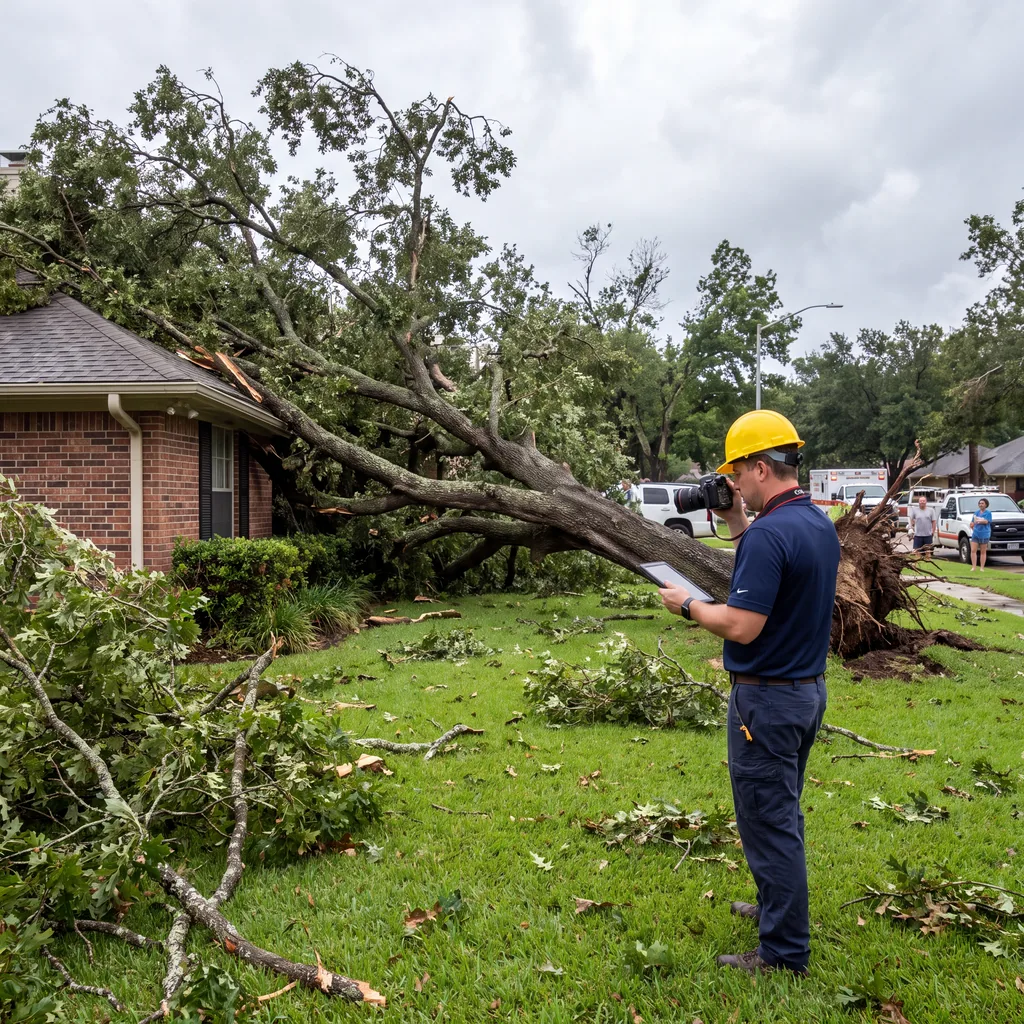
2. Photograph everything before any cleanup: the tree on the structure, wide shots, close-ups, the failed trunk/roots.
3. Mitigate further damage — tarp the roof hole, board the window; insurers require reasonable mitigation and reimburse those costs.
4. Call the claim line early — post-storm queues are long, and adjuster scheduling gates everything.
5. Get an itemized removal invoice — cutting, crane, hauling, and structure-related work broken out (this is what the sublimit-allocation argument runs on).
6. Keep the cause-of-failure evidence — an arborist's note that the tree was healthy pre-storm defeats the neglect exclusion.
7. Track every receipt — tarps, hotel if uninhabitable (loss-of-use coverage), everything.
Neighbor Trees: The Rules Nobody Believes Until It Happens
- Neighbor's healthy tree falls on your house in a storm → YOUR policy pays. Storm failure of a healthy tree is an Act of God; ownership of the trunk is irrelevant. Your insurer may subrogate against the neighbor and recover your deductible — that's their call, driven by evidence of negligence.
- Neighbor's long-dead tree you warned them about falls → their liability (and their insurer) — but only because your certified-mail notice created documented knowledge. Without paper, it defaults back to your policy.
- Your tree falls on the neighbor's garage → their policy pays, symmetrical rules. You're exposed only if they can prove you ignored a known hazard.
The prevention play is boring and effective: send written hazard notices before storm season and keep copies. Full liability details live in the neighbor tree law guide.
"Will State Farm / Allstate / USAA Pay for My Tree Removal?"
Carrier-specific promises found on the internet are guesses — including this site's. Standard HO-3 logic above applies across major carriers, but sublimit amounts, storm deductibles (percentage-based wind/hurricane deductibles in coastal states), and endorsement options vary by carrier, state, and policy form. The questions that get you real answers from your carrier:
- "What is my debris-removal limit per tree and per occurrence?"
- "Does my policy cover removal when a tree blocks the driveway without structure damage?"
- "Is my wind/hail deductible flat or percentage-based for this event?"
- "Do I have any landscaping or tree endorsement on the policy?"
Ten minutes with your declarations page and the claim line beats every forum thread.
When Insurance Says No: Managing the Cost Yourself
Denied or sub-deductible? Price the job like any planned removal: fallen tree removal calculator for downed trees, the main calculator for standing hazards, off-season scheduling for 20–40% savings, and wood-left-on-site pricing to trim hauling. If the loss traces to a declared disaster, a casualty-loss deduction may partially recover it at tax time — rules and math in the tax deduction guide.
Frequently Asked Questions
Does homeowners insurance cover tree removal?
Only when a covered peril (wind, lightning, hail, ice) causes the tree to damage a covered structure or block your driveway. Structure repairs fall under dwelling coverage minus your deductible; the removal itself is capped by a debris sublimit, typically $500 per tree and $1,000 per event. Trees that fall harmlessly in the yard, preventive removals, and rot/neglect failures are not covered.
Will home insurance pay for tree removal if the tree didn't hit anything?
Generally no. The standard exceptions: the fallen tree blocks your driveway, or blocks a ramp/access route used by a disabled household member — many policies cover removal in those cases even without structure damage. Check your policy's debris-removal clause for this exact language.
Is a fallen tree covered by insurance?
The tree itself usually isn't — insurers reimburse structure damage and capped removal costs, not the value of the lost tree (standard policies pay at most ~$500 per tree for the tree/landscaping under limited perils like lightning or vandalism, and often nothing for wind). For genuinely valuable specimen trees, document value with a formal appraisal and consider a landscaping endorsement.
Who pays for fallen tree removal — me or my neighbor?
Whoever's property it landed on. Your yard, your policy — even if it was the neighbor's tree, storm failure of a healthy tree is an Act of God. Liability shifts to the owner only with provable negligence: a visibly hazardous tree, documented notice, and no action. Certified mail before the storm is what makes that case.
Will State Farm pay for tree removal?
No one can promise a specific carrier's decision — State Farm, like all major carriers, applies the covered-peril + covered-structure test with policy-specific sublimits and deductibles. Call the carrier with your policy number and ask for your debris-removal limit per tree/occurrence and how your wind deductible applies; the declarations page plus that one call gives you the real answer.
Does insurance cover dead tree removal?
Almost never. Dead and dying trees are classified as a maintenance responsibility, and damage they eventually cause can also be denied under the neglect exclusion. A dead tree near structures is the strongest possible case for paying for removal now — it converts an uninsurable future claim into a controlled, schedulable cost. The full economics are in the dead tree removal cost guide.
Methodology & Sources
Sources:
- Insurance Information Institute — If a tree falls on your house, are you covered? — iii.org
- NAIC consumer resources on homeowners policy forms and debris removal — naic.org
- Standard ISO HO-3 policy form structure (debris removal additional coverage)
- State DOI consumer guides on storm claims and percentage wind deductibles
This article is educational, not insurance advice. Coverage is contract-specific: your policy form, endorsements, state rules, and adjuster findings control the outcome. Verify everything against your declarations page and your carrier.
Related Cost Resources
Storm Damage & Emergency Tree Removal Cost — What the removal will cost, insured or not.
Fallen Tree Removal Cost Calculator — Scenario-based pricing before you talk to the adjuster.
Is Tree Removal Tax Deductible? — Declared-disaster losses and the casualty deduction.
Specimen Tree Valuation Guide — Documenting what the tree was worth.
Tree Removal Estimate Template — The itemized invoice format adjusters can allocate.
Neighbor Tree Law & Property Rules — Liability, notices, and boundary trees.