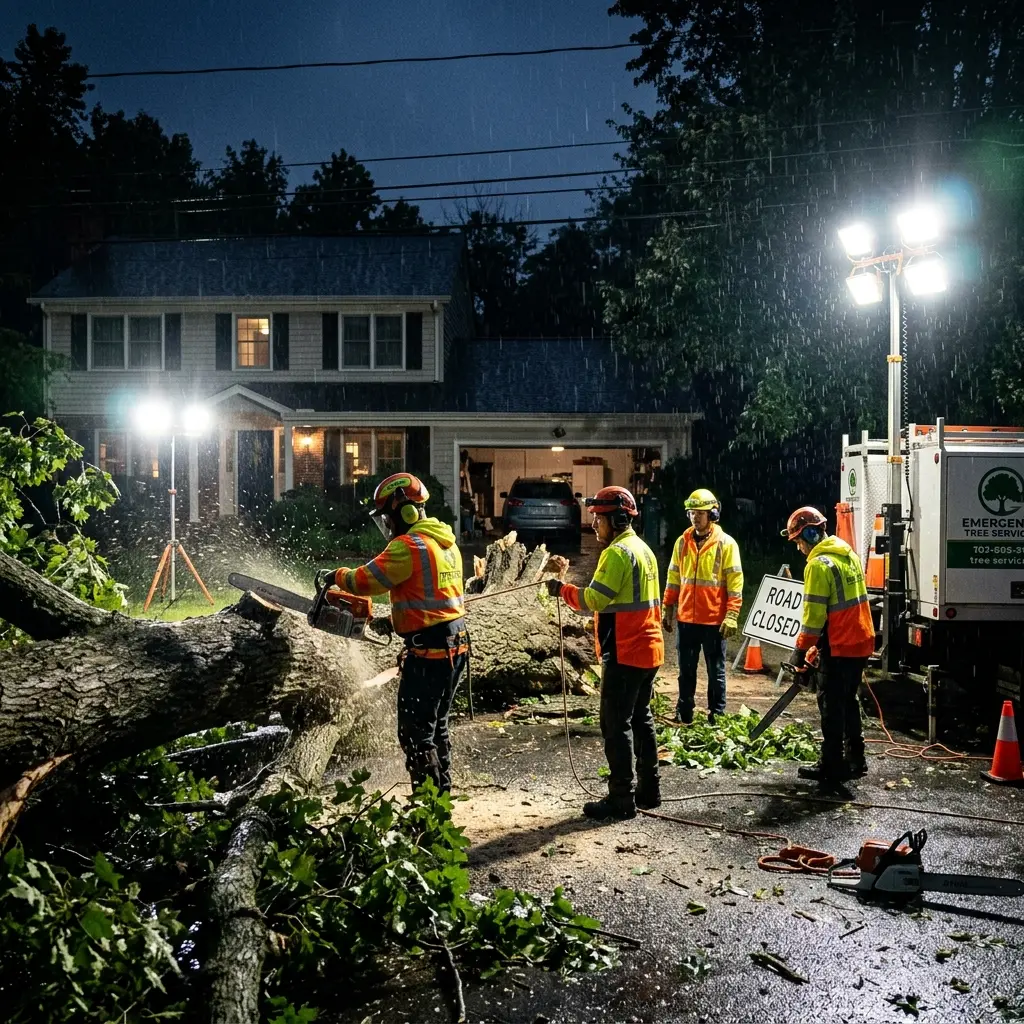

Quick Answer
Storm damage tree removal costs $500 to $5,000+, driven almost entirely by where the tree landed and how fast you need the crew. A grounded tree in an open yard runs $300–$800; a tree on your roof with crane extraction runs $1,000–$5,000+; and true 24/7 emergency response adds a 25–100% premium on top. This guide owns the storm-and-emergency context — for a number on your specific tree, use the fallen tree removal cost calculator, and for standing trees use the main tree removal cost calculator.
Storm Tree Removal Cost by Scenario
Where the tree landed is 80% of the price. One counterintuitive rule: a partially fallen tree usually costs MORE than one flat on the ground — a grounded trunk is just cutting and hauling, while a "hanger" is a loaded spring that must be rigged and released in controlled stages.
| Storm damage situation | Typical cost | Key cost drivers |
|---|---|---|
| Fallen tree in open yard (no structures) | $300-$800 | Easy access, no rigging needed |
| Fallen tree blocking driveway | $500-$1,800 | Urgent access restoration required |
| Fallen tree on fence or shed | $700-$2,500 | Structure protection, careful extraction |
| Fallen tree on car | $800-$2,500 | Crane or airbag lift, insurance documentation |
| Fallen tree on roof or house | $1,000-$5,000+ | Roof protection, crane may be needed |
| Partially fallen / hung-up tree ("hanger") | $800-$3,500+ | Stored tension, staged rigging, highest crew risk |
| Tree tangled near power lines | $1,500-$4,000+ | Utility coordination, safety protocols |
| Multiple fallen trees (storm cleanup) | $1,500-$8,000+ | Volume discount possible per tree |
A tree resting on a structure needs to be lifted off, not dropped — that is why roof and car scenarios push into crane territory. See the crane-assisted removal guide for how crane pricing works.
Storm-Damaged but Still Standing: Unstable Tree Pricing
Storm-damaged trees that are still standing but unstable are priced differently from fallen ones. A split trunk, exposed roots, or a new heavy lean all increase risk and labor time. Storm tree removal for standing hazards typically costs $800 to $4,000+ depending on:
- Whether the tree is leaning toward a structure
- How much of the root system is intact
- Whether the trunk is cracked or split
- Access for emergency equipment
- Availability of crews during peak storm season
Cracked-trunk and root-lifted trees can fail without warning. Keep everyone out of the fall radius and treat quotes-in-hand speed as part of the value, not gouging.
Emergency Tree Removal Premiums: How the Surcharges Actually Work
"Emergency" pricing is not one number — it is a stack of specific premiums. Knowing the stack lets you read a quote intelligently:
| Premium type | Typical amount | When it applies |
|---|---|---|
| Same-day / urgent response | +25–50% over standard rates | Crew reshuffles schedule during business hours |
| After-hours / night call-out | 1.5×–2× standard rates, or $150–$500 flat | Evenings, weekends, holidays |
| Storm-surge demand | +50–100% at peak | Days after a major storm when every crew is booked |
| Hazard / stabilization fee | $150–$500 | Tree must be secured or rigged before any cutting |
| Minimum emergency call-out | $500–$1,500 | Small jobs still pay for the mobilized crew |
Two practical implications. First, if the tree is down in the yard and nothing is threatened, you don't need emergency service — declining the premium and booking normal-schedule work often halves the bill. Second, premiums are legitimate cost recovery (overtime pay, night-work risk, deferred jobs), but they should be itemized. A quote that says "$4,000, storm price" without a breakdown is a quote to walk away from.
Why Quotes Triple After a Hurricane (Storm-Season Triage)
After a named storm, three forces hit simultaneously: demand explodes (thousands of trees down at once), supply shrinks (crews work sunrise-to-dark and out-of-state contractors haven't arrived), and job mix worsens (hangers, roof extractions, and power-line entanglements dominate). The result is triage pricing:
1. Life-safety and structure jobs go first — trees on houses, blocking egress, near lines. These pay peak rates.
2. Access restoration second — blocked driveways ($500–$1,800 normally) can run double in the first post-storm week.
3. Yard cleanup last — grounded trees with no hazard may wait 2–6 weeks, but they also escape most of the surge premium if you're willing to be scheduled "when we get there."
The money move: get on multiple crews' non-emergency lists immediately, document everything for insurance, and resist door-knocking storm chasers — verify insurance exactly as described in the contractor verification guide.
Who Pays When a Neighbor's Tree Falls on Your Property?
The answer surprises almost everyone: your insurance handles trees that land on your property, regardless of whose yard the trunk stood in. The law treats a healthy tree felled by storm winds as an "Act of God" — the neighbor isn't liable just because it was their tree.
The exception is negligence: if the tree was visibly dead or hazardous and the owner knew (or was formally notified) and did nothing, liability can shift to them. This is why certified-mail hazard notices matter before storm season — they establish the knowledge that converts an Act of God into negligence. The full rules, including boundary trees and self-help pruning rights, are in the neighbor tree law guide.
Does Homeowners Insurance Pay for Storm Tree Removal?
Usually only when the tree damaged a covered structure (house, garage, fence) or blocked a driveway/access ramp — and the payout for the removal itself is capped by a debris-removal sublimit, commonly $500 per tree / $1,000 per storm event. The structure repairs are covered separately under your dwelling coverage, minus your deductible. Key rules of thumb:
- Tree fell in the yard, hit nothing → removal is typically not covered.
- Tree hit your house/fence/shed (wind, lightning, hail = covered perils) → structure repair + capped removal covered.
- Dead tree you'd been meaning to remove finally fell → expect a fight; neglect is excluded.
- Photograph everything before cleanup, keep receipts, and get the arborist's cause-of-failure note.
The complete breakdown — sublimits, deductible math, when not to claim, and carrier-by-carrier questions — is in Does Homeowners Insurance Cover Tree Removal?
What To Do First (Before Any Contractor Arrives)
1. Assume every downed line is live — stay away and call the utility; never let a tree crew touch line-entangled wood before the utility clears it.
2. Don't cut anything under load. Bent trunks and hung limbs store spring tension that kills chainsaw users every storm season.
3. Photograph the scene from multiple angles before any cleanup — insurance adjusters need the tree on the structure.
4. Tarp roof holes if safely reachable — insurers expect reasonable damage mitigation.
5. Price the job yourself with the fallen tree removal cost calculator so surge quotes have a baseline.
6. Verify insurance before signing — storm chasers concentrate wherever adjusters do.
Frequently Asked Questions
How much does storm damage tree removal cost?
Storm damage tree removal costs $500–$5,000+ depending on where the tree landed: $300–$800 for open-yard trees, $700–$2,500 for fence/shed strikes, and $1,000–$5,000+ for trees on roofs needing crane extraction. Emergency response adds a 25–100% premium, and post-hurricane surge pricing can temporarily double normal rates.
How much does emergency tree removal cost?
Emergency tree removal typically costs $500–$5,000+, which is standard removal pricing plus an urgency stack: +25–50% for same-day response, 1.5×–2× for after-hours calls, and $150–$500 hazard fees when the tree must be stabilized first. Most crews carry a $500–$1,500 emergency minimum.
Why does a partially fallen tree cost more than one on the ground?
A grounded tree is simple cutting and hauling. A partially fallen tree — hung in another canopy or resting on a structure — stores enormous spring tension and must be rigged, redirected, and released in controlled stages, often with a crane. That risk and rigging time is why "hangers" run $800–$3,500+ versus $300–$800 for grounded trees.
Who pays for tree removal when a neighbor's tree falls on my property?
Your homeowners insurance, in almost all cases — storm-felled healthy trees are treated as an Act of God regardless of ownership. The neighbor (or their insurer) pays only if you can show negligence: the tree was visibly hazardous, they knew, and they did nothing. Documented written notice before the failure is what makes that case.
Will insurance cover my storm tree removal?
Only if the tree damaged a covered structure or blocked the driveway, and removal payouts are capped by a debris sublimit — commonly $500 per tree, $1,000 per event. A tree that lands harmlessly in the yard is your bill. Check your policy's declarations page before assuming either way.
Should I wait to remove a storm-damaged tree to save money?
If it threatens nothing, yes — declining emergency premiums and booking normal-schedule (or off-season) work can cut the bill 30–50%. If the tree is on a structure, near lines, split, or root-lifted, no: failure timing is unpredictable and the danger premium exists for a reason.
Methodology & Sources
Sources:
- ISA Best Management Practices: Tree Risk Assessment — treesaregood.org
- TCIA ANSI A300 / Z133 Safety Standards — tcia.org
- Insurance Information Institute — tree/debris removal coverage norms — iii.org
- OSHA storm-cleanup chainsaw and struck-by hazard guidance — osha.gov
Related Cost Resources
Fallen Tree Removal Cost Calculator — Scenario-based estimate: where it landed, trunk size, urgency, hauling, crane.
Fallen Tree Cost by Scenario (Data) — The benchmark tables behind this guide.
Does Homeowners Insurance Cover Tree Removal? — Sublimits, claim process, and when not to file.
Crane Tree Removal Cost Guide — When roof extractions require a crane and what it adds.
Neighbor Tree Law & Property Rules — Liability, boundary trees, and hazard notices.
Tree Removal Cost in New Jersey — Nor'easter-belt pricing for NJ readers.