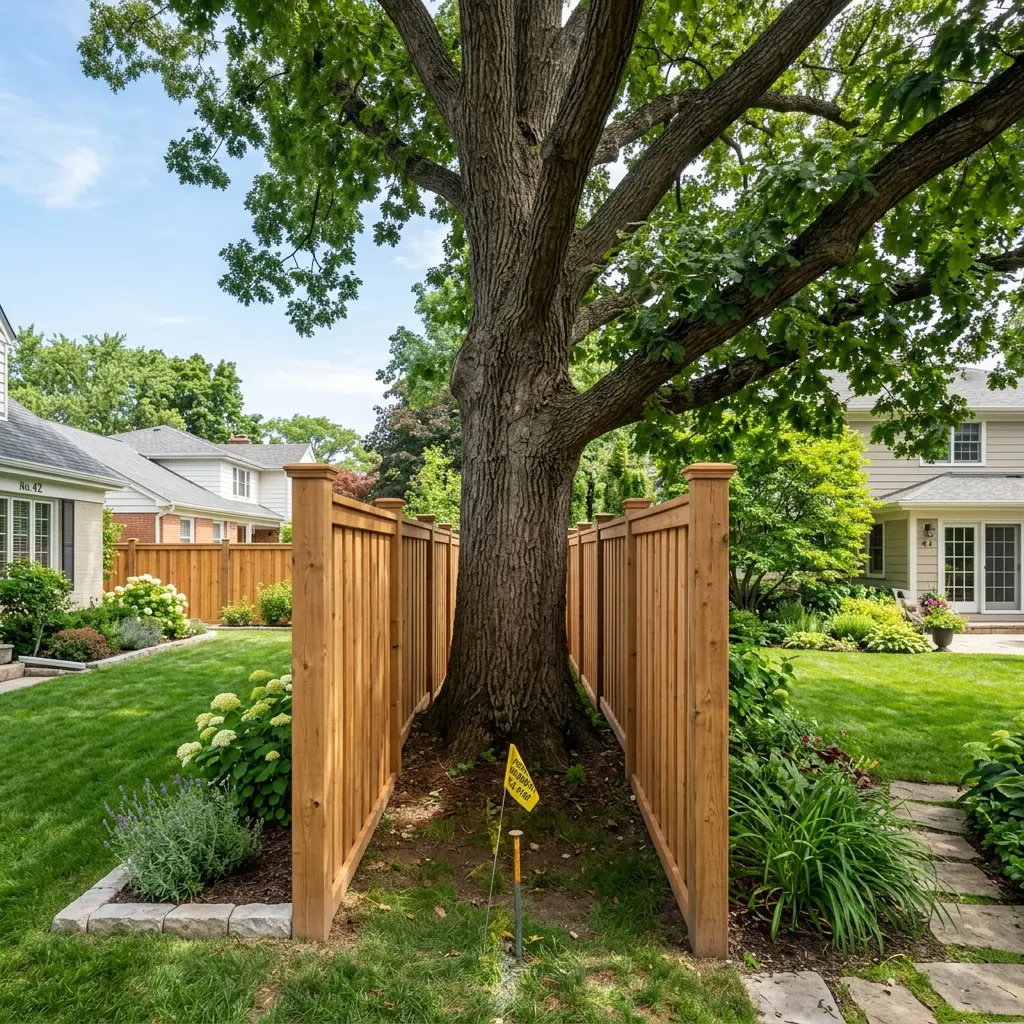

1. Air Rights & Common Law Property Limits
In the United States, property ownership is three-dimensional. Under the classic common law doctrine Cuius est solum, eius est usque ad coelum et ad inferos ("Whoever owns the soil, it is theirs all the way to Heaven and to Hell"), a landowner holds vertical airspace rights above their physical boundaries.
When a neighbor's tree branches or root system grow across your physical property line, they are technically encroaching on your airspace and soil column. This creates immediate legal disputes regarding pruning rights, structural damage, and civil liability.
---
2. The Massachusetts Rule: The Right to Self-Help Pruning
The foundational legal standard in US tree law is the Massachusetts Rule (established in Ponte v. Bustard, 1982). This rule dictates that you have an absolute right to "Self-Help" pruning: you can cut back branches or roots of a neighbor's tree that encroach onto your property, up to the exact boundary line.
However, this right is governed by three critical legal restrictions:
1. Strict Boundary Constraint: You cannot cross the property line. You cannot step foot on your neighbor's land or enter their airspace with a bucket truck arm without explicit permission. All cuts must be made from your side of the property line.
2. No Fatal Damage: Your pruning must not kill, structurally weaken, or permanently disfigure the tree. If you aggressively cut back the limbs of an oak on your side, and the resulting canopy imbalance causes the tree to blow over or die from fungal infection, you can be held civilly liable for the full replacement cost of the tree.
3. Cost Allocation: You are financially responsible for the labor and disposal costs of the branches you prune from your side. You cannot dump the cut debris back onto your neighbor's yard, nor can you send them the invoice for the work.
---
3. The Hawaii Rule vs. The Massachusetts Rule
Modern courts are shifting away from the Massachusetts Rule in high-density urban areas. If a neighbor's tree roots are actively damaging your foundation, breaking sewer pipes, or lifting your driveway, the legal remedies vary by state:
| Legal Rule | Primary Jurisdiction | Homeowner Rights & Liabilities |
|---|---|---|
| Massachusetts Rule | MA, NY, TX, IL, GA | The sole remedy is self-help. You must cut the roots at the line at your own expense. The tree owner is not liable for root damage. |
| Hawaii Rule | HI, CA, WA, VA, DC | If encroaching roots or branches cause actual structural damage, the tree owner is legally liable for repairs and can be forced to remove the tree. |
---
4. Boundary Trees & Triple-Damage (Treble) Liability
A Boundary Tree is defined as any tree whose trunk is physically intersected by the property line. The law treats boundary trees as the joint property of both homeowners (tenants in common).
- Strict Mutual Consent: Neither neighbor has the legal right to cut down, structurally prune, or treat a boundary tree without the written consent of the other.
- The Penalty for Willful Trespass: If you unilaterally cut down a shared boundary tree because it blocks your view or drops leaves in your pool, you are committing a civil tort.
- Treble Damages: In many states (such as Washington, California, Oregon, and New York), the legislature has enacted Tree Trespass Statutes that mandate Treble (Triple) Damages for willful, unauthorized logging. If a heritage boundary tree is appriased at a standard value of $15,000, a court can award your neighbor $45,000 in damages, plus attorney fees.
---
5. Proactive Risk Mitigation for Neighbors
- Send Written Notices: If a neighbor's tree is visibly dead or decaying and poses a threat to your home, do not just speak to them. Send a certified letter detailing the hazard. This formally establishes Actual Knowledge. If the tree subsequently falls, their insurer cannot claim it was an "Act of God," and the neighbor will be held fully liable for negligence.
- Verify Property Line Surveys: Before executing any root cutting or branch pruning, hire a licensed surveyor to mark your exact boundary line. Standard fences are often misaligned by 1 to 3 feet, and pruning based on a fence line can lead to accidental trespass.
---
6. Boundary Tree Law: The Quick-Reference Rules
Because boundary trees generate the most expensive disputes in tree law, here is the doctrine reduced to its operating rules:
- Definition test: a tree is a boundary tree when the trunk is intersected by the property line at ground level. Overhanging canopy alone does not create co-ownership — trunk position controls.
- Ownership: boundary trees are owned by both parties as tenants in common. Neither owner may remove or structurally alter the tree without the other's consent — in practice, get it in writing.
- Removal consent: unilateral removal exposes you to the tree's appraised value in damages, and in treble-damage states (WA, CA, OR, NY, and others) up to three times that value plus fees. A $15,000 appraisal becomes a $45,000 judgment.
- Maintenance costs: absent an agreement, courts generally treat routine maintenance as shared, but the case law is thin — which is exactly why the written agreement below exists.
- Valuation: boundary-tree damages are established by formal appraisal (CTLA Trunk Formula Method) — see the specimen tree valuation guide for how courts arrive at these numbers.
---
7. The Written Neighbor Agreement (Shared Tree Removal)
When you and a neighbor split the cost of removing a shared or boundary-line tree, a one-page signed agreement prevents essentially every common dispute. It should record:
1. The tree, identified by species, size, and location (photo attached).
2. Authorization — both owners consent to removal (mandatory for boundary trees).
3. Cost split — percentage or fixed amounts, and who pays the contractor directly.
4. Contractor selection — named company, license/registration number, and the requirement that a COI be sent from the insurer's agent before work (verification steps in the contractor insurance guide).
5. Liability allocation — whose insurance responds for damage on each side of the line during the work.
6. Debris & wood — who keeps or hauls logs, chips, and firewood from each side.
7. Stump decision — grinding depth and cost allocation.
8. Signatures and date, with the winning written estimate attached (use the estimate template so the scope is itemized).
Attach the agreement to the contractor's written estimate and both parties keep copies. Courts routinely enforce these simple documents; they routinely refuse to reconstruct verbal deals.
Frequently Asked Questions
What is tree law?
Tree law is the body of property and tort law governing trees on and between private properties: encroachment and self-help pruning rights, boundary-tree co-ownership, liability for fallen trees and root damage, timber trespass and treble-damage statutes, and municipal protections like heritage-tree ordinances. It blends centuries-old common law doctrines (the Massachusetts and Hawaii Rules) with modern state statutes.
What is the law on boundary trees?
A tree whose trunk sits on the property line is jointly owned by both neighbors as tenants in common. Neither may remove it or structurally alter it without the other's consent, and unilateral removal can trigger liability for the tree's full appraised value — tripled in treble-damage states like Washington, California, Oregon, and New York.
Do I need a written agreement to remove a tree shared with my neighbor?
Legally, consent is what's required for boundary trees — but a signed one-page agreement covering authorization, cost split, contractor choice, insurance responsibility, and debris handling is what makes that consent provable and the cost split enforceable. Attach it to the contractor's itemized written estimate.
Can I make my neighbor pay for tree removal?
Only with leverage the law recognizes: if their tree is dead or visibly hazardous and you've sent a documented written notice, liability for subsequent damage shifts to them — which motivates action. For healthy trees, you generally cannot force removal; your remedy is self-help pruning to the property line (Massachusetts Rule states) or a damage claim if roots/branches cause actual structural harm (Hawaii Rule states).