
Quick Answer
A specimen tree is valued using the Council of Tree and Landscape Appraisers (CTLA) Trunk Formula Method, which calculates real estate asset value based on trunk size, species rarity, and property location. While timber value might be negligible, a mature specimen tree can appraise for $10,000 to $100,000+. If destroyed by negligence or trespass, many states allow owners to sue for Treble Damages (3x the appraised value).
---
> :warning: Critical Distinction: Asset Value != Removal Cost
>
> *This page calculates appraised asset value* for legal damages, insurance claims, and real estate equity. It does not** estimate the cost to cut down and haul away the tree.
>
> * A 36-inch White Oak may have a CTLA appraised value of $65,000 (your legal claim).
> * The same tree may cost $2,800 to remove (contractor labor).
>
> Do not confuse the two. Use our Tree Removal Cost Calculator for removal estimates. Use this guide for appraisal methodology, legal recourse, and insurance negotiation.
---
Timber Value vs. Amenity Value: Why Your Oak Is Worth $40,000 (Not $50)
A logger sees a 40-inch DBH White Oak and calculates timber value: ~$50-$150 for firewood or low-grade pulp. The wood is heavy, hard to mill, and urban logs contain nails, cables, and embedded metal that destroy sawmill blades.
A real estate appraiser sees the same tree and calculates amenity value (CTLA Trunk Formula): $35,000-$80,000+. Why the 500x difference?
| Value Type | Basis | Typical Range (40" Oak) | Used For |
|---|---|---|---|
| Timber / Lumber Value | Weight x local mill price per ton | $50 - $200 | Logging, salvage |
| Firewood Value | Cord volume x local retail | $150 - $400 | Homeowner use |
| Amenity / Appraised Value (CTLA) | Replacement cost x trunk area x Species x Condition x Location ratings | $35,000 - $80,000+ | Lawsuits, insurance claims, divorce settlements, property tax appeals, estate planning |
*The CTLA method values the ecosystem services* the tree provides while standing: shade (HVAC savings), stormwater interception, carbon sequestration, property curb appeal, and neighborhood character. These are real estate assets**, not forest products.
---
The 3 Methods of Tree Appraisal (And When Courts Accept Them)
The Guide for Plant Appraisal (10th Edition) -- published by the International Society of Arboriculture (ISA) on behalf of the CTLA -- defines three approaches. Courts and insurers accept different methods depending on tree size and context.
1. Replacement Cost Method (For Small, Transplantable Trees)
- Applies to: Trees up to ~4-inch caliper (DBH) that can be purchased at a nursery and transplanted with a tree spade.
- Formula: Cost of replacement tree + Installation labor + Establishment care (2-3 years) + Warranty
- Typical range: $500 - $15,000 per tree
- Court acceptance: High for small ornamental trees; rejected for legacy specimens because no nursery carries 30-inch caliper Oaks.
2. Trunk Formula Method (TFM) -- The Gold Standard for Specimen Trees
- Applies to: Trees too large to transplant (DBH > 4 inches). This covers virtually every mature shade tree.
- Formula: Appraised Value = (Replacement Cost + (Unit Basic Cost x DeltaTrunk Area)) x Species Rating x Condition Rating x Location Rating
- Typical range: $5,000 - $250,000+
- Court acceptance: Primary method for mature tree litigation. Endorsed by ISA, ASCA (American Society of Consulting Arborists), and cited in state timber trespass statutes.
3. Income Approach / Cost Approach (Commercial Timber and Orchards)
- Applies to: Commercial timber tracts, Christmas tree farms, nut/fruit orchards.
- Basis: Present value of future harvest revenue (Income) or cost to re-establish the stand (Cost).
- Not used for: Residential landscape specimens.
---
The CTLA Trunk Formula Method: The Math Explained
The Trunk Formula Method is the industry standard for valuing irreplaceable landscape trees. Here is the step-by-step breakdown using the 10th Edition framework.
The Core Equation
> Appraised Value = (Replacement Cost + [Unit Basic Cost x DeltaTrunk Area]) x Species Rating x Condition Rating x Location Rating
| Variable | Symbol | What It Measures | Source |
|---|---|---|---|
| Replacement Cost | $C_R$ | Cost to buy and install the largest available nursery tree of same species (typically 3-4" caliper) | Regional nursery surveys |
| Unit Basic Cost | $C_U$ | Cost per square inch of trunk cross-sectional area above the replacement size | Regional cost guides (ISA, state chapters) |
| Trunk Area (Subject) | $TA_S$ | $0.7854 x DBH^2$ | Field measurement at 4.5 ft |
| Trunk Area (Replacement) | $TA_R$ | $0.7854 x ReplacementCaliper^2$ | Nursery standard |
| DeltaTrunk Area | $DeltaTA$ | $TA_S - TA_R$ | Calculated |
| Species Rating | $SR$ | 0.00-1.00 (regional guide) | ISA Species Ratings |
| Condition Rating | $CR$ | 0.00-1.00 (roots, trunk, scaffold, canopy, foliage) | On-site inspection |
| Location Rating | $LR$ | Average of Site, Contribution, Placement (each 0.10-1.00) | Appraiser judgment |
---
Worked Example: 30-inch DBH Northern Red Oak (Quercus rubra) -- Suburban Lot
| Step | Calculation | Result |
|---|---|---|
| 1. Replacement Cost ($C_R$) | 4-inch caliper Red Oak, installed | $1,650 |
| 2. Unit Basic Cost ($C_U$) | Regional guide (Mid-Atlantic) | $98 / sq. in. |
| 3. Subject Trunk Area ($TA_S$) | $0.7854 x 30^2$ | 706.86 sq. in. |
| 4. Replacement Trunk Area ($TA_R$) | $0.7854 x 4^2$ | 12.57 sq. in. |
| 5. DeltaTrunk Area ($DeltaTA$) | $706.86 - 12.57$ | 694.29 sq. in. |
| 6. Basic Cost ($C_B$) | $1,650 + ($98 x 694.29)$ | $69,690 |
| 7. Species Rating ($SR$) | Red Oak, Mid-Atlantic guide | 0.85 (85%) |
| 8. Condition Rating ($CR$) | Good health, minor deadwood | 0.80 (80%) |
| 9. Location Rating ($LR$) | Site 0.90, Contribution 0.85, Placement 0.80 -> Avg | 0.85 (85%) |
| 10. Composite Multiplier | $0.85 x 0.80 x 0.85$ | 0.578 |
| 11. Final Appraised Value | $69,690 x 0.578$ | $40,281 |
Result: This 30-inch Red Oak has a CTLA appraised value of ~$40,300. If a neighbor's contractor destroys it, the starting legal claim in a treble-damage state is ~$120,900.
---
Visual: Trunk Formula Equation Breakdown
\begin{aligned}
\textbf{Appraised Value} = &\underbrace{\bigl(C_R + C_U \times \Delta TA\bigr)}_{\text{Basic Cost Basis}} \
&\times \underbrace{SR}_{\text{Species}} \times \underbrace{CR}_{\text{Condition}} \times \underbrace{LR}_{\text{Location}}
\end{aligned}
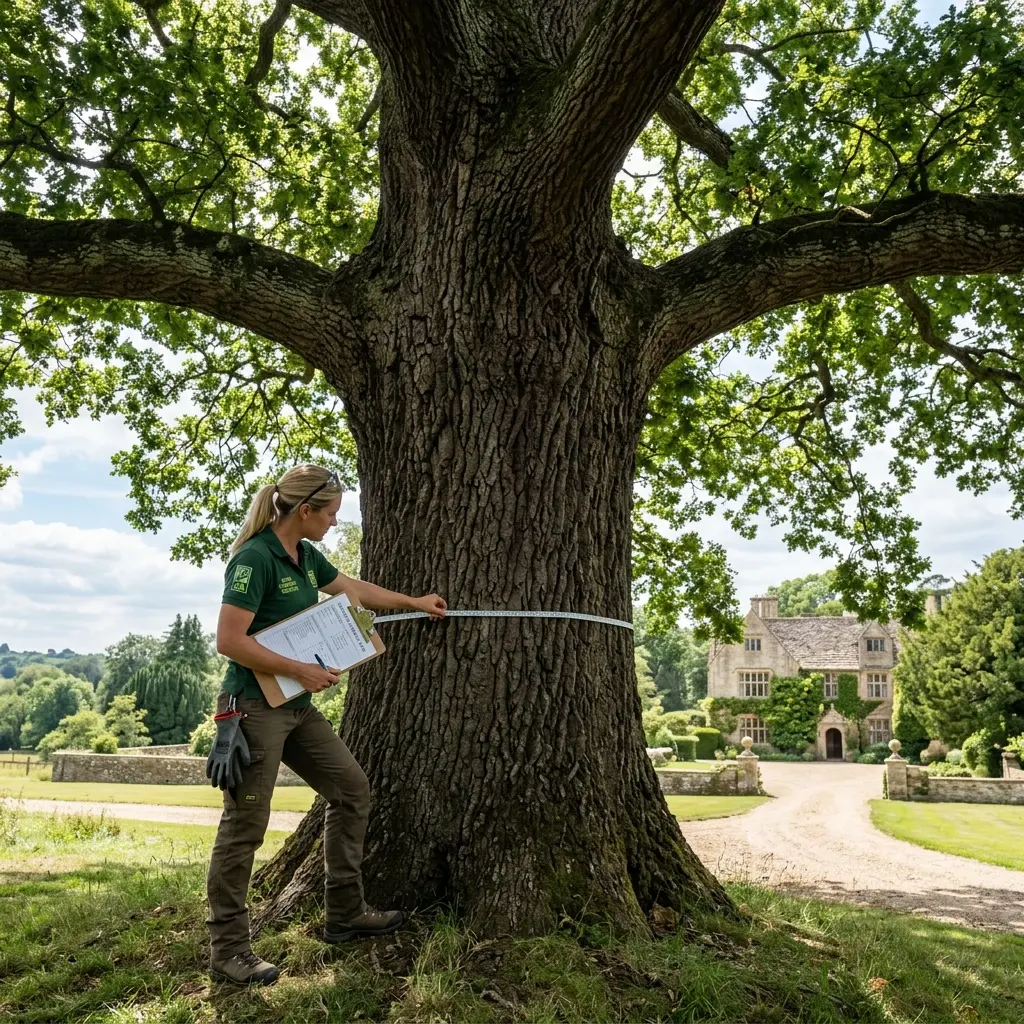
> DBH Measurement Protocol: Measure at 4.5 ft (1.37 m) above ground on the uphill side. If the tree forks below 4.5 ft, measure each stem separately and sum the cross-sectional areas. For multi-stemmed specimens, the 10th Edition applies specific aggregation rules -- consult a consulting arborist.
---
Timber Trespass and Treble Damages: Suing for Unauthorized Tree Destruction
When a neighbor, contractor, utility crew, or developer cuts, damages, or kills your tree without permission, you may have a Timber Trespass claim. This is a specific legal tort distinct from general property damage.
What Constitutes Timber Trespass?
- Intentional cutting of a tree on your property (or a boundary tree) without consent.
- Negligent damage -- e.g., a contractor's excavator severs structural roots of a specimen oak during foundation work, causing decline and death within 1-3 years.
- Chemical trespass -- Herbicide drift or improper soil sterilant application killing a neighbor's trees.
- Boundary tree removal -- Cutting a tree whose trunk straddles the property line without the co-owner's written consent.
Treble Damages: The 3x Multiplier
Many states have enacted statutory treble damage laws for willful tree trespass. If the court finds the act was intentional, reckless, or in bad faith, the judgment = 3 x CTLA appraised value + attorney fees + court costs.
| State | Statute / Case Law | Treble Damages? | Notes |
|---|---|---|---|
| California | Civil Code section 3346; Penal Code section 384a | Yes (3x) | Also allows attorney fees under section 1021.9 |
| Washington | RCW 64.12.030 | Yes (3x) | Strict liability for intentional cutting |
| Texas | Civil Practice and Remedies Code section 85.002 | Yes (3x) | Applies to "timber" -- courts include landscape trees |
| North Carolina | GS section 1-539.1 | Yes (3x) | "Willful trespass" standard |
| Massachusetts | G.L. c. 242, section 7 | Yes (3x) | "Willful cutting" of trees on land of another |
| New York | RPAPL section 861 | Yes (3x) | Applies to "timber, trees, or underwood" |
| Oregon | ORS 105.810 | Yes (3x) | Includes "shrubs, trees, or vegetation" |
| Tennessee | TCA section 28-1-104 | Yes (3x) | "Knowing and intentional" standard |
| Georgia | OCGA section 51-12-51 | Yes (3x) | "Willful trespass" |
| Most other states | Common law / case law | Sometimes (judicial discretion) | Often requires proof of "willful," "malicious," or "reckless" conduct |
> :warning: Legal Disclaimer: This is legal information, not legal advice. Timber trespass laws vary significantly by state and even local jurisdiction. Statutes of limitations apply (often 2-3 years). Consult a licensed real estate or property attorney in your state immediately if you believe a tree was illegally destroyed. Do not rely solely on this guide for legal strategy.
Critical Evidence to Preserve
1. Pre-loss documentation: Dated photos, drone aerials, prior arborist reports.
2. Post-loss documentation: Photos of stump, slash, equipment tracks, chemical labels.
3. Witness statements: Neighbors, passersby, other contractors on site.
4. Professional appraisal: Hire an ASCA Registered Consulting Arborist (RCA) or ISA Certified Arborist with appraisal credentials to produce a USPAP-compliant report before the stump is ground.
5. Written demands: Send a certified letter demanding preservation of evidence and stating your intent to pursue treble damages under applicable state statute.
---
Utility Companies and Easement Overreach: When Vegetation Management Goes Too Far
The #1 cause of specimen tree disputes nationwide is utility line clearance. Utilities hold vegetation management easements granting them the right to prune or remove trees interfering with power lines. But easement rights are not unlimited.
The Legal Boundary: "Reasonable and Necessary"
- Permitted: Directional pruning to maintain OSHA/ANSI clearances (typically 10-15 ft for distribution lines). Removal of trees that cannot be safely pruned to clearance standards.
- Overreach (Actionable):
- Topping / Heading cuts instead of proper reduction cuts (violates ANSI A300).
- Removing a specimen tree outside the easement width (e.g., easement is 15 ft, tree trunk is 20 ft from pole).
- Destroying a heritage/protected/specimen tree without exploring alternatives (undergrounding, insulated wire, relocating pole).
- Failing to notify the property owner (many states require 14-30 days' notice for non-emergency work).
- Using non-arborist crews (line clearance contractors without ISA certification) on high-value specimens.
Your Leverage Points
1. Demand the Work Plan: Request the utility's specific pruning prescription for your tree. It must cite ANSI A300 Part 1 standards.
2. Invoke "Specimen Tree" Status: If your tree meets local criteria (heritage ordinance, specimen registry, >X" DBH), the utility may need a permit or variance to remove it.
3. Request Alternatives in Writing: Ask for cost estimates for: (a) undergrounding the service drop, (b) installing covered/conductor wire, (c) relocating the pole. Utilities often deny these citing cost -- but a written denial strengthens your case if they destroy the tree anyway.
4. *Commission an Independent Appraisal Before Work:* If the utility marks your tree for removal, hire a consulting arborist immediately. A pre-work CTLA appraisal establishes the asset value. If they proceed and destroy it, you have the valuation ready for a demand letter.
5. File a PUC/PSC Complaint: Every state has a Public Utilities Commission (or Public Service Commission) overseeing utility vegetation management. File a formal complaint before the crew arrives.
> :warning: Legal Disclaimer: Utility easements are governed by state public utility law, franchise agreements, and case law. Outcomes depend on the specific easement language recorded on your deed. Consult a real estate attorney experienced in utility law. Do not physically interfere with utility crews -- you can be arrested. Document, object in writing, and litigate after.
---
Insurance Claims for Landscape Damage: Navigating the $500 Cap
Standard Homeowners Insurance (HO-3 / HO-5) policies treat trees as "landscaping" -- not "dwelling" or "personal property." This distinction is financially devastating for specimen tree owners.
The Standard Policy Limits
| Coverage | Typical Limit | Applies To |
|---|---|---|
| Landscaping / Trees / Shrubs | $500 - $1,000 per tree (often $5,000-$10,000 aggregate) | Fire, lightning, explosion, theft, vandalism, vehicles not owned by resident |
| Wind / Hail / Storm | Usually EXCLUDED for standing trees | Fallen trees only if they damage a covered structure (house, fence, garage) |
| Debris Removal | $500 - $1,000 (only if tree hits structure) | Cleanup of fallen tree on structure |
Translation: If lightning strikes your $60,000 appraised White Oak, your HO-3 policy pays $500-$1,000. The remaining $59,000 is your loss unless you have a rider/endorsement or can recover from a liable third party.
When You Can Recover Full CTLA Value
| Scenario | Whose Policy Pays | Basis of Recovery |
|---|---|---|
| Neighbor's tree falls on your house | Neighbor's Liability (HO-3 Section II) | Negligence (they knew it was dead/hazardous) -- Full CTLA value + cleanup |
| Contractor destroys your tree | Contractor's General Liability (GL) | Property damage / trespass -- Full CTLA value + treble damages if applicable |
| Utility company over-clears | Utility's Self-insurance / GL | Easement overreach / negligence -- Full CTLA value |
| Vandalism / malicious cutting | Your HO-3 (Vandalism peril) | Often subject to $500/tree cap -- Check for "Ordinance or Law" or "Specified Property" endorsements |
| Auto hits your tree | Driver's Auto Property Damage | Full CTLA value (vehicle liability covers real property damage) |
Action Steps for Insurance Claims
1. Do not accept the adjuster's first offer of $500/tree. It is a policy default, not a valuation.
2. Commission a CTLA appraisal (cost: $500-$2,500). Submit the USPAP-compliant report with your claim.
3. Demand "Replacement Cost" endorsement review. Some carriers offer "Landscape Enhancement" or "Specified Tree" riders for high-value specimens -- but they must be in force before the loss.
4. If a third party is liable (neighbor, contractor, utility), file against THEIR liability policy, not your homeowners. Their GL limits are typically $1M-$2M per occurrence -- sufficient for even the largest specimen claims.
5. Document diminution of property value. Hire a real estate appraiser to quantify the FMV loss of the property with vs. without the tree. This often exceeds the CTLA tree value alone.
---
How Much Does a Tree Appraisal Cost?
| Appraisal Type | Typical Cost | Use Case | Turnaround |
|---|---|---|---|
| Consultation / Verbal Opinion | $250 - $500 | Preliminary assessment, decide if full appraisal is warranted | 1-2 days |
| Desktop Appraisal (Photos + Data) | $500 - $1,200 | Insurance pre-loss documentation, estate planning | 3-5 days |
| Field Appraisal (On-site Inspection) | $1,000 - $3,500+ | Litigation, insurance claims, divorce, tax deduction -- Court-admissible | 7-14 days |
| Expert Witness / Deposition / Trial | $300 - $600/hr | If case proceeds to litigation | As needed |
Credentials to Require
- ISA Certified Arborist (minimum)
- ASCA Registered Consulting Arborist (RCA) -- Preferred for litigation
- USPAP Compliance -- The appraisal report must follow Uniform Standards of Professional Appraisal Practice to be admissible in court.
- Experience with your species and region -- Species ratings are regional; a Florida arborist may misrate a Northern Red Oak.
> Budget Reality: A full litigation-grade appraisal runs $1,500-$3,500+. If your tree's CTLA value exceeds $15,000, this cost is almost always justified by the increased recovery. Many attorneys will advance this cost on contingency in strong treble-damage cases.
---
FAQ
How do you calculate the value of a mature specimen tree?
Professional appraisers use the CTLA Trunk Formula Method (10th Edition): (Replacement Cost + Unit Basic Cost x DeltaTrunk Area) x Species Rating x Condition Rating x Location Rating. This yields the tree's appraised value as a real estate asset, not its timber or firewood value. A 30-inch DBH Red Oak in a suburban yard typically appraises for $30,000-$50,000+.
What is the CTLA Trunk Formula Method?
The Trunk Formula Method is the industry-standard appraisal technique for trees too large to transplant (DBH > 4 inches). It calculates value by starting with the cost of the largest available nursery replacement tree, then adding value for each additional square inch of trunk cross-sectional area, adjusted by species, condition, and location ratings. Published in the Guide for Plant Appraisal, 10th Edition by the Council of Tree and Landscape Appraisers (CTLA).
Can I sue my neighbor if their contractor cuts down my tree?
Yes. This is timber trespass. If a neighbor's contractor crosses the property line and cuts or mortally damages your tree, both the contractor (direct actor) and potentially the neighbor (vicarious liability / hiring an unqualified contractor) can be sued. In many states (CA, WA, TX, NC, NY, OR, MA, GA, TN), treble damages (3x appraised value) apply for willful trespass. Consult a licensed real estate attorney in your state immediately.
What are "treble damages" in timber trespass laws?
Treble damages are a statutory penalty allowing a court to award three times the appraised value of the wrongfully destroyed tree, plus attorney fees and costs. They are designed to deter intentional or reckless tree cutting. Availability and standards (willful, intentional, reckless, negligent) vary by state -- see the state table in the "Timber Trespass" section above.
Does homeowners insurance cover the loss of a valuable landscape tree?
Standard HO-3 policies cap tree/landscape coverage at $500-$1,000 per tree (often $5,000-$10,000 aggregate) for named perils like fire, lightning, vandalism, or vehicle impact. Wind, hail, and storm damage to standing trees are typically excluded. Full CTLA value is recoverable only if a third party is liable (neighbor's tree, contractor, utility, auto accident) and you claim against their liability policy.
How much does it cost to hire a consulting arborist for a tree appraisal?
A court-admissible, USPAP-compliant field appraisal typically costs $1,000-$3,500+ depending on tree count, complexity, and region. Desktop/photo-based reviews cost $500-$1,200. Expert witness testimony adds $300-$600/hour. Hire an ASCA Registered Consulting Arborist (RCA) or ISA Certified Arborist with appraisal credentials.
Can a utility company legally cut down a specimen tree in my yard?
Utilities have easement rights for "vegetation management" to maintain line clearances. They cannot legally: (1) top/head a specimen tree instead of using ANSI A300 reduction cuts, (2) remove a tree outside the easement width, (3) destroy a protected/heritage/specimen tree without exploring alternatives (undergrounding, covered wire, pole relocation), or (4) fail to provide required notice (14-30 days in many states). Document everything and consult a utility law attorney before work begins.
What is the difference between "timber value" and "amenity value"?
Timber value is what a logger pays for the wood ($50-$200 for a mature oak) -- based on weight and mill prices. Amenity value (CTLA appraised value) is the tree's contribution to real estate value while standing: shade/HVAC savings, stormwater mitigation, carbon sequestration, curb appeal, neighborhood character. A 40-inch oak may have $100 timber value but $60,000+ amenity value. Courts use amenity value for damage claims.
Is a tree appraisal admissible in court?
Yes, if it is prepared by a qualified appraiser (ASCA RCA or ISA Certified Arborist with appraisal training) and complies with USPAP (Uniform Standards of Professional Appraisal Practice). The report must include: scope of work, inspection date, methodology (CTLA 10th Ed.), all ratings with justification, photos, measurements, and a signed certification. "Back-of-napkin" estimates or verbal opinions are generally inadmissible.
How does a tree's species rating affect its appraised value?
Species rating (0.00-1.00) is a multiplier in the CTLA formula reflecting the species' desirability based on longevity, structural strength, pest/disease resistance, and aesthetic qualities. A White Oak (0.90) appraises ~2.25x higher than a Silver Maple (0.40) of identical size and condition. Regional ISA chapters publish species rating guides -- always use the guide for your state/climate zone.
What happens if a protected or heritage tree is destroyed?
Most municipalities with tree protection ordinances impose civil penalties (often $500-$10,000 per inch DBH) in addition to civil liability for the tree's CTLA value. Some ordinances mandate replacement planting (e.g., 3:1 caliper ratio) or restitution payments to a city tree fund. Violations can also trigger stop-work orders on development projects. Check your local "Tree Protection Ordinance" or "Heritage Tree Registry."
Does the Trunk Formula account for a tree's historical significance?
The standard CTLA formula does not include a "historical significance" multiplier. However, appraisers may adjust the Location Rating (specifically the Contribution sub-rating) upward if the tree is a documented landmark, contributes to a historic district, or has recognized cultural value. For formally designated historic trees, some jurisdictions require a separate historical value assessment alongside the CTLA appraisal.
How do I prove the value of a tree that was destroyed in a storm?
For insurance/tax casualty claims (IRC section 165), you must prove the decrease in Fair Market Value (FMV) of the entire property, not the tree in isolation. Steps: (1) Obtain a certified real estate appraisal of the property before the storm (or a retroactive appraisal using pre-storm photos/aerials). (2) Obtain a post-storm appraisal of the diminished property. (3) The difference = deductible basis (subject to $100 floor + 10% AGI limit). A CTLA tree appraisal supports the real estate appraisal but does not replace it. Consult a CPA/tax attorney for casualty loss deductions.
What is the "Replacement Cost Method" for tree appraisal?
Used for trees small enough to transplant (typically up to 4-inch caliper). Value = cost of replacement nursery tree + installation labor + 2-3 years establishment care (watering, mulching, monitoring) + warranty. Typical range: $500-$15,000. Courts accept this for ornamental/young trees but reject it for mature specimens because no nursery stocks 30-inch caliper shade trees.
---
Methodology and Sources
This guide is based on the *Council of Tree and Landscape Appraisers (CTLA) Guide for Plant Appraisal, 10th Edition*** (ISA, 2018), the authoritative standard for tree valuation in U.S. courts and insurance claims.
Primary Sources:
- CTLA / ISA: Guide for Plant Appraisal, 10th Edition -- Trunk Formula Method, Species/Condition/Location ratings, Replacement Cost Method.
- ASCA (American Society of Consulting Arborists): Consulting Arborist Standards of Practice -- USPAP compliance, expert witness qualifications, appraisal report requirements.
- ISA (International Society of Arboriculture): Arborists' Certification Study Guide -- DBH measurement, species identification, hazard assessment.
- USPAP (Uniform Standards of Professional Appraisal Practice): Appraisal Foundation -- Standards 1, 2, 6, 7, 8 for real property and personal property appraisal.
Legal References:
- State timber trespass statutes (CA Civ. Code section 3346, WA RCW 64.12.030, TX Civ. Prac. and Rem. section 85.002, NC GS section 1-539.1, MA G.L. c. 242 section 7, NY RPAPL section 861, ORS 105.810, TCA section 28-1-104, GA OCGA section 51-12-51).
- ANSI A300 Part 1 (Pruning) -- Utility vegetation management standards.
- IRC section 165 / IRS Pub. 547 -- Casualty loss deduction framework (FMV decrease method, $100 floor, 10% AGI limit).
Industry Data:
- Regional Unit Basic Cost surveys (ISA chapter publications, state forestry extensions).
- Species Rating guides (ISA chapter guides, state-specific publications).
- BLS Occupational Employment Statistics -- Arborist/Tree trimmer wage data for labor cost modeling.
---
Author and Reviewer
Imtinan Farooq -- Founder, Tree Removal Cost Calculator
Reviewed by: ISA Certified Arborist (Credential verification available on request)
Last Updated: July 2026
---
Related Cost Resources
Trunk Formula Method Calculator -- Interactive CTLA-style appraisal tool: trunk area × species × condition × location, with worked value tables by DBH.
Timber Value vs. Landscape Value -- What mills pay for the wood, and why it's a different number than the appraisal.
Tree Removal Cost Calculator -- Estimate removal labor, rigging, hauling, stump grinding, and crane costs by species, height, diameter, and access.
Tree Removal Cost by Type -- Compare wood-specific density multipliers and height bands for pine, oak, maple, cedar, fir, willow, walnut.
Fallen Tree Removal Cost Calculator -- Storm-damaged tree cleanup with emergency pricing, crane, and insurance claim guidance.
Tree Removal Estimate Template -- Sample arborist contract template to compare bids, verify insurance clauses, and itemize stump additions.
Stump Grinding Cost Calculator -- Diameter-based pricing with species density, access, depth, and regional multipliers.
State Permit Laws -- Check state-by-state permit requirements, HOA rules, and municipal laws for tree clearing and public utility safety.
IRS Casualty Loss Guide -- Storm damage tax deduction rules, FMV decrease method, and audit documentation.
Neighbor Tree Law Guide -- Boundary trees, self-help pruning rights, Massachusetts vs. Hawaii rules, treble damages.
Pine vs Oak Removal Cost Guide -- Why hardwoods cost 2x more to remove than conifers at the same height.