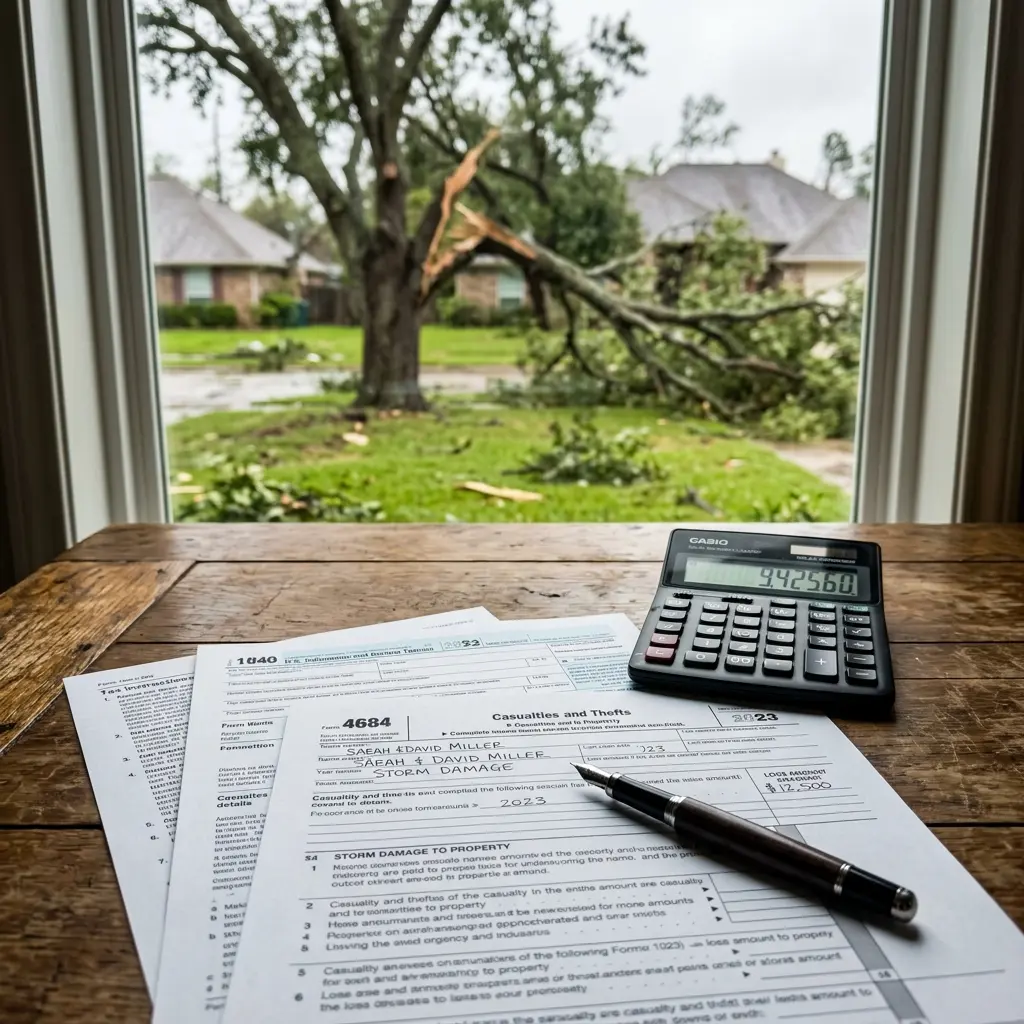

Quick Answer: Is Tree Removal Tax Deductible?
For most homeowners, no — routine tree removal on a personal residence is not tax deductible. It is treated as a personal expense, like lawn care. The exception is a casualty loss: if trees are destroyed by a sudden event that is part of a federally declared disaster (and, beginning with tax year 2026, certain state-declared disasters), the decline in your property's value — not the removal invoice itself — may be deductible under IRC Section 165. Rental and business property follow different, more generous rules. This guide walks through every scenario. Always confirm your specific situation with a CPA or tax professional before filing.
Tree Removal Tax Treatment by Scenario
| Scenario | Deductible? | How It's Treated |
|---|---|---|
| Routine removal (healthy or unwanted tree, personal residence) | No | Personal expense — never deductible |
| Dead, diseased, or pest-killed tree (gradual decline) | No | Fails the "suddenness" test — disease and rot are progressive |
| Tree destroyed by storm — no disaster declaration | No (personal property, 2018 onward) | Personal casualty losses outside declared disasters are suspended |
| Tree destroyed in a federally declared disaster | Possibly | Casualty loss via the Fair Market Value method (below) |
| Tree destroyed in a state-declared disaster (tax year 2026+) | Possibly | Newly eligible under the 2025 tax law; same §165 tests apply |
| Tree removal on a rental property | Often, yes | Ordinary repair/maintenance expense on Schedule E, or added to basis if part of an improvement |
| Removal as part of a landscaping improvement you capitalize | Not deducted now | May be added to your home's cost basis — matters when you sell |
---
The Declared-Disaster Requirement (What Changed in 2018 — and Again for 2026)
This is where most outdated advice gets it wrong. Since the 2017 Tax Cuts and Jobs Act:
- Tax years 2018–2025: casualty losses on personal-use property are deductible only if attributable to a federally declared disaster (a FEMA-declared event). A lone lightning strike, a localized windstorm, or a neighborhood microburst — no matter how sudden — does not qualify unless it is within a declared disaster area.
- Tax year 2026 onward: the 2025 tax legislation (P.L. 119-21) made the casualty-loss rules permanent and expanded eligibility to certain state-declared disasters, not just federal ones. All other §165 requirements still apply.
- Business and income-producing property (rental homes, timber operations) was never subject to the declared-disaster limitation — sudden casualty losses there remain deductible under the traditional rules.
Practical takeaway: before spending any effort on a personal casualty claim, check whether your event appears on FEMA's declared-disasters list or, for 2026+ losses, your state's official disaster declarations.
---
The Three-Tier Qualification Test
To qualify a tree loss as a deductible casualty, the IRS mandates that the event must pass three specific tests:
| Test Name | Legal Standard & Definition | Examples of Qualified Events | Examples of Disqualified Events |
|---|---|---|---|
| Suddenness | The damage must be swift, rapid, and sharp, not gradual or progressive. | Lightning strikes, tornadoes, microburst winds. | Emerald Ash Borer infestation, Dutch Elm Disease, slow root rot. |
| Unexpectedness | The event must be unanticipated, unintended, and a surprise. | Sudden branch snap from a freak winter ice load. | Normal seasonal leaf dropping, decay of an old hollow tree. |
| Unusualness | The damage must result from an event that is extraordinary and not a common occurrence. | A Category 3 hurricane in a coastal zone. | Standard annual rainfall or normal wind gusts. |
---
The Fair Market Value Method: What is Actually Deductible?
The most common error homeowners make is attempting to deduct the direct cost of removing the tree. The IRS does not allow you to deduct tree removal, cleanup, or replanting invoices as a direct casualty loss.
Instead, the IRS measures the loss by the decrease in the Fair Market Value (FMV) of the entire property as a result of the casualty.
The Mechanics of the Deduction:
1. The Single-Asset Rule: For residential property, the land, buildings, and landscaping are treated as a single, combined asset. You must prove that the loss of the tree decreased the market value of your entire real estate property, not just the individual tree.
2. Exclusion of Cleanup Costs: While cleanup costs are not directly deductible, they can be used as evidence of the scale of the damage if they are:
- Necessary to restore the property to its pre-casualty condition.
- Not excessive or unreasonable.
- Do not increase the value of the property beyond its pre-casualty state.
3. The 10% AGI Limitation: For personal-use property, the deduction is highly restricted:
- First, you must reduce each individual casualty loss by $100.
- Second, you can only deduct the portion of your total net casualty losses that exceeds 10% of your Adjusted Gross Income (AGI).
---
Walkthrough: Calculating a Storm Loss Deduction
Let's model a realistic tax scenario for a homeowner with an AGI of $120,000 who lost two mature legacy maples when a hurricane — part of a federally declared disaster — moved through their county (the declaration is what makes this claim possible at all):
- Property Value Before Storm: $480,000 (verified by a certified appraisal)
- Property Value After Storm: $462,000 (due to lost shade, windbreak, and curb aesthetics)
- Contractor Tree Removal Bill: $6,500
- Insurance Reimbursement: $1,500 (standard landscaping cap in home policy)
Step-by-Step Calculation:
1. Determine the Raw Loss:
2. Apply Insurance Reduction:
3. Apply the $100 Per-Event Rule:
4. Apply the 10% AGI Threshold:
The homeowner reports the loss on Form 4684, which flows to Schedule A — an active $4,400 deduction (itemizers only).
---
Qualified Disaster Losses: The More Generous Track
Congress periodically designates specific major disasters as "qualified disaster losses" (for example, under the Federal Disaster Tax Relief Act). When your event carries that designation, the math improves substantially:
- The 10% of AGI threshold is waived — in the walkthrough above, the deduction would jump from $4,400 to $16,000.
- The per-event floor is $500 instead of $100.
- You can claim the loss without itemizing (it increases your standard deduction).
- You may elect to claim the loss on the prior year's return for a faster refund.
Whether your disaster has this designation is event-specific — check IRS Publication 547 for the current list or ask your tax professional.
---
Tree Removal on Rental & Business Property
The declared-disaster limitation applies to personal-use property only. If the trees were on an income-producing property, the rules are friendlier:
- Ordinary removal (dead or hazardous tree threatening tenants) is generally deductible in the current year as a repair/maintenance expense on Schedule E.
- Removal that is part of an improvement (clearing for an addition, new driveway, or major re-landscaping) is capitalized — added to the property's basis and recovered through depreciation or at sale.
- Storm casualties on business property remain deductible under traditional §165 rules even without a disaster declaration.
The classification (repair vs. improvement) is fact-specific and is exactly the kind of judgment call worth a 30-minute conversation with your CPA.
---
Audit-Proofing Your Tax File
If you claim a significant casualty deduction, you must compile a comprehensive audit shield folder to protect your return:
- Before-and-After Evidence: Retain dated aerial drone views and high-resolution ground-level photos.
- Certified Arborist Evaluation: Secure a written statement from an ISA Certified Arborist confirming that the tree was healthy and structurally stable prior to the weather event, proving that the failure was caused entirely by the storm and not pre-existing internal rot. A formal specimen tree appraisal using the CTLA Trunk Formula Method is the strongest evidence of the tree's contributory value.
- Official Weather Reports: Print the NOAA local climatological data sheet showing wind speeds, lightning strikes, or ice accumulation on the exact day of the event.
- The Disaster Declaration Itself: Save the FEMA declaration number (or the state declaration for 2026+ losses) that covers your county and date — it is the gating document for the entire claim.
- Insurance Paper Trail: Keep the claim decision letter. You must reduce the loss by reimbursements received, and an unfiled insurance claim can disqualify the insured portion of the loss.
Frequently Asked Questions
Is tree removal tax deductible?
Not for routine removal on a personal residence — that is a personal expense. Tree losses may support a casualty loss deduction only when caused by a sudden event that is part of a federally declared disaster (or, starting with tax year 2026, certain state-declared disasters), and even then you deduct the property's loss in fair market value, not the removal bill. Consult a tax professional for your specific situation.
Can you claim tree removal on taxes?
Only in limited cases. Homeowners: casualty losses from declared disasters, measured by before/after property appraisals on Form 4684, minus $100 per event and 10% of AGI (unless it's a designated qualified disaster loss). Landlords: hazardous-tree removal on a rental is usually a currently deductible Schedule E maintenance expense.
Is tree removal tax deductible on a rental property?
Often, yes. Removing a dead or dangerous tree to protect tenants is generally a deductible repair/maintenance expense in the year paid. If the removal is part of an improvement project (clearing for construction or new landscaping), it must be capitalized into the property's basis instead. Ask your CPA which side of the line your project falls on.
Does insurance reimbursement affect the tax deduction?
Yes, directly. Your casualty loss must be reduced by any insurance reimbursement you receive (or could have received — failing to file a claim for insured damage disqualifies that portion). In practice, insurance recovery plus the 10% AGI threshold eliminates many smaller claims.
What changed for casualty losses in 2026?
The 2025 tax law (P.L. 119-21) made the personal casualty-loss framework permanent and, beginning with tax year 2026, expanded eligibility beyond federally declared disasters to include certain state-declared disasters. All other requirements — suddenness, FMV measurement, the $100 floor, and the 10% AGI threshold — still apply.
Sources & Professional Guidance
- IRS Publication 547 — Casualties, Disasters, and Thefts — irs.gov/publications/p547
- IRS Form 4684 — Casualties and Thefts (and instructions) — irs.gov/forms-pubs/about-form-4684
- IRS: Casualty loss deduction expanded and made permanent (P.L. 119-21 changes) — irs.gov
- FEMA Declared Disasters Database — fema.gov/disaster/declarations
This article is educational, not tax advice. Casualty-loss rules are fact-specific and change with legislation — verify your situation with a CPA, enrolled agent, or tax attorney before filing. For documenting the tree's value itself, see the Specimen Tree Valuation Guide; for insurance interaction, see Does Homeowners Insurance Cover Tree Removal?