
Quick Answer
Dead tree removal costs $150 to $3,000+ depending on size and how long the tree has been dead: $150–$500 for small trees, $300–$1,200 medium, $700–$1,800 large, and $1,200–$3,000+ for very large ones. A recently dead but structurally sound tree prices close to a living one; a long-dead, brittle tree runs 20–50% more because decayed wood cannot be climbed or rigged normally. Price your specific tree with the tree removal cost calculator — and don't sit on the quote: this is the one removal category where waiting reliably raises both the price and the risk. (Tree already on the ground? That's the fallen tree calculator and the storm damage guide — this page covers standing dead trees.)
Dead Tree Removal Cost by Size
| Tree size | Typical cost (recently dead) | Long-dead / brittle premium | Common examples |
|---|---|---|---|
| Small (under 30 ft) | $150–$500 | +$50–$150 | Dead ornamental, beetle-killed pine sapling |
| Medium (30–60 ft) | $300–$1,200 | +$100–$400 | EAB-killed ash, storm-stressed maple |
| Large (60–80 ft) | $700–$1,800 | +$200–$600 | Mature oak with root rot, big dead pine |
| Very large (80+ ft) | $1,200–$3,000+ | +$400–$1,000+ | Legacy hardwood, tall conifer near structures |
Urgency stacks on top: a dead tree actively shedding limbs over a driveway books same-day service at 2–3× standard rates — the emergency premium mechanics apply in full.
Why Dead Wood Changes the Price (The Mechanics)
A living tree flexes, holds rigging loads, and fails predictably under a saw. Dead wood does none of that:
- No climbing: decayed stems can't be trusted with a climber's life. Crews shift to bucket trucks or cranes earlier than the height alone would demand — pulling the crane-assist threshold down toward smaller trees.
- No shock-loading: rigging that would safely catch a green limb can snap a brittle one, so sections are cut smaller and lowered slower — more cuts, more hours.
- Unpredictable failure: dead trunks "barber-chair" (split vertically mid-cut) and drop limbs from vibration alone. Every step gets a hazard buffer.
- Species matters: dead ash (EAB kills) becomes dangerously brittle within 1–2 years — many crews refuse to climb dead ash at any price. Dead pine holds together longer; dead oak splits the difference.
The practical takeaway: the cheapest day to remove a dead tree was the month it died. Every season of standing decay moves it toward crane pricing.
The Insurance Math: Why Waiting Is the Expensive Option
Here is the calculation most homeowners run only after the claim is denied. Homeowners insurance excludes damage from neglect — and a documented dead tree you left standing is the textbook case:
- Dead tree falls on your house → insurer investigates tree condition; visible long-term death = potential denial of a $15,000–$50,000 structure claim. The coverage rules are unforgiving here.
- Dead tree falls on the neighbor's property → if they ever sent you a written hazard notice, you're personally liable under the negligence rules in the neighbor tree law guide.
- Remove it now → an $800 schedulable, quotable, off-season-discountable expense.
An $800 certain cost against an uninsurable five-figure risk isn't a close decision. If you need ammunition for the household budget conversation, that's it.
Is It Actually Dead? Spend $150 Before Spending $1,500
Drought-stressed, transplant-shocked, and late-leafing trees get condemned every year while genuinely hazardous trees stand. Before paying for removal:
1. Scratch test: green under the bark on multiple limbs = alive somewhere.
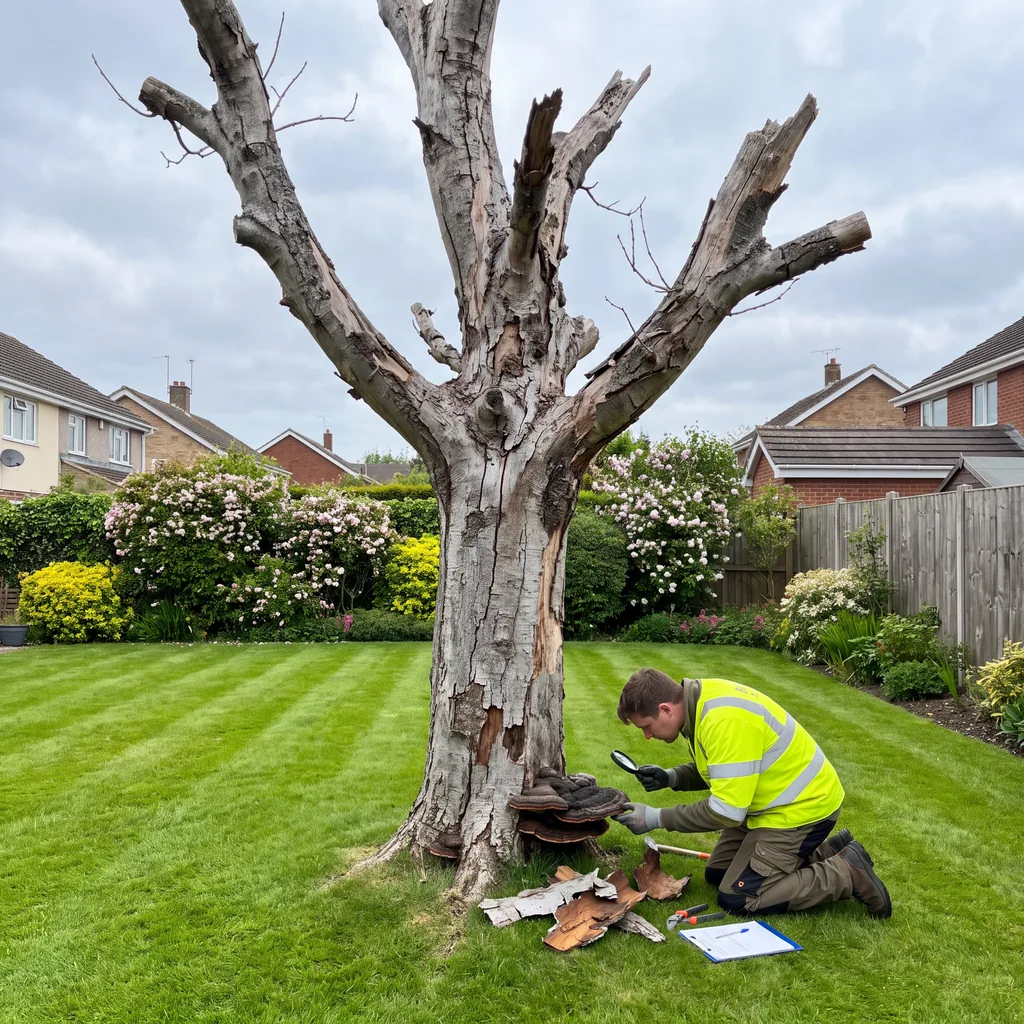
2. Look for the true kill signs: no leaves in full season, bark sloughing in sheets, fungal conks at the base (internal decay flag — see the disease diagnostic matrix), woodpecker excavation lines.
3. When it's ambiguous or the tree is valuable, buy a verdict: a certified arborist consultation ($75–$250) settles dead-vs-stressed, and a written report doubles as your insurance and permit documentation — many towns waive removal permits for documented dead trees, which in permit states like New Jersey also skips replacement-planting fees.
What Drives Your Dead Tree Quote
- Decay stage — the dominant variable, per the mechanics above.
- Targets below — house, fence, lines, play areas force rigged piece-down; an open-field dead tree can sometimes still be felled whole (cheap).
- Access — standard multipliers apply, but note dead trees near structures skip straight to bucket/crane methods.
- Stump & haul — same add-ons as any removal: stump grinding $100–$500, hauling $75–$500. Dead wood has no firewood-barter value if rot has set in, so wood-on-site discounts shrink.
- Count — beetle and EAB kills come in groups; multi-tree pricing discounts 15–25% per tree after the first.
DIY Warning: This Is the One You Don't Practice On
Felling a dead tree is chainsaw work at its most unforgiving: hinges crumble (the notch-and-back-cut method depends on live wood fiber), tops snap out backwards, and limbs release on vibration. The safe felling basics guide exists for healthy trees — its techniques explicitly degrade on dead ones. Small dead ornamental in open ground? Fine. Anything tall, near targets, or long-dead: this is precisely what insured professionals are for — verified per the contractor insurance checklist.
Frequently Asked Questions
How much does it cost to remove a dead tree?
Dead tree removal costs $150–$500 for small trees, $300–$1,200 for medium (30–60 ft), $700–$1,800 for large, and $1,200–$3,000+ for very large trees. Long-dead, brittle trees add 20–50% over those ranges because they can't be climbed or rigged normally, and same-day hazard response runs 2–3× standard rates.
Does it cost more to remove a dead tree than a living one?
Recently dead and structurally sound: only slightly more. Long-dead and brittle: substantially more — crews must use buckets or cranes instead of climbing, cut smaller sections, and rig slower. The price gap grows every year the tree stands, which is why early removal is the budget move.
Will insurance pay to remove a dead tree?
Almost never — standing dead tree removal is classified as owner maintenance. Worse, if the dead tree eventually falls and causes damage, the neglect exclusion can void that claim too. A dead tree near structures is effectively an uninsured liability until it's removed.
Who removes dead trees for free?
Utility companies remove trees threatening their lines, and some cities remove street trees or disease-program trees (EAB, oak wilt) at no cost. Private yard trees are rarely free — the full option list, including the wood-exchange reality check, is in the free tree removal guide.
How do I know if my tree is dead or just stressed?
Scratch test several limbs (green cambium = alive), check for full-season leaf absence, sloughing bark, and fungal conks at the base. When it's ambiguous — or the tree is big enough that removal costs four figures — a $75–$250 arborist consultation is the cheap way to be sure before you pay for a removal you might not need.
Methodology & Sources
Size-band ranges align this site's removal cost model with 2026 published market data (Angi, HomeGuide, This Old House surveys); decay-premium bands reflect the equipment substitutions (climb → bucket → crane) detailed in our height and crane guides.
Sources:
- ISA — hazard tree assessment resources — treesaregood.org
- USDA Forest Service — emerald ash borer and standing-dead hazards — fs.usda.gov
- OSHA — struck-by hazards in tree care — osha.gov
Related Cost Resources
Tree Removal Cost Calculator — Price your dead tree with hazard conditions applied.
Does Insurance Cover Tree Removal? — The neglect exclusion, in detail.
Arborist Cost Guide — The $150 consult that prevents wrong-tree removals.
Storm & Emergency Removal Costs — If it's already down or actively failing.
Crane-Assisted Removal Costs — Where long-dead trees near structures end up.
Stump Grinding Cost Guide — The stump that's left afterward.