
1. Introduction: The Silent Forest Threat
While physical storm damage and construction accidents cause immediate destruction, microbial tree pathogens are the leading cause of silent landscape death. In the United States, millions of mature shade trees are lost annually to fungal, bacterial, and insect-borne diseases that decay structural wood from the inside out.
For a homeowner, diagnosing these pathogens early is the difference between an inexpensive preventative treatment and a multi-thousand-dollar hazard felling bill. This manual provides a practical diagnostic checklist for identifying the most common fatal tree diseases.
---
2. Diagnostic Pathogen Reference Matrix
Use this guide to inspect your trees for target symptoms of major vascular and structural tree diseases:
| Disease Name | Target Host Trees | Primary Warning Symptoms | Biological Transmission Route |
|---|---|---|---|
| Oak Wilt (Bretziella fagacearum) | Red Oaks, White Oaks | Rapid summer leaf browning starting at leaf tips (bronzing), sudden canopy leaf drop within 4 weeks. | Sap-feeding beetles carrying spores, and shared underground root grafts. |
| Emerald Ash Borer (EAB) | All native Ash species | Canopy dieback from the top down, D-shaped exit holes in bark, serpentine larval tunnels under bark. | Wood-boring beetles (Agrilus planipennis) laying eggs in bark crevices. |
| Fungal Cankers (Nectria spp.) | Maples, Birches, Oaks | Sunken, discolored oval patches on branches and trunk, oozing sap, dead bark peeling back. | Fungal spores entering wounds made by storm breaks or un-sanitized pruning tools. |
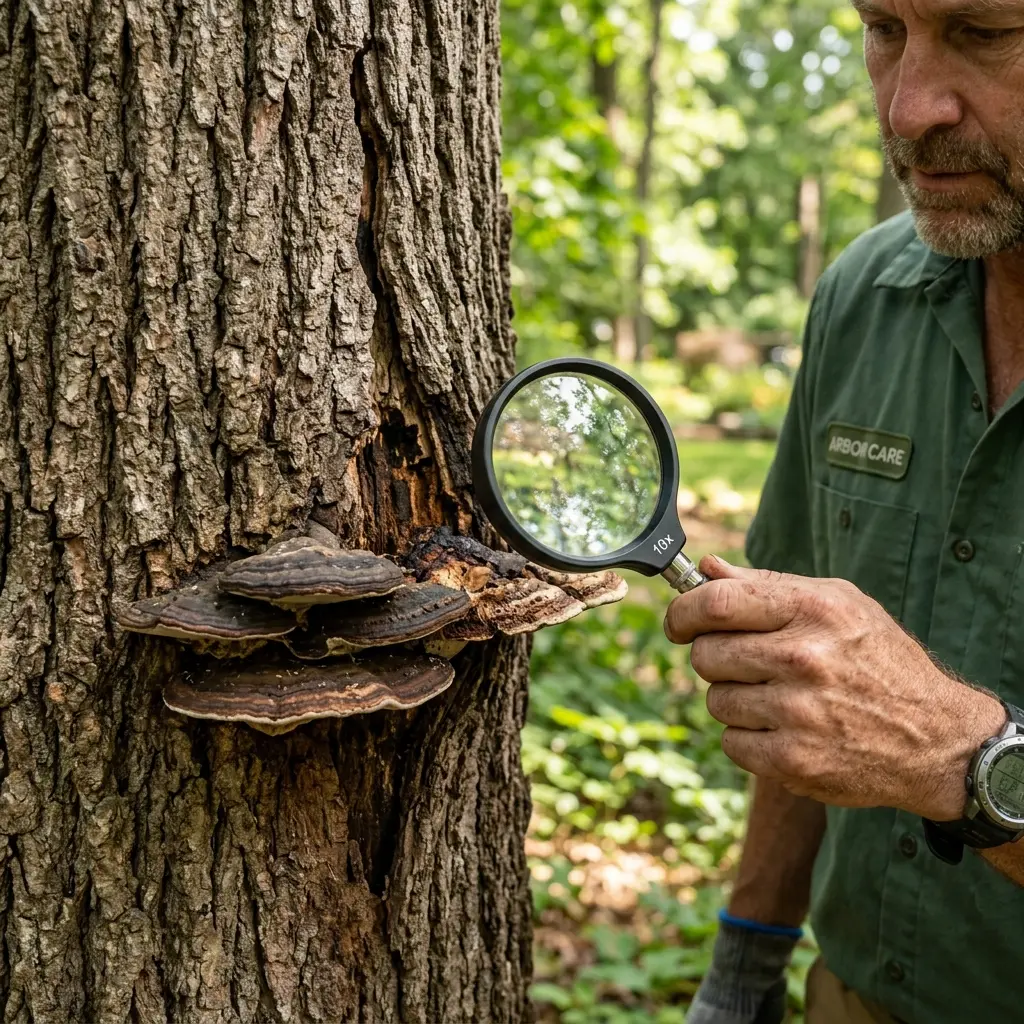
| Bracket Fungi (Conks) | All hardwood specimens | Large, shelf-like woody mushrooms growing at the base of the trunk or root flare. | Indicates advanced internal heartwood decay. The structural core of the tree is actively rotting. |
---
3. Deep Dive: The Threat of Oak Wilt
Oak Wilt is one of the most destructive tree diseases in North America, particularly devastating to the Red Oak group (which can die within 30 days of infection).
- The Root Graft Network: Oak trees of the same species growing within 50 feet of each other often graft their roots together underground, creating a shared vascular pipeline. Once a single oak is infected, the fungal pathogen moves rapidly through these root connections, killing entire rows of trees in a single season.
- Pruning Vulnerability: The fungus is also spread by sap-feeding nitidulid beetles. These beetles are attracted to fresh pruning cuts. Never prune oak trees during active spring months (April 1 to July 15). Pruning during this window leaves open wounds that act as beacons for spore-carrying beetles.
---
4. Active Systemic Treatment Protocols
If a disease is detected before it has claimed more than 30% of the tree's canopy, professional arborists can deploy targeted systemic interventions to isolate or cure the pathogen:
- Macro-Infusion of Fungicides: For high-value oaks threatened by Oak Wilt, arborists perform root flare macro-infusions of Propiconazole. This systemic fungicide is pumped directly into the tree's vascular system, suppressing the fungus for up to two years.
- Vibratory Plow Root Severing: To stop the underground spread of Oak Wilt, arborists use a heavy tractor with a 5-foot vibratory blade to physically slice and sever the grafted root connections between infected and healthy trees.
- Systemic Insecticide Injections: Ash trees threatened by EAB are treated with trunk micro-injections of Emamectin Benzoate every two years, which kills larval borers feeding under the bark.
- Pruning Hygiene Rules: Standard pruning saws can transmit pathogens between trees. Always sanitize your tools by spraying them with 70% Isopropyl Alcohol or a 10% bleach solution between cuts on different specimens.
---
5. What Does Tree Disease Diagnosis Cost?
Getting a professional answer is cheaper than most homeowners expect — and far cheaper than guessing wrong:
- ISA Certified Arborist site consultation: $75–$250 for a walk-through diagnosis of one or a few trees. Many tree services credit the fee against subsequent work — the full fee landscape (consults, reports, TRAQ, appraisals) is in the arborist cost guide.
- Formal written assessment (TRAQ risk rating): $150–$500 — needed when the finding supports an insurance claim, permit exemption for a hazardous tree, or a legal dispute.
- Lab pathology (state extension or private lab): $20–$150 per sample for definitive identification of pathogens like oak wilt — your county extension office is the budget route.
- Treatment, if caught early: $100–$600 per tree per cycle (fungicide macro-infusion or EAB trunk injection, typically every 2 years).
- Removal, if caught late: a dead or structurally decayed tree is priced as hazard work — commonly 20–50% above healthy-tree rates because dead wood is unpredictable to climb and rig. The full economics (size bands, decay premiums, the insurance-neglect trap) are in the dead tree removal cost guide; price your tree with the tree removal cost calculator.
The economics are lopsided: a $150 diagnosis that catches oak wilt one season early can save a $2,000+ removal — and in a root-grafted oak row, several of them.
---
6. Six More Diseases Worth Recognising
The matrix above covers the highest-impact pathogens. These are the next tier, and several are commonly misdiagnosed as something harmless.
| Disease | Hosts | What you see | Prognosis |
|---|---|---|---|
| Dutch Elm Disease | American and European elms | Flagging — one branch yellows and wilts while the rest stays green; brown streaking under the bark | Poor once symptoms are visible; sanitation felling protects neighbours |
| Armillaria root rot | Most hardwoods and conifers | Honey-coloured mushroom clusters at the base in autumn; white mycelial fans under bark at the root collar | Structurally serious — the root plate is being consumed, so failure risk rises before the canopy looks bad |
| Phytophthora root rot | Oak, maple, dogwood, rhododendron | Thinning canopy, undersized pale leaves, dark oozing lesions at the root collar | Often traced to over-irrigation or grade changes; correctable early, fatal late |
| Anthracnose | Sycamore, ash, maple, dogwood | Irregular brown blotches following leaf veins, early leaf drop in wet springs | Rarely fatal; unsightly and repeated defoliation weakens the tree over years |
| Verticillium wilt | Maple, ash, catalpa, redbud | Sudden one-sided branch wilt, olive-green streaking in the sapwood | No cure; some trees compartmentalise it and live for years with pruning and care |
| Hypoxylon canker | Stressed oaks | Bark sloughing to reveal a silver-grey then black crust underneath | Terminal, and a reliable indicator the tree was already drought-stressed |
Two patterns are worth internalising. Mushrooms at the base are never cosmetic — fruiting bodies mean the decay is advanced enough to reproduce, and the structural question is now more urgent than the health question. And one-sided wilt in an otherwise healthy canopy points to a vascular pathogen rather than a watering problem, which is the opposite of most homeowners' first instinct.
---
7. A Seasonal Inspection Routine
Most diseases announce themselves in a specific season, and a tree inspected only in high summer hides several of them.
Late winter, no leaves. The best time to read structure. Look for cankers, bark cracks, dead limbs, included bark in branch unions, and old pruning wounds that have not sealed. Without foliage the trunk and scaffold branches are fully visible.
Spring, as leaves emerge. Note anything that leafs out late, sparsely, or not at all compared with the rest of the canopy or with the same species nearby. Delayed leaf-out is one of the earliest vascular disease signals available.
Early summer. Peak oak wilt season. Watch red oaks for bronzing that starts at leaf tips and progresses inward, and for rapid leaf drop of green-and-brown leaves. This is also when to check ash for canopy thinning at the very top.
Late summer into autumn. Fungal fruiting season — walk the root flare and lower trunk of every mature tree looking for conks and mushroom clusters. Distinguish genuinely early autumn colour on one branch from seasonal change across the whole canopy; the former is a symptom.
After every significant storm. Fresh wounds are infection courts. Look for torn bark, broken stubs, and root plate movement, and get large wounds cleaned up promptly.
---
8. Taking a Sample That the Lab Can Actually Use
A lab diagnosis costs $20 to $150 and is the only way to be certain, but most rejected samples are rejected for the same avoidable reasons.
- Sample the transition zone, not the dead part. The pathogen is active where diseased tissue meets healthy tissue. Wood that has been dead for months is colonised by secondary organisms and tells the lab nothing.
- Take a branch section 6 to 12 inches long and at least half an inch in diameter, including that transition. For root problems, take root sections with soil attached.
- Wrap in dry paper, never plastic alone. Sealed plastic grows mould in transit and destroys the sample. Paper inside a bag is right.
- Keep it cool and ship it fast — same or next day, and avoid a weekend in a warehouse.
- Include the context the lab needs: species, tree age and size, when symptoms appeared, how they progressed, recent construction, grade changes, irrigation changes, and any chemicals applied nearby.
Your county extension office is almost always the cheapest route and often subsidised. Search for your state's plant diagnostic clinic before paying a commercial lab.
---
9. Treat or Remove: How the Decision Is Actually Made
Arborists work through four questions in order, and the answers are usually clearer than homeowners expect.
1. How much canopy is already gone? Below about 30% dieback, treatment is generally worth attempting. Above 50%, the tree rarely recovers regardless of spend, because the remaining foliage cannot support the root system it needs.
2. Is the problem structural or physiological? A leaf disease weakens a tree slowly. Root and butt rot — armillaria, advanced Phytophthora, basal conks — attack the part holding it upright. A tree can look healthy in canopy and still be a failure risk, which is why root-collar decay generally overrides everything else in the decision.
3. What does it threaten? The same decayed oak is a monitoring case in the middle of a paddock and an urgent removal over a driveway. Risk is hazard multiplied by target, and the target is what usually drives the answer.
4. Do the numbers work? Treatment is recurring — typically $100 to $600 per tree every two years, indefinitely. Removal is once. For a young or replaceable tree the arithmetic often favours removal and replanting; for a mature specimen whose appraised value runs into five figures, years of treatment are cheap by comparison. Our specimen tree valuation guide covers how that value is established.
Where the answer is removal, price it with the tree removal cost calculator and expect a premium over healthy-tree rates — decayed wood is unpredictable to climb and rig, as the dead tree removal cost guide explains.
---
10. Prevention Is Where the Money Is
Nearly every fatal tree disease arrives through a wound or takes hold in a tree already weakened by something the owner controlled.
- Prune in the right season. Never prune oaks between April 1 and July 15 in oak wilt regions. Late winter is correct for most species.
- Sanitise between trees. 70% isopropyl alcohol or a 10% bleach solution on blades between specimens. Pruning saws are an efficient way to move pathogens around a garden.
- Protect the root zone. Most mature tree decline traces to construction — trenching, regrading, or driving equipment over roots. Damage appears two to five years later, long after anyone connects the two.
- Do not volcano-mulch. Mulch piled against the trunk holds moisture against bark and creates ideal conditions for collar rot. Mulch goes in a flat ring, never touching the trunk.
- Water deeply and infrequently. Frequent shallow watering encourages surface roots and Phytophthora. Drought stress is the precondition for hypoxylon canker.
- Do not move firewood. This is how emerald ash borer crossed the continent. Buy firewood where you burn it.
The economics stay lopsided at every stage: a correctly timed pruning cut costs nothing, a $150 diagnosis catches oak wilt a season early, and a removal after the fact costs thousands — several times over in a root-grafted oak row.