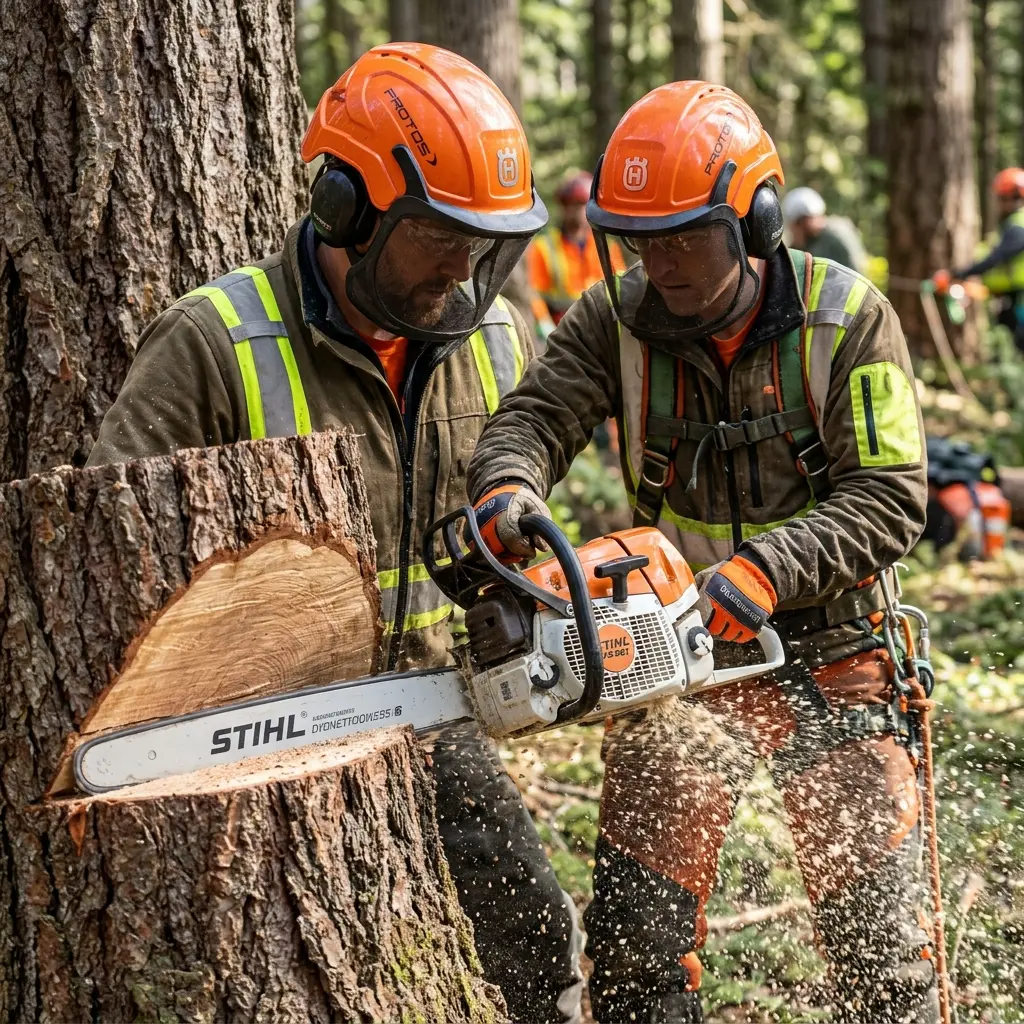

1. Introduction: The Physics of Felling
To a bystander, dropping a mature tree looks like a simple application of brute force: cut a wedge, slice the back, and let gravity do the rest. In professional forestry and tree care, however, tree felling is a precise engineering task.
Arborists utilize trunk dynamics, wind speed coefficients, canopy weight distribution, and wood biology to dictate the exact landing path of a falling timber column. This manual introduces the foundational mechanics of directional felling so homeowners can understand how professionals operate safely.
---
2. The 3 Primary Cuts of a Directional Fall
Controlled tree felling requires three distinct cuts in the trunk to create a natural, temporary mechanical hinge that guides the tree to the forest floor.
A. The Face Notch
The Face Notch is the wedge-shaped cut made on the side of the trunk facing the desired landing direction. It dictates when and where the tree starts its descent. Modern arboriculture utilizes three primary notch variations:
- Open-Face Notch (70° to 90° Wedge): The modern arborist standard. It allows the tree to fall completely to the ground before the notch closes and the hinge breaks, providing the highest degree of directional control.
- Conventional Notch (45° Wedge): The classic forestry cut. The notch closes when the tree has fallen only halfway, causing the hinge to break prematurely while the tree is still in mid-air.
- Humboldt Notch (45° Wedge with Flat Top): Favored in steep timber logging. The flat slope is cut on the bottom, maximizing the usable log length of the trunk.
B. The Hinge Wood
The Hinge Wood is the thin, horizontal band of wood fibers left uncut between the back of the face notch and the final back cut. It acts exactly like a door hinge, guiding the tree down along a single linear plane and preventing it from slipping sideways or twisting off the stump.
If a tree has a 20-inch diameter at the cut line, the arborist will preserve exactly 2 inches (10%) of solid, uncut hinge wood to maintain steering control.
C. The Back Cut
The Back Cut is the final horizontal cut made from the opposite side of the tree, slicing inward toward the hinge wood. It must be cut slightly higher (typically 1 to 2 inches) than the flat floor of the face notch. This slight step-up acts as a physical block, preventing the falling tree from kicking backward off the stump onto the chainsaw operator.
---
3. Hazard Assessment: Identifying Structural Failures
Before any steel touches wood, a professional arborist conducts a rigorous 5-Point Felling Plan to evaluate hazard conditions:
- Assess Natural Lean: Arborists use a plumb bob or visual sighting to calculate the tree's natural leaning axis. If the tree leans heavily to the north, felling it to the south requires advanced wedge driving or block-and-tackle tension lines.
- Check Canopy Weight Distribution: Trees rarely have symmetric canopies. A heavy branch cluster on one side will pull the tree off-target if the hinge is cut too thin.
- Identify Frictional Wind Loads: High winds can easily override a wood hinge, catching the canopy like a sail and blowing the tree onto adjacent structures. Felling operations are immediately suspended if wind gusts exceed 15 mph.
- Detect Internal Heartwood Decay: Arborists tap the trunk with a sounding mallet or use a micro-drill (resistograph) to detect hollow pockets. A hollow trunk lacks the structural wood fibers needed to form a strong hinge, making the fall highly unpredictable.
---
4. The 45-Degree Escape Path Protocol
The moment the tree begins to tip and the hinge wood activates, the chainsaw operator shuts off the tool's chain brake and immediately retreats along a pre-cleared Escape Path.
- The Danger Zone: The area directly behind the tree (180 degrees opposite the fall path) is highly dangerous due to potential trunk kickbacks.
- The Safest Retribution Corridor: The designated escape paths must extend backward at a 45-degree angle relative to the felling path on both sides. The path must be cleared of all brush, logs, and tools prior to the cut, ensuring a flat, unobstructed egress.
---
5. Wedges and Pull Lines: Overcoming a Bad Lean
The hinge steers a tree; it does not lift one. When a tree leans away from where it needs to go, the arborist has to add force, and there are two ways to do it.
Felling wedges are plastic or aluminium tapers driven into the back cut behind the saw bar. Each wedge lifts the trunk fractionally, shifting the centre of gravity toward the notch. Stacked wedges can overcome a modest back-lean on the order of a few degrees on a mid-size tree. Plastic is used deliberately — steel wedges destroy saw chain if the bar contacts them.
Pull lines apply force at height. A rope is set high in the canopy, run to an anchor well outside the fall zone, and tensioned with a rope puller, winch, or vehicle. Because leverage scales with height, a line set at 40 feet does dramatically more work than the same force applied at the stump. This is how a tree leaning toward a house is brought down away from it.
The rule that governs both: force is applied before the back cut is completed, never after. Once the hinge is thin, the tree is already deciding where it is going, and a crew scrambling to add tension at that point has lost control of the operation.
---
6. How Fellings Fail
Almost every serious felling accident is one of five failures, and each has a specific cause.
| Failure mode | What happens | Root cause |
|---|---|---|
| Barber chair | The trunk splits vertically upward and the butt kicks violently backward and up | Back cut made too fast on a heavily leaning tree, with no bore cut or strap to control release |
| Hinge blowout | The hinge snaps early; the tree rotates off the stump unguided | Hinge cut too thin, cut unevenly, or placed in decayed wood |
| Kickback off the stump | The butt jumps backward toward the operator | Back cut placed level with or below the notch floor instead of 1–2 in above it |
| Widow-maker drop | A dead limb lodged in the canopy falls during cutting | Canopy not inspected from a distance before the cut |
| Hang-up | The tree falls into a neighbouring tree and stops, fully loaded | Fall path not cleared to the full height of the tree plus margin |
The barber chair is the one that kills people. It develops in under a second, sends the trunk up and back through the space the operator occupies, and is essentially unsurvivable at close range. It is also entirely preventable with a bore cut, which is why heavily leaning trees are a professional job rather than a technique to practise on.
A hang-up is the failure most likely to tempt a homeowner into a fatal second mistake. A tree suspended in another tree is a loaded spring with an unpredictable release point. The correct response is a winch from outside the zone. The incorrect responses — climbing the leaning tree, cutting the supporting tree, cutting the hung tree into sections from below — account for a grim share of annual fatalities.
---
7. When to Stop and Call a Professional
This section is the practical point of the article. Felling is a skill, and the honest threshold for a homeowner is lower than most people assume.
Do not fell it yourself if any of the following is true:
- The tree is within its own height plus 20% of a house, garage, shed, fence, vehicle, pool, or septic field.
- Any part of the tree is within 10 feet of a power line — this is a utility or line-clearance job, full stop, and contact is usually fatal.
- The trunk is dead, hollow, fungal, or sounds hollow when struck. Decayed wood cannot form a reliable hinge, which is why hazard trees are priced above healthy ones in the dead tree removal cost guide.
- The tree leans significantly toward where it must not go, or the canopy is badly asymmetric.
- Any cut would be made above shoulder height, from a ladder, or off the ground.
- The trunk is larger in diameter than your saw bar is long, requiring cuts you cannot see the far side of.
- Wind gusts exceed 15 mph, or are forecast to during the operation.
- You would be working alone.
A single reasonable case remains: a small, healthy, straight tree under about 20 feet, leaning gently toward open ground, with a clear fall zone of its full height in every direction, felled with a helper present and a phone in your pocket.
Everything else is a professional job. Price it with the tree removal cost calculator, and check what a proper quote should itemise in the estimates guide.
---
8. The Liability Side
The physics are only half the risk. If a tree you fell yourself lands on a neighbour's property, their fence, or their car, your homeowner's policy may treat it as an intentional act rather than an accident, and intentional acts are commonly excluded. If it lands on a person, you face personal liability with no professional carrier behind you.
Two further exposures catch homeowners out. Many municipalities require a permit to remove a mature tree, and removing one without it carries fines that scale with trunk diameter — see the permit rules by city. And if the tree straddles a boundary or overhangs a neighbour's land, timber trespass statutes in most states award double or treble the tree's appraised value to the neighbour, a figure calculated the way our specimen tree valuation guide describes.
A professional crew carries general liability and workers' compensation precisely so that these outcomes are their insurer's problem rather than yours. Verifying that coverage is a four-minute phone call, described in the tree service insurance guide.
Frequently Asked Questions About Tree Felling
What is the hinge and why does it matter?
The hinge is the band of uncut wood left between the face notch and the back cut. It works like a door hinge, steering the tree along one plane as it falls. Cut it too thin and it snaps early, leaving the tree unguided; cut it unevenly and the tree rotates toward the thicker side.
How thick should the hinge be?
Roughly 10% of the trunk diameter at the cut, running about 80% of the trunk's width. On a 20-inch trunk that is about 2 inches of solid, uncut wood. Decayed wood does not count toward that measurement.
Why must the back cut be above the notch?
The 1–2 inch step creates a physical stop that prevents the trunk sliding backward off the stump toward the operator. A back cut level with or below the notch floor removes that stop.
What is a barber chair?
A vertical split up the trunk that throws the butt upward and backward, usually toward the operator. It is caused by cutting the back of a heavily leaning tree too quickly, and it is the most lethal common felling failure.
How far away should I stand when a tree falls?
Retreat along a pre-cleared path at 45 degrees behind the fall line, at least 15 feet, and keep watching the canopy. The area directly opposite the fall direction is the most dangerous place to be.
Can I fell a tree near a power line myself?
No. Any tree within 10 feet of a conductor is line-clearance work requiring specialised training and utility coordination. Electricity arcs — contact is not required for a fatality.