
Quick Answer
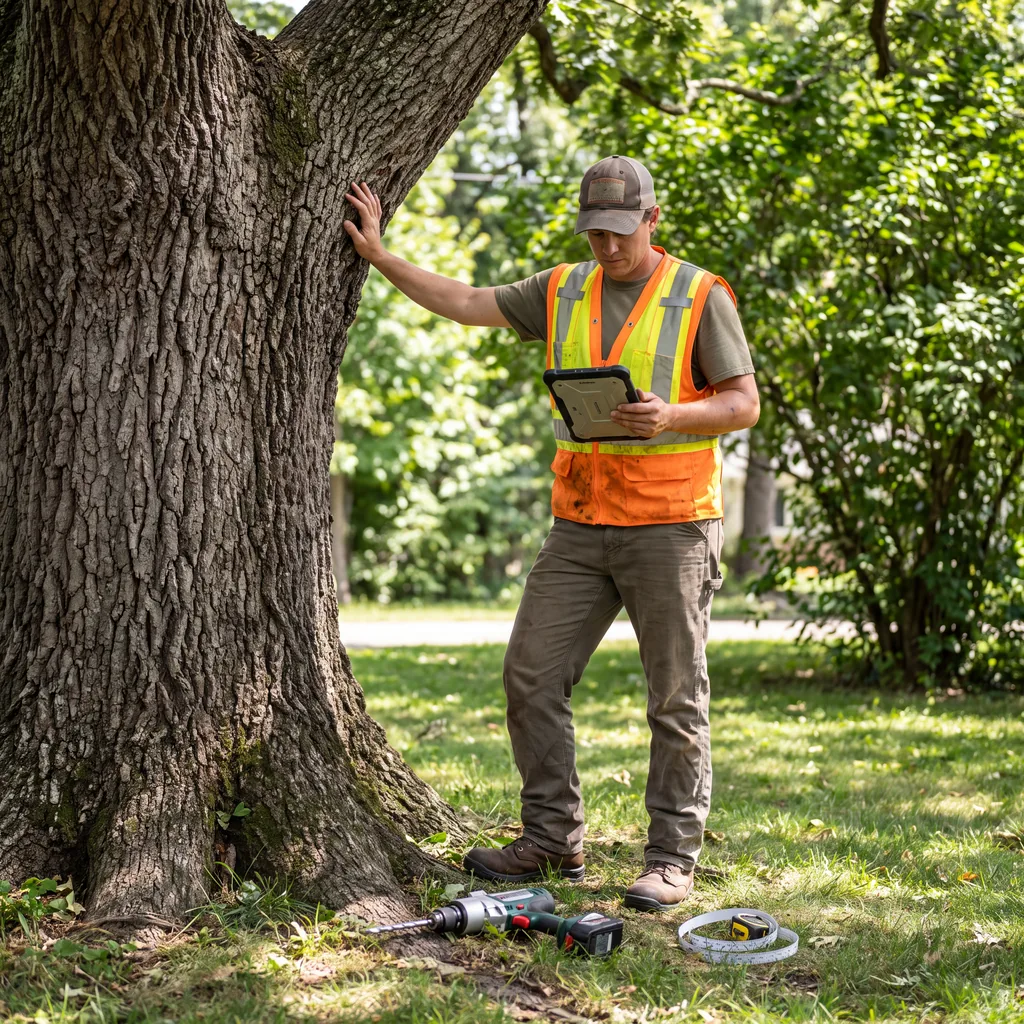
Hiring an arborist costs $75–$250 per hour for a consultation (most site visits land at $150–$300 flat), $150–$450 per tree for a written report, and $250–$1,500+ for a formal tree risk assessment. The service tiers are not interchangeable — a permit office, an insurance adjuster, and a court each demand a different document. This hub maps every tier to its use-case so you buy exactly the paper you need. One framing rule up front: an arborist sells judgment; a tree service sells removals. The free "estimate" from a removal crew is a sales visit — genuinely useful for pricing (sanity-check it against the tree removal cost calculator), but it is not an independent opinion about whether the tree needs to come down at all.
The Four Service Tiers (and When You Need Each)
| Service | Typical cost | What you get | When you need it |
|---|---|---|---|
| Verbal consultation / site walk | $75–$250/hr (common flat: $150–$300) | Diagnosis, save-vs-remove opinion, care plan | "Is this tree dead/sick/dangerous?" decisions |
| Written arborist report | $150–$450 per tree ($450–$700+ multi-tree/site) | Documented findings, photos, recommendations | Permit applications & exemptions, insurance files, HOA disputes |
| Tree risk assessment (TRAQ) | $250–$1,500+ | Standardized risk rating (likelihood × consequence), mitigation options | Liability decisions, pre-storm audits, trees over targets |
| Formal appraisal (CTLA) | $300–$800+ | Defensible dollar value for the tree | Insurance claims, lawsuits, treble-damage cases |
Bulk pricing exists at the top tier: development and multi-tree assessments commonly run $15–$50 per tree in volume (e.g., ~$35/tree at 10 trees, ~$25 at 50+), which matters if you're assessing a wooded lot before clearing it.
The Credential Decoder (Who Is Actually an "Arborist"?)
"Arborist" is legally unprotected in most states — anyone with a chainsaw can print it on a truck. The credentials that mean something:
- ISA Certified Arborist (CA) — the baseline professional credential: passed exam, continuing education, verifiable in the ISA directory. Minimum bar for paid advice.
- ISA TRAQ qualification — Tree Risk Assessment Qualified: trained in the standardized risk methodology. Required for a risk rating an insurer or lawyer will respect.
- ASCA Registered Consulting Arborist (RCA) — the expert-witness tier: forensic reports, appraisals, litigation. Costs more ($150–$300+/hr) and is what courts expect.
- Board Certified Master Arborist (BCMA) — ISA's top credential; overkill for a sick maple, right for complex or high-value cases.
- State licenses — a few states license the profession itself; in New Jersey, tree work legally requires a Licensed Tree Expert (LTE) — details in the NJ cost guide.
Verification takes two minutes: ISA and ASCA both run public directories. A "certified arborist" not in either is a red flag with foliage.
When the $150 Visit Pays for Itself (Three Worked Cases)
Case 1 — The permit exemption. Your town requires removal permits with replacement fees, but exempts documented dead/hazardous trees. A $150–$450 arborist letter converts a permit + replacement-planting bill (often $300–$1,000+ in ordinance towns) into a fee-waived removal. This is now the standard play in New Jersey and similar regimes.
Case 2 — The insurance file. After storm damage, the adjuster's first question is whether the tree was healthy (covered peril) or neglected (excluded). A pre-storm report — or a post-storm cause-of-failure letter ($200–$500) — is the difference-maker documented in our insurance guide. For the tree's value, the casualty-loss deduction and any lawsuit both run on a formal appraisal.
Case 3 — The wrong-verdict save. A removal crew quotes $1,800 to take down a "dying" oak that an independent consult identifies as drought-stressed and treatable for $300. Reverse case: the crew calls a decayed trunk "fine to leave" because they're busy — a dead-tree call an assessment would have flagged. Either direction, $150 of independent judgment repriced a four-figure decision.
Arborist vs. Tree Service vs. Free Estimate (Know What You're Buying)
- Free tree-service estimate = a price for work they'd like to perform. Collect three (the estimates guide shows how to force comparability), but understand the incentive.
- Paid arborist consultation = an opinion with no removal revenue attached. Worth paying for exactly when the question is whether, not how much.
- The clean sequence for a big decision: consult first ($150–$300) → verdict → then bid the work among insured crews with the calculator as your baseline. Some firms credit the consult fee against later work — ask.
- Treatment economics: if the verdict is "treatable," expect $100–$600 per tree per treatment cycle (systemic injections run ~2-year cycles) — the full disease-side economics are in the tree disease guide.
What Moves Arborist Pricing
Travel radius (rural call-outs add $50–$150), tree count (volume discounts kick in fast), documentation depth (photos + measurements + methodology cost more than a verbal), urgency (post-storm assessment queues run long and some firms surge), and credential tier (an RCA's forensic report bills 2–3× a CA's site letter — buy the tier the audience of the document requires, not the fanciest one).
Frequently Asked Questions
How much does an arborist cost?
Arborists charge $75–$250 per hour, with typical flat-rate site consultations at $150–$300. Written reports run $150–$450 per tree, formal TRAQ risk assessments $250–$1,500+ depending on tree count and documentation depth, and CTLA appraisals for insurance or legal use $300–$800+.
How much does an arborist report cost?
A single-tree written report costs $150–$450; multi-tree or development-site reports run $450–$700+, with volume pricing of $15–$50 per tree on larger inventories. Insurance-grade cause-of-failure letters typically land at $200–$500.
Is an arborist consultation worth it?
When the question is whether a tree is dead, dangerous, or saveable — yes, disproportionately. The consult fee is 5–20% of a typical removal price and routinely reverses wrong verdicts in both directions (unnecessary removals and missed hazards). It's the only opinion in the transaction with no removal revenue behind it.
What's the difference between an arborist and a tree service?
A tree service performs work (cutting, trimming, removal) and gives free estimates priced to win that work. An arborist sells assessment and diagnosis — paid, independent, and documented. Big decisions use both, in order: arborist verdict first, then competitive bids from insured crews.
Do I need a certified arborist to remove a tree?
For the removal itself, most states require insurance and business licensing rather than arborist certification (New Jersey's LTE/LTCO licensing is a notable exception). Where a certified arborist becomes necessary is the paperwork around removal: permit-exemption letters, hazard documentation, insurance reports, and appraisals.
Methodology & Sources
Fee ranges synthesized from 2026 published pricing surveys and professional-side rate guides, mapped against the four documentation tiers (consult / report / TRAQ / appraisal) as defined by ISA and ASCA practice standards.
Sources:
- ISA — credential directory and TRAQ program — treesaregood.org
- ASCA — Registered Consulting Arborist directory — asca-consultants.org
- CTLA — Guide for Plant Appraisal (appraisal tier) — via ISA/ASCA
Related Cost Resources
Tree Removal Cost Calculator — The baseline every free estimate gets checked against.
Trunk Formula Method Calculator — Preview the appraisal number before commissioning one.
Tree Disease & Diagnosis Guide — The diagnosis-side costs an arborist visit unlocks.
Dead Tree Removal Cost — The verdict that changes the removal price.
Does Insurance Cover Tree Removal? — Where arborist letters win claims.
Contractor Insurance Verification — Vetting the crew after the arborist's verdict.