
Quick Answer
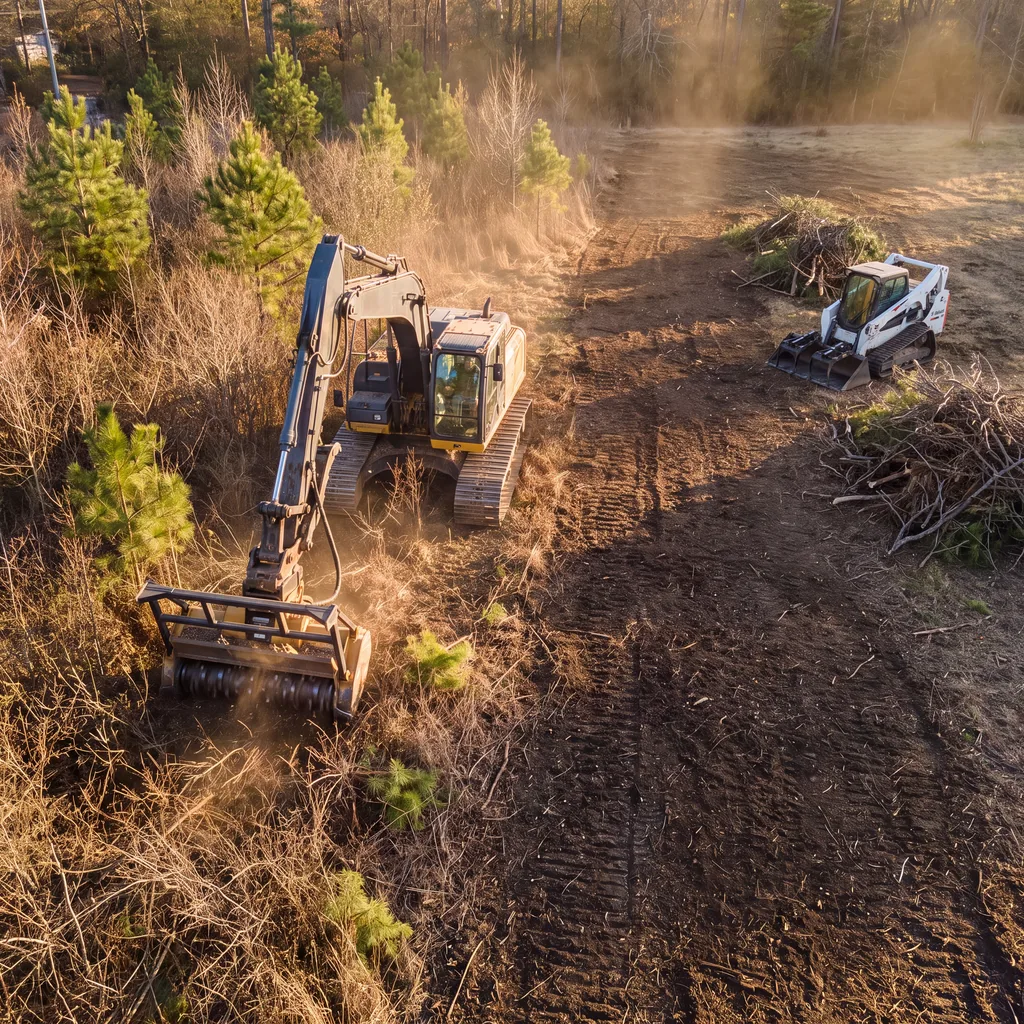
Land clearing costs $1,200–$3,500 per acre for lightly wooded ground and $3,400–$6,200+ per acre for heavy woods with large trees; brush-only clearing runs $600–$1,300 per acre. Residential lots scale down but hit job minimums around $1,000: a quarter-acre clears for $1,200–$5,000 and a half-acre for $2,000–$7,500 depending on density. Critically, "cleared" usually means vegetation dropped and hauled — stumps, grading, and permits are separate line items that can add 30–60%. If your project is really 3–6 individual trees rather than continuous vegetation, per-tree pricing is cheaper — run it through the tree removal cost calculator before accepting an acreage quote.
Land Clearing Cost Per Acre (2026)
| Vegetation density | Cost per acre | What the crew is dealing with |
|---|---|---|
| Grass/light brush (mow-down) | $600–$1,300 | Forestry mower passes, no trees |
| Light woods (saplings, few small trees) | $1,200–$3,500 | Mulcher + occasional saw work |
| Moderate woods (mixed mid-size trees) | $2,500–$4,500 | Excavator + mulcher + haul trucks |
| Heavy woods (dense, large trees) | $3,400–$6,200+ | Full crew, big iron, serious hauling |
| Extreme (old growth, slopes, wet ground) | $5,000–$8,000+ | Specialized equipment, staged work |
Residential Lot Clearing Cost (Fractional Acres)
Most homeowners aren't clearing farmland — they're clearing a building lot, a backyard expansion, or a fire-break. Fractional pricing:
| Lot size | Light vegetation | Moderate | Heavily wooded |
|---|---|---|---|
| 1/4 acre | $1,200–$2,000 | $2,000–$3,500 | $3,500–$5,000 |
| 1/2 acre | $2,000–$3,500 | $3,500–$5,500 | $5,500–$7,500 |
| Full acre | $1,200–$3,500 | $2,500–$4,500 | $3,400–$6,200+ |
Note the per-acre rate rises as lots shrink: mobilizing an excavator costs the same for a quarter-acre as for five acres, so small jobs carry the fixed cost on fewer square feet — the same mobilization-floor logic as stump grinding minimums.
Per-Tree or Per-Acre? The Break-Even Nobody Explains
This is the decision that saves (or wastes) four figures, and no ranking cost guide runs it:
- Count the removable trees. If your "clearing" project is actually 1–5 distinct trees with lawn between them, per-tree removal pricing wins — price each through the calculator and see the height guide for what each band costs.
- 6+ trees plus underbrush on continuous ground flips the math: a mulcher-equipped clearing crew prices the area, not the stems, and beats the sum of individual removals — often dramatically for small-diameter woods.
- Worked example: eight 25-ft scrub trees + brush on a quarter acre. Per-tree: 8 × $250–$500 + brush work = $2,400–$4,500. Clearing crew: $2,000–$3,500 moderate-density lot rate — and the brush is included.
- The hybrid case: a wooded lot with 2–3 large hardwoods. Clearing crews price big trees poorly (their mulchers max out around 8–12" diameter). Standard play: individual removal of the big stems first, then area-clear the rest.
What "Cleared" Includes — and the 30–60% It Doesn't
Every clearing dispute starts with this table not being in the contract:
| Line item | Typically included? | If separate, expect |
|---|---|---|
| Felling/mulching vegetation | Yes | — |
| Brush hauling or on-site mulch | Usually | $75–$500+ |
| Stump grinding/removal | Usually NOT | $100–$400 per stump, or $150–$400/hr excavator |
| Root raking | No | $500–$1,500/acre |
| Rough grading | No | $500–$2,500/acre |
| Erosion control / silt fence | No | $1–$3 per linear ft |
| Permits & tree-ordinance fees | No | Varies by town — see below |
Stumps are the classic gap: a "cleared" acre can still contain 40 stumps. If the land is headed for construction or lawn, specify grind or extract, with depth, in writing — use the estimate template so every bid itemizes the same way.
Permits: Clearing Is Regulated Harder Than Single Removals
Single-tree rules scale up fast when you clear: many municipalities require clearing permits above a threshold area or tree count, wetland and steep-slope reviews, and tree-replacement or fee-in-lieu payments per removed tree. In ordinance states this bites hard — New Jersey's statewide tree removal/replacement ordinance regime applies per tree, which can add real money to a wooded-lot clear. Two universal rules: call the zoning office with your parcel number before signing anything, and make the contract name who files and who pays fines. Erosion-control requirements (silt fencing, stabilization) are commonly triggered above disturbance thresholds even on private land.
How Crews Actually Price It (Read Your Quote Like an Estimator)
Clearing quotes are built from: mobilization ($500–$2,000 for heavy equipment transport), machine-hours (forestry mulcher $150–$400/hr; excavator + operator $100–$300/hr), hauling (truckloads × dump fees), and disposal rules (burn permits where legal save hauling; chip-on-site is cheapest). Day-rate sanity check: a mulcher crew clearing light woods covers 1–2 acres/day — if the quote implies four mulcher-days for a half acre of saplings, ask why. Multi-acre jobs should show a declining per-acre rate; if acre five costs the same as acre one, the mobilization isn't being amortized in your favor.
Frequently Asked Questions
How much does land clearing cost per acre?
Land clearing costs $600–$1,300 per acre for brush-only work, $1,200–$3,500 for lightly wooded ground, and $3,400–$6,200+ per acre for heavily wooded land with large trees. Stump removal, root raking, and grading are typically separate and can add 30–60% to reach build-ready condition.
How much does it cost to clear a half-acre lot?
A half-acre clears for $2,000–$3,500 with light vegetation, $3,500–$5,500 moderately wooded, and $5,500–$7,500 heavily wooded. Small lots carry a higher per-acre rate because equipment mobilization is a fixed cost, and most crews hold a job minimum around $1,000.
Is it cheaper to clear trees individually or clear the whole lot?
Count the stems: 1–5 distinct trees with open ground between them favors per-tree removal pricing; six or more trees plus continuous underbrush favors an area-clearing crew with a forestry mulcher. Lots with a few large hardwoods among small growth are usually priced hybrid — big stems individually, the rest by area.
Does land clearing include stump removal?
Usually not — "cleared" typically means standing vegetation dropped and hauled, with stumps left at grade. Stump grinding runs $100–$400 per stump or hourly for excavator extraction. If the ground is headed for construction or lawn, put stump disposition and depth in the written scope.
Do I need a permit to clear my land?
Very often, yes — clearing triggers rules single removals don't: area/tree-count thresholds, wetland and slope reviews, erosion-control requirements, and per-tree replacement fees in ordinance states. Call your zoning office with the parcel number before signing, and make the contract assign permit responsibility by name.
Methodology & Sources
Acreage bands synthesized from 2026 market surveys (Angi, HomeGuide, LawnStarter, LawnLove) and equipment-rate math (mulcher/excavator machine-hours + mobilization), cross-checked against this site's per-tree model for the break-even analysis.
Sources:
- USDA NRCS — land clearing and erosion-control practice standards — nrcs.usda.gov
- State forestry agencies — burn permit and debris rules
- TCIA — safety standards for felling and heavy equipment — tcia.org
Related Cost Resources
Tree Removal Cost Calculator — Price the per-tree side of the break-even.
Tree Removal Cost by Height — What each large stem costs individually.
Stump Grinding Cost Guide — The 40 stumps your "cleared" acre still contains.
Stump Grinder Rental vs. Hiring — DIY math for multi-stump lots.
Tree Removal Estimate Template — Force every clearing bid into the same line items.
Tree Removal Cost by State — Regional multipliers that apply to clearing labor too.