
Quick Answer
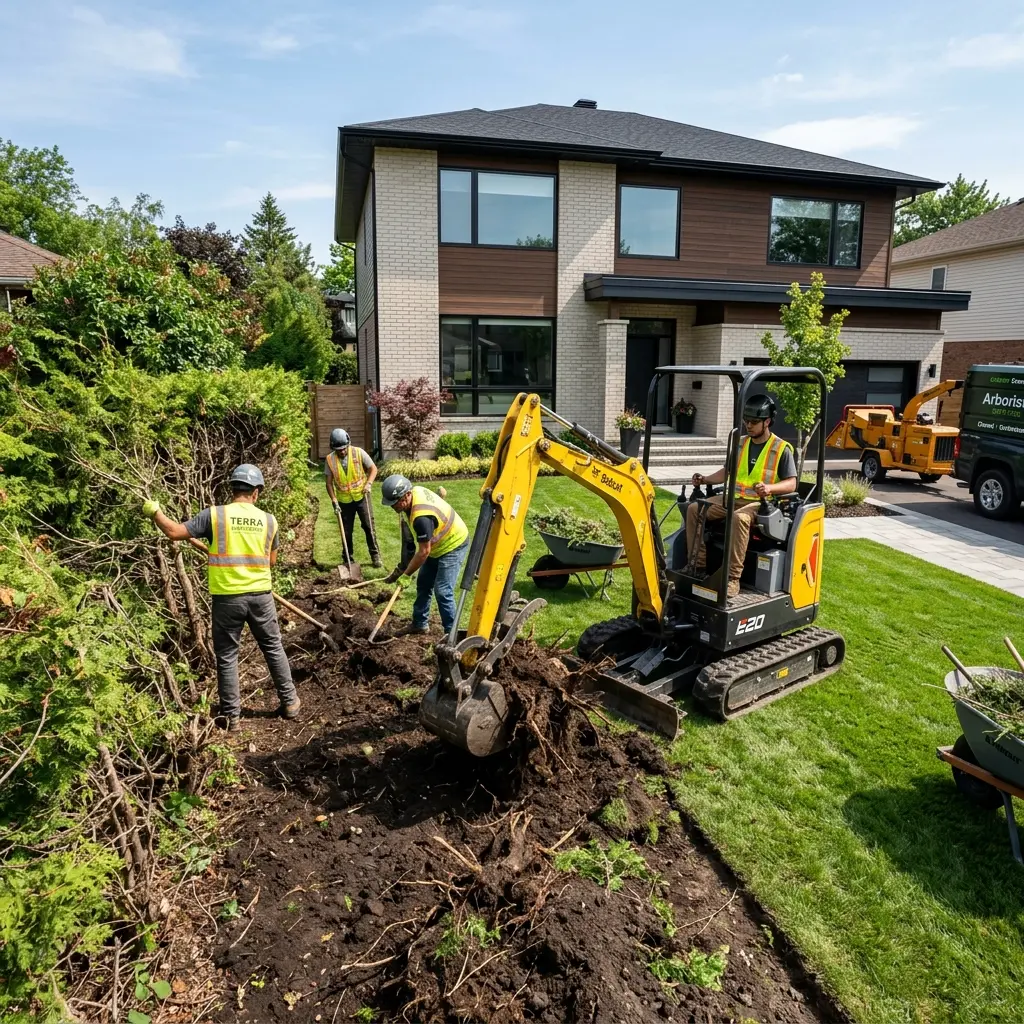
Hedge removal costs $10–$50 per linear foot for standard jobs. Shrub removal costs $25–$300+ per plant depending on size and root extraction. The critical cost divider is cut-to-grade ($10–$25/ft) vs. full root extraction ($25–$50/ft). Species like Privet, Yew, and Holly must have roots removed or they will aggressively resprout. Use the Shrub & Hedge Removal Cost Calculator above for an instant estimate.
Average Hedge Removal Cost by Linear Foot (2026)
| Hedge Height & Type | Cut-to-Grade (per linear ft) | Full Root Extraction (per linear ft) | Typical Equipment |
|---|---|---|---|
| Low hedge (under 3 ft) | $8–$15 | $15–$25 | Hand tools, small excavator |
| Medium hedge (3–6 ft) | $12–$22 | $22–$38 | Mini-excavator, brush cutter |
| Tall hedge (6–10 ft) | $18–$30 | $30–$50 | Full-size excavator, chipper |
| Overgrown/dense (10+ ft) | $25–$40 | $40–$70+ | Heavy equipment, crane assist possible |
| Privet / Boxwood / Yew | Add $5–$10/ft | Add $10–$15/ft | Root extraction strongly advised |
> Note: The ranges above represent national averages for 2026. Your actual quote depends on species resprouting behavior, root density, access, hauling, and regional labor rates. The calculator applies species-specific multipliers automatically.
Shrub & Bush Removal Cost by Species (Per Plant)
Species is the single biggest variable after size. The table below shows full removal with root extraction — the only method that prevents regrowth for aggressive species.
| Species (Common Name) | Small (under 3 ft) | Medium (3–5 ft) | Large (5–8 ft) | Overgrown (8+ ft) | Resprouting Risk | Extraction Required? |
|---|---|---|---|---|---|---|
| Boxwood (Buxus) | $40–$80 | $80–$150 | $150–$300 | $300–$500+ | High — dense crown resprouts | Yes |
| Privet (Ligustrum) | $35–$70 | $70–$130 | $130–$250 | $250–$450+ | Very High — aggressive runners | Yes |
| Yew (Taxus) | $50–$100 | $100–$180 | $180–$350 | $350–$600+ | High — toxic, persistent roots | Yes |
| Holly (Ilex) | $45–$90 | $90–$160 | $160–$300 | $300–$500+ | High — suckers from roots | Yes |
| Burning Bush (Euonymus) | $40–$85 | $85–$150 | $150–$280 | $280–$450+ | High — prolific suckering | Yes |
| Juniper (Juniperus) | $30–$60 | $60–$110 | $110–$200 | $200–$350+ | Low — rarely resprouts | Optional |
| Arborvitae (Thuja) | $35–$70 | $70–$120 | $120–$220 | $220–$400+ | Low–Moderate | Recommended |
| Forsythia | $30–$60 | $60–$110 | $110–$200 | $200–$350+ | Moderate | Recommended |
| Lilac (Syringa) | $40–$80 | $80–$140 | $140–$250 | $250–$400+ | Moderate | Recommended |
| Hydrangea | $25–$50 | $50–$90 | $90–$160 | $160–$280+ | Low | Optional |
| Rose of Sharon | $35–$70 | $70–$120 | $120–$220 | $220–$380+ | Moderate | Recommended |
| Oleander (Nerium) | $45–$90 | $90–$160 | $160–$300 | $300–$500+ | High — suckers from crown | Yes (toxic disposal) |
| Leylandii (Leyland Cypress) | $35–$70 | $70–$130 | $130–$250 | $250–$450+ | Low — conifers rarely resprout | Optional (extract if replanting) |
| Wisteria | $40–$85 | $85–$160 | $160–$320 | $320–$600+ | Very High — runners resprout for years | Yes |
| Azalea | $25–$50 | $50–$90 | $90–$160 | $160–$280+ | Low — shallow fibrous roots | Optional |
| Rhododendron | $35–$70 | $70–$130 | $130–$240 | $240–$400+ | Low–Moderate | Recommended |
| Yucca | $50–$100 | $100–$180 | $180–$350 | $350–$600+ | Very High — regrows from root fragments | Yes |
The Cut-to-Grade vs. Full Root Extraction Decision
This is the most important cost decision you'll make. Choosing wrong can double your long-term cost.
Cut-to-Grade (Stump Left in Ground)
- Cost: $10–$25 per linear foot (hedge) / $25–$75 per plant (shrub)
- What happens: Crew cuts stems at soil level. Roots remain intact.
- Result: Privet, Boxwood, Yew, Holly, Burning Bush, and Forsythia will resprout aggressively within 6–18 months. You'll pay for removal again.
- When it's acceptable: Junipers, Arborvitae, Hydrangeas, Roses — species that rarely resprout from roots.
Full Root Extraction (Stump + Root Ball Removed)
- Cost: $25–$50 per linear foot (hedge) / $75–$250+ per plant (shrub)
- What happens: Mini-excavator or skid-steer digs out the root crown and major lateral roots. Hole is backfilled with clean soil.
- Result: Permanent removal. No resprouting. Soil ready for replanting or hardscaping.
- When it's mandatory: Privet, Boxwood, Yew, Holly, Burning Bush, Bamboo, Wisteria, English Ivy — any species with rhizomes, suckers, or persistent root crowns.
Decision Flowchart
1. Is the species on the "Must Extract" list above? → Full extraction required.
2. Are you replanting, paving, or building in this spot? → Full extraction required.
3. Is the hedge/shrub a low-resprout species (Juniper, Arborvitae, Hydrangea)? → Cut-to-grade acceptable.
4. Not sure of the species? → Default to full extraction. The cost difference is smaller than a redo.
Which Species Grow Back If You Only Cut Them Down
Whether a shrub returns after a cut-to-grade removal is entirely a species question, and it is the single thing most worth knowing before you choose between cutting and extraction.
Boxwood (Buxus spp.) — Extract Required
Dense, fibrous root crown. Cut stems produce dozens of epicormic shoots within weeks. Root fragments as small as 1/2" can regenerate. Extraction adds ~$10/ft but prevents perpetual maintenance.
Privet (Ligustrum spp.) — Extract Required
The most aggressive resprouter in North American landscaping. Rhizomatous roots send up suckers 3–6 ft from the original stem. Cut-to-grade creates a "hydra" effect — one plant becomes twenty. Full extraction with root raking is the only permanent solution.
Yew (Taxus spp.) — Extract Required + Toxicity Warning
All parts are toxic (taxine alkaloids). Wear gloves, long sleeves, eye protection. Dust from cutting/chipping can cause respiratory irritation. Roots persist for years; cut stumps flush and they'll still push new growth. Extract entire root ball.
Holly (Ilex spp.) — Extract Required
Deep taproot with extensive lateral suckering. Female plants produce berries → bird-dispersed volunteers. Root fragments readily regenerate. Extract to 18–24" depth.
Burning Bush (Euonymus alatus) — Extract Required
Invasive in 20+ states. Prolific root suckering and seed spread. Many municipalities require certified disposal. Extract roots + monitor for seedlings 2+ years.
Juniper (Juniperus spp.) — Cut-to-Grade Often Acceptable
Shallow, fibrous roots. Rarely resprouts from root crown after cut-to-grade. Exception: Creeping junipers (J. horizontalis) can layer. If replanting same spot, extract anyway.
Arborvitae / Thuja (Thuja spp.) — Extract Recommended
Generally low resprout, but dense root mats impede new plantings. Extract if installing fence, pavers, or new hedge.
Oleander (Nerium oleander) — Extract Required + Toxic Disposal
Oleander removal costs $45–$300+ per plant depending on size. Every part is toxic (cardiac glycosides), so crews wear PPE, bag material, and haul to green waste — never chip into mulch or burn. The root crown suckers back if left, so full extraction is standard. Common in CA, FL, TX, and AZ landscapes.
Leylandii / Leyland Cypress — Cut-to-Grade Often Acceptable
Leylandii removal costs $35–$250+ per plant, or $18–$50 per linear foot for tall hedge rows. As a conifer it rarely resprouts from the stump, so cut-to-grade is viable — but mature leylandii hedges (15–25 ft) generate enormous chip volume, which is what drives the price. Extract roots only if replanting or building in the same line.
Wisteria — Extract Required, Then Monitor
Wisteria removal costs $40–$320+ per plant, plus $20–$40 per linear foot when it has colonized a fence line. Runners root wherever they touch soil and resprout for 2–3 years from fragments. Full extraction plus follow-up treatment of new shoots is the only permanent fix — budget a second visit.
Yucca — Extract Required to Full Depth
Yucca removal costs $50–$350+ per plant. Deep taproots and rhizomes regenerate from fragments left 2–3 ft down, making yucca one of the most persistent regrowers in the table. Crews excavate the full root mass; grinding alone almost guarantees regrowth.
Shrub Removal Cost by Plant Size (With Root Extraction)
| Shrub Size | Typical Cost (with root ball) | Time on Site | Equipment |
|---|---|---|---|
| Small (under 3 ft, e.g., dwarf boxwood) | $40–$80 | 15–30 min | Hand digging, mattock |
| Medium (3–5 ft, e.g., standard holly) | $80–$160 | 30–60 min | Mini-excavator or spade + winch |
| Large (5–8 ft, e.g., mature lilac) | $150–$300 | 60–90 min | Mini-excavator, root rake |
| Overgrown / Tree-like (8+ ft, e.g., overgrown privet) | $250–$500+ | 2–4 hrs | Full excavator, chipper, haul truck |
| Add: Hauling & Disposal | +$25–$75 per plant | Green waste facility fees vary by region |
Root Ball Excavation vs. Stump Grinding
| Method | Cost Range | Depth | Best For | Limitations |
|---|---|---|---|---|
| Stump Grinding | $75–$150 per stump | 6–12" below grade | Junipers, Arborvitae, Hydrangeas (low resprout) | Leaves root mass; Privet/Boxwood/Yew will resprout through grindings |
| Root Ball Excavation | $100–$300+ per plant | 18–36" + lateral roots | Privet, Boxwood, Yew, Holly, Burning Bush, Bamboo | Requires equipment access; more backfill soil needed |
| Root Raking (hedge lines) | $15–$30 per linear ft | 12–24" + raking laterals | Long hedge rows of aggressive species | Most thorough; prepares bed for immediate replanting |
> Pro tip: For hedge lines over 30 ft, root raking with a mini-excavator is often cheaper per foot than individual plant excavation and leaves a plantable bed. For tree roots — surface roots in lawns, roots under hardscape, and root barriers — see the tree root removal cost guide.
Toxic & Hazardous Species — Safety First
Yew (Taxus spp.) — All parts toxic
- Taxine alkaloids cause cardiac arrest in humans, dogs, horses, livestock.
- No burning. Smoke carries toxins.
- Chips/mulch from yew are hazardous — must go to lined landfill.
- Wear N95 respirator when cutting; wash clothes separately.
Oleander (Nerium oleander) — Extremely toxic
- Cardiac glycosides. One leaf can kill a child or dog.
- Never burn. Smoke is toxic.
- Common in CA, FL, TX, AZ. Treat as hazardous waste.
Burning Bush (Euonymus alatus) — Skin irritant + invasive
- Sap causes contact dermatitis in sensitive individuals.
- Seeds spread aggressively; check local disposal rules (often "bag and landfill only").
Poison Ivy / Oak / Sumac — Urushiol oil
- Often vine through hedge rows. Crews charge $50–$150 hazard surcharge.
- Never burn. Oil aerosolizes in smoke → systemic reaction.
Vine & Ivy Removal From Fences: Cost Per Linear Foot
Fence-line vegetation is priced per linear foot, because crews work down the line at a predictable pace. Almost nobody publishes these numbers, so here is how contractors actually build them — crew-hour rates ($60–$120/hr for a two-person crew) divided by feet cleared per hour, plus disposal:
| Vine / Coverage | Cost Per Linear Foot | What's Included | Regrowth Risk |
|---|---|---|---|
| English Ivy — light coverage (one side) | $5–$12/LF | Cut, strip, bag, haul | High — resprouts from rooted stems |
| English Ivy — dense/mature (both sides) | $12–$25/LF | Strip both faces, root-line grub | High — needs follow-up pass |
| Wisteria / Trumpet Vine on fence | $20–$40/LF | Cut, unwind, chase runners at base | Very High — 2–3 yr monitoring |
| Poison Ivy through fence line | $15–$35/LF | PPE handling, bag-and-landfill only | High + hazard surcharge |
| Mixed brush + vine fence row | $10–$30/LF | Brush cutter, rake-out, haul | Varies by species mix |
What moves you inside these ranges:
- Fence material — chain link releases vines easily; wood pickets and lattice trap stems and can double labor time. Budget for fence repair ($150–$500+ per damaged section) if ivy has grown into boards or rails.
- Root treatment — cutting at the fence line without grubbing the root zone means English ivy and wisteria return within a season. Root-line grubbing adds $3–$8/LF and is worth it.
- Disposal rules — poison ivy must be bagged and landfilled (never chipped or burned); some municipalities apply the same rule to invasive wisteria.
- Minimum call-out — most crews carry a $150–$300 minimum, so a 10 ft section costs the same as 25 ft.
A typical job: 50 ft of dense English ivy on a wood fence runs $600–$1,250 including root grubbing and haul-away. Get the per-linear-foot rate and the regrowth plan in writing.
Benchmark Tables (Citable Data)
We maintain a dedicated shrub, hedge and bush removal cost dataset with modelled benchmark ranges by shrub size, hedge linear footage, and difficulty multiplier — the tables to cite or to hold a quote against. Two patterns it makes obvious: removal price tracks root ball volume, not plant height, which is why a squat mature juniper outprices a tall thin privet; and hedge work is priced per linear foot until access degrades, at which point it reverts to per-plant pricing and jumps sharply.
Worked Cost Examples (Calculator-Generated)
| Scenario | Species | Length/Count | Method | Est. Range | Key Drivers |
|---|---|---|---|---|---|
| 1. 30 ft Privet hedge, 4 ft tall, suburban lot | Privet | 30 LF | Full extraction + haul | $1,050–$1,650 | Must extract; dense roots; green waste fees |
| 2. 50 ft Arborvitae row, 8 ft tall, fence line | Arborvitae | 50 LF | Cut-to-grade + haul | $1,100–$1,800 | Low resprout; tall = more chip volume; fence access |
| 3. 10 large Boxwoods (4 ft), foundation planting | Boxwood | 10 plants | Full extraction + backfill | $1,400–$2,400 | Must extract; tight access near foundation; soil replacement |
| 4. Mixed shrub bed clearing (15 plants, various) | Mixed | 15 plants | Extraction + bed prep | $2,200–$3,800 | Species mix requires extraction for most; soil amendment included |
| 5. 100 ft overgrown Privet + Burning Bush, 10 ft tall | Privet + Burning Bush | 100 LF | Root raking + haul | $4,500–$7,500 | Two invasive species; root raking most efficient; disposal surcharges |
How to Compare Contractor Quotes — Checklist
Before signing, verify every quote includes:
- [ ] Method specified: "Cut-to-grade" vs. "Full root extraction" vs. "Root raking" — in writing.
- [ ] Species identified: Contractor names the plants and acknowledges resprouting behavior.
- [ ] Depth commitment: Extraction depth in inches (e.g., "excavate to 24" below grade").
- [ ] Backfill included: Clean topsoil to finish grade, not just subsoil or chips.
- [ ] Hauling & disposal: Green waste facility receipts provided (required in CA, FL, NJ, others).
- [ ] Stump grinding: Separate line item if offered; confirm depth (6" vs 12" vs 18").
- [ ] Irrigation/utility protection: Hand-dig near lines; 811 ticket number on quote.
- [ ] Re-sprout warranty: "If target species resprouts within 12 months, we retreat at no charge" — strong signal of competence.
- [ ] Insurance: GL $1M+ + Workers' Comp cert on file.
- [ ] Permits: If hedge is on property line, in easement, or >6 ft in some municipalities.
Frequently Asked Questions
How much does it cost to remove a hedge?
Hedge removal costs $10–$50 per linear foot nationally. Cut-to-grade runs $10–$25/ft; full root extraction runs $25–$50/ft. A 50 ft medium hedge typically costs $600–$1,500 for extraction.
How much does shrub removal cost per bush?
Shrub removal with root extraction costs $40–$500+ per plant. Small boxwoods: $40–$80. Large overgrown privets: $250–$500+. Cut-to-grade is cheaper ($25–$75) but only appropriate for non-resprouting species.
How much does juniper bush removal cost?
Juniper bush removal costs $30–$350+ per plant depending on size — $30–$60 for small junipers under 3 ft, $60–$110 for medium (3–5 ft), and $110–$350+ for large or overgrown specimens. Junipers rarely resprout, so cheaper cut-to-grade removal is usually acceptable unless you're replanting the same spot.
What does vine removal from a fence cost per linear foot?
Vine and ivy removal from fences costs $5–$25 per linear foot for English ivy (light vs. dense coverage) and $20–$40 per linear foot for wisteria or trumpet vine that needs root chasing. Root-line grubbing adds $3–$8/LF but prevents regrowth. Most crews carry a $150–$300 minimum call-out.
How much does oleander removal cost?
Oleander removal costs $45–$500+ per plant depending on size. All parts are toxic, so crews use PPE, bag the material, and haul it to a green-waste facility — it can never be chipped into mulch or burned. Full root extraction is standard because the crown resprouts.
Does hedge removal include root removal?
Not unless specified. "Hedge removal" often means cut-to-grade only. Always confirm "full root extraction" or "root raking" is in the scope. Roots left behind = regrowth for Privet, Boxwood, Yew, Holly, Burning Bush.
Will my hedge grow back if I cut it to the ground?
Yes, for Privet, Boxwood, Yew, Holly, Burning Bush, Forsythia, Bamboo, Wisteria, English Ivy. These species resprout aggressively from root crowns and lateral roots. Junipers, Arborvitae, and Hydrangeas rarely resprout.
What is the difference between stump grinding and root extraction?
Stump grinding shaves the visible stump 6–12" below grade. Roots remain and can resprout. Root extraction digs out the root crown and major laterals (18–36" deep). Grinding is fine for Junipers; extraction is mandatory for Privet/Boxwood/Yew.
Can I burn my hedge trimmings?
No for Yew, Oleander, Poison Ivy/Oak/Sumac — toxic smoke. Check local ordinances — many municipalities ban all yard waste burning. Green waste facility disposal is the standard and often required.
How do I remove a hedge near a fence or property line?
Hand-dig within 12" of fence. Confirm property line with survey if uncertain. Neighbor notification recommended. Root raking parallel to fence line avoids fence damage. Some cities require permits for boundary hedge removal.
Does homeowners insurance cover hedge removal?
Almost never for maintenance or landscaping. Only if a fallen hedge damages a covered structure (house, garage, fence) from a covered peril (storm, vehicle impact). Preventive removal is never covered.
What's the cheapest way to remove a hedge?
Cut-to-grade yourself + rent a chipper ($150–$250/day) + green waste drop-off. Only viable for Junipers/Arborvitae/Hydrangeas. For Privet/Boxwood/Yew, DIY cut-to-grade creates a regrowth nightmare — professional extraction is cheaper long-term.
How deep do hedge roots go?
Most hedge roots are in the top 12–18". Privet and Boxwood have dense mats at 6–12". Yew and Holly can have taproots to 24–30". Root raking typically goes 12–24" deep.
Can I plant a new hedge in the same spot immediately?
Only after full root extraction + root raking + clean backfill. Old root fragments (especially Privet) will compete with new plants. Wait 2–4 weeks after extraction, irrigate to sprout any fragments, remove them, then plant.
Are there permits for hedge removal?
Sometimes. HOAs often require approval. Some cities require permits for hedges >6 ft, in easements, on property lines, or if native species. Always check with your municipality before cutting.
What's the best time of year for hedge removal?
Late fall through early spring (dormant season). Easier access, less debris, lower contractor demand = better pricing. Avoid nesting bird season (Mar–Jul in most states) — federal law protects active nests.
Methodology & Sources
Our calculator models hedge removal using per-linear-foot base rates adjusted by:
- Species multiplier (Privet/Boxwood/Yew +25–40% for mandatory extraction)
- Height band (under 3 ft = 1.0x; 3–6 ft = 1.3x; 6–10 ft = 1.8x; 10+ ft = 2.5x)
- Extraction method (cut-to-grade = 0.6x; full extraction = 1.0x; root raking = 1.2x)
- Access multiplier (easy = 0.9x; standard = 1.0x; tight = 1.35x)
- Hauling ($35–$75 per plant / $8–$15 per linear foot)
- Regional labor multiplier (6 market zones, 0.92x–1.22x)
Sources:
- ISA (International Society of Arboriculture) — Best Management Practices: Shrub & Hedge Management, Guide for Plant Appraisal (10th Ed.) — treesaregood.org
- ANSI A300 Standards — Part 1 (Pruning), Part 6 (Planting/Transplanting), Part 9 (Tree Risk Assessment) — tcia.org
- USDA PLANTS Database — Species resprouting behavior, invasive status, toxicity profiles — plants.usda.gov
- State Extension Services (UF/IFAS, UC ANR, Texas A&M AgriLife) — Regional disposal regulations, invasive species lists
Related Cost Resources
Shrub & Hedge Removal Cost Calculator — Instant estimate with species, height, extraction method, and regional pricing.
Tree Removal Cost Calculator — For jobs that include trees over 15 ft or trunk diameter >6".
Stump Grinding Cost Calculator — If only stumps remain after hedge removal.
Fallen Tree Removal Calculator — Storm cleanup for hedge rows damaged by wind.
State Permit Laws — Check local permitting for boundary hedge removal.