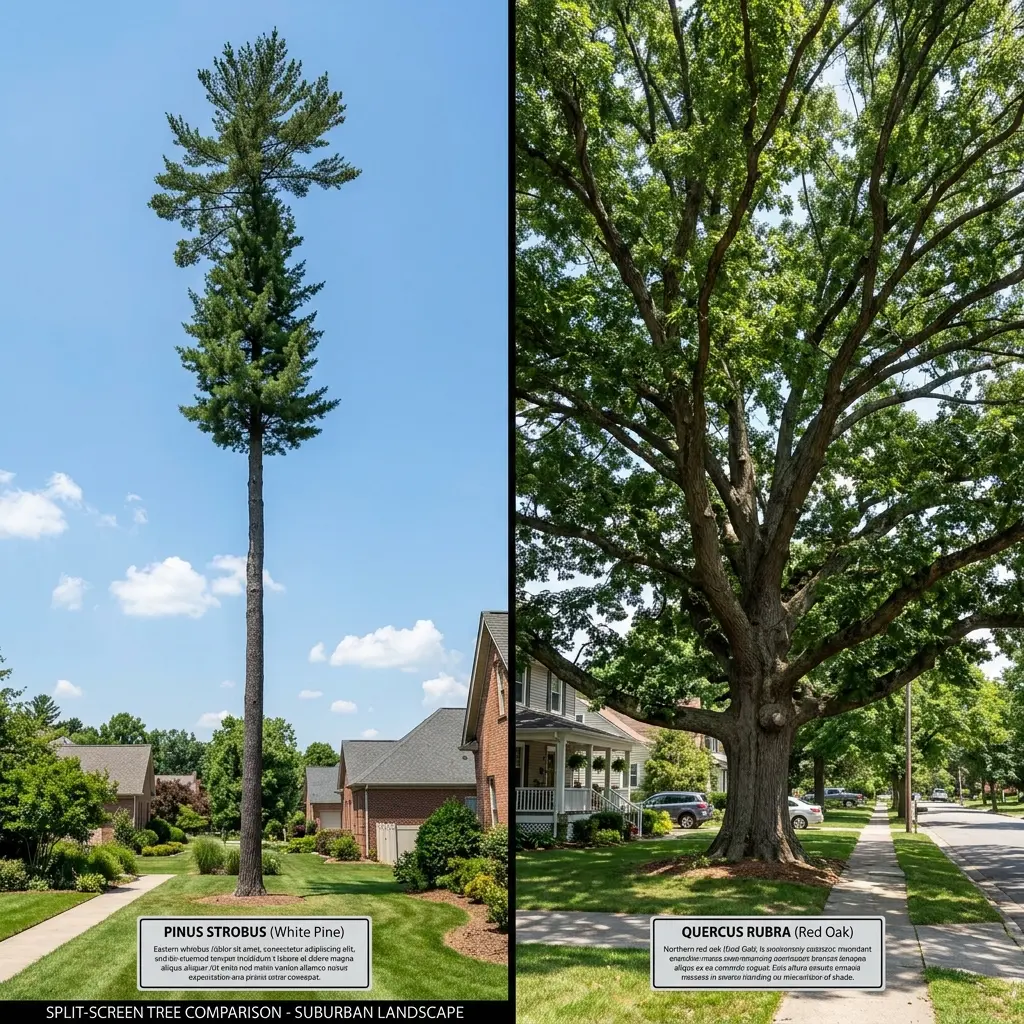

Quick Answer
Pine tree removal typically costs $400–$2,000; oak tree removal typically costs $600–$3,500+. At the same height, an oak costs 1.5–2.5× more than a pine because oak wood is ~75% denser (0.75 g/cm³ vs 0.43 g/cm³), requiring heavier rigging, slower cutting, more chipper time, and larger equipment. A 60-ft pine: $800–$1,800. A 60-ft oak: $1,500–$3,500+. Use the Tree Removal Cost Calculator above for an instant species-specific estimate.
Why Species Changes the Price — The Physics of Wood
Most homeowners assume tree removal is priced by the foot. It isn't. Arborists price by equipment class, rigging complexity, and disposal weight — all driven by wood density and tree architecture.
| Property | Pine (Softwood) | Oak (Hardwood) | Cost Impact |
|---|---|---|---|
| Wood density | 0.40–0.45 g/cm³ | 0.65–0.85 g/cm³ | Oak sections weigh 75–100% more |
| Typical 24" log weight | ~180 lbs | ~320 lbs | Heavier rigging, slower cycle time |
| Canopy architecture | Narrow, columnar | Broad, spreading | Oak limbs overhang structures |
| Branch attachment | Strong (excurrent) | Variable, often included bark | Oak limbs fail unpredictably |
| Debris volume (chipped) | High volume, light weight | Lower volume, heavy weight | Chipper throughput vs. dump weight |
| Equipment trigger | Height-based | Height + weight-based | Oaks hit crane threshold sooner |
> The "$15/ft" Myth: You'll see "$15 per foot" online. That's a rough average for pines only. A 60-ft oak is never $900. It's $1,500–$3,500+ because the 24" oak log weighs 320 lbs — the climber can't throw it, the chipper chokes on it, and the truck hits weight limits faster.
Average Pine vs Oak Removal Cost by Height (2026)
| Height | Pine (Softwood) | Oak (Hardwood) | Primary Cost Driver Difference |
|---|---|---|---|
| Under 30 ft | $300 – $600 | $450 – $900 | Oak: heavier limbs, wider spread |
| 30 – 45 ft | $600 – $1,200 | $900 – $1,800 | Oak: bucket truck often required |
| 45 – 60 ft | $800 – $1,800 | $1,500 – $3,200 | Oak: crane threshold reached |
| 60 – 80 ft | $1,500 – $2,800 | $2,500 – $5,000+ | Oak: 40–50 ton crane often mandatory |
| 80 – 100 ft | $2,500 – $4,500 | $4,000 – $8,000+ | Oak: 80+ ton crane, traffic control |
| 100+ ft | $4,000 – $7,000 | $6,000 – $12,000+ | Oak: specialized rigging, engineering |
> Note: Ranges assume single-trunk trees with standard access. Add 30–60% for: poor access, structures under canopy, power lines, emergency timing, or protected species permits.
The Equipment Threshold — Where the Bill Jumps
Equipment isn't chosen by height alone — it's chosen by section weight. The calculator uses this logic:
```
Section Weight = π × (DBH/2)² × Section Length × Wood Density
If Section Weight > 300 lbs → Bucket truck minimum
If Section Weight > 600 lbs → Crane evaluation triggered
If Section Weight > 1,000 lbs → 50+ ton crane likely required
```
Pine Example: 60-ft pine, DBH 18". 8-ft section = π × 9² × 8 × 0.43 ≈ 875 lbs. Bucket truck (60-ft reach) handles this.
Oak Example: 60-ft oak, DBH 28". 6-ft section = π × 14² × 6 × 0.75 ≈ 1,385 lbs. Crane required — bucket truck capacity exceeded. Crane mobilization: $1,500–$2,500 floor.
This is why a 60-ft oak starts where a 60-ft pine ends.
Canopy Architecture & Rigging Physics
Pine (Excurrent / Central Leader):
- Single straight trunk, narrow crown
- Limbs attach at wide angles, rarely fail
- Rigging: Straightforward vertical drop or light tip-tying
- Time per section: 3–5 minutes
Oak (Decurrent / Spreading):
- Multiple competing leaders, broad crown (often wider than tall)
- Included bark common → weak unions → limbs fail under load
- Limbs often overhang roofs, pools, fences, power lines
- Rigging: Complex lateral lowering, negative rigging, spider legs, speedlines
- Time per section: 12–25 minutes
Result: An oak crew spends 3–5× longer per section. Labor is the biggest line item.
Species-Specific Cost Adders
Oak-Specific Adders
| Factor | Typical Added Cost | Why |
|---|---|---|
| Oak Wilt Protocol (TX, MN, WI, MI, etc.) | $150–$500 | Tool sterilization, wound paint, timing restrictions (no pruning Feb–Jul) |
| Heritage/Specimen Oak Permit | $200–$1,000+ | Municipal review, arborist report, replacement planting bond |
| Acorn/Debris Cleanup | $100–$300 | Heavy acorn mast + leaf volume = extra chipper/haul time |
| Included Bark / Co-dominant Stems | +20–40% labor | Each stem requires independent rigging plan |
Pine-Specific Adders
| Factor | Typical Added Cost | Why |
|---|---|---|
| Pitch/Sap Contamination | $75–$200 | Chainsaw/chain cleaning, chipper blade gumming, PPE replacement |
| Storm Lean / Wind Throw Risk | +15–25% | Pre-tensioned stem requires careful release cuts |
| Power Line Proximity (tall, straight) | $200–$600 | Utility coordination, line clearance certification |
| Crane for Dead Top | $800–$1,500 | If top 15–20 ft dead, climber can't tie in — needs lift |
The "Can I Sell My Oak for Lumber?" Myth — Debunked
Short answer: No.
Residential oaks almost never have commercial lumber value because:
1. Metal/Embedded Objects: Nails, screws, fence staples, cables — destroy sawmill blades ($5,000+ repair). Mills reject urban logs.
2. Taper & Sweep: Open-grown yard trees have heavy lower limbs → severe trunk taper → low-grade lumber.
3. Logistics: A 20-ft log weighs 1,500+ lbs. Loading requires a knuckleboom ($300/hr) + log truck ($200/hr). Transport alone exceeds lumber value.
3. Grade: Urban oak is typically #3 Common or pallet grade ($0.30–$0.50/bf). A 500 bf tree = $150–$250 gross. Minus harvest/haul = net negative.
> Exception: Plantation-grown pine can have pulp/timber value if 20+ acres, straight, limbless to 40 ft, and near a mill. Your single yard pine? Firewood at best.
Worked Cost Examples (Calculator-Generated)
| Scenario | Species | Height / DBH | Equipment | Est. Range | Key Drivers |
|---|---|---|---|---|---|
| 1. Suburban pine, open yard | Loblolly Pine | 55 ft / 16" | 60-ft bucket | $900 – $1,600 | Straight stem, light wood, fast chip |
| 2. Pin oak over roof | Pin Oak | 45 ft / 22" | 75-ft bucket + rigging | $1,400 – $2,500 | Negative rigging over structure, included bark |
| 3. White oak, back yard, fence access | White Oak | 65 ft / 28" | 50-ton crane | $2,800 – $4,800 | Crane mobil., 1,400-lb sections, hand-carry debris |
| 4. Storm-leaning pine on power line | Slash Pine | 50 ft / 14" | Utility coord. + bucket | $1,200 – $2,200 | Line clearance crew, emergency premium |
| 5. Twin-stem live oak, heritage permit | Live Oak | 50 ft / 30" + 26" | 40-ton crane + permit | $3,500 – $6,000+ | Two stems, permit fees, traffic control, replacement bond |
| 6. Dead white pine, tight access | White Pine | 70 ft / 18" | 80-ft bucket + hand haul | $1,800 – $3,200 | Dead wood snaps unpredictably, no climber tie-in |
Pine vs Oak — Decision Checklist for Homeowners
| Question | If YES → Pine Logic | If YES → Oak Logic |
|---|---|---|
| Is the trunk straight with a single leader? | ✓ Typical | Rare |
| Is the canopy wider than the tree is tall? | Rare | ✓ Typical |
| Are there limbs over the house/pool/fence? | Sometimes | ✓ Almost always |
| Is the trunk >24" DBH? | Bucket truck usually OK | Crane likely |
| Are you in an Oak Wilt zone? | N/A | ✓ Check seasonal bans |
| Is the tree dead or storm-damaged? | Unpredictable breakage | Extreme hazard — crane often only safe option |
Frequently Asked Questions
How much does it cost to remove a 60-foot pine tree?
A 60-ft pine typically costs $800–$1,800 with a bucket truck. Add $200–$600 if near power lines, $300–$800 for storm lean, $90–$300 for hauling. Dead tops add crane cost ($800+).
How much does it cost to remove a 60-foot oak tree?
A 60-ft oak typically costs $1,500–$3,500+. The heavier wood (2× pine weight) usually triggers a crane ($1,500–$2,500 mobilization). Add $200–$500 for Oak Wilt protocols in affected states, $100–$300 for acorn/debris cleanup.
Why is oak tree removal so much more expensive than pine?
Oak wood is ~75% denser than pine. A 24" oak log weighs ~320 lbs vs ~180 lbs for pine. This forces: (1) heavier rigging gear, (2) slower cutting cycles, (3) larger equipment (crane vs bucket), (4) faster truck weight-out, (5) more chipper time per ton. Labor hours are 3–5× higher per section.
Does tree removal include stump grinding?
Almost never. Stump grinding is a separate service ($100–$500+ depending on diameter). Oak stumps are harder (dense wood) and often wider at the flare — expect the high end. Pine stumps grind faster but pitch gums the teeth.
Can I save money by having the tree "topped" instead of removed?
No. Topping destroys structural integrity, creates hazardous regrowth, violates ANSI A300 standards, and often costs 80% of removal while leaving a dying liability. Municipalities may fine you for topping protected oaks.
What is Oak Wilt and does it affect removal cost?
Oak Wilt (Bretziella fagacearum) is a fatal fungal disease spreading via root grafts and beetles. In active zones (Central TX, parts of MN/WI/MI/PA/SC), pruning/removal is banned Feb–Jul. Removal requires tool sterilization, wound sealant, and sometimes trenching to sever root grafts — adding $150–$500.
How do I know if my tree is a pine or an oak?
Pine: Needles in bundles (2, 3, or 5), cones, scaly bark, straight trunk. Oak: Broad leaves with lobes, acorns, furrowed/ridged bark, spreading crown. If unsure, take a photo of bark, leaves/needles, and overall shape — any arborist can ID in seconds.
What's the cheapest time of year to remove pine or oak?
Late fall through winter (Nov–Mar). Demand is 30–50% lower, frozen ground protects lawns, deciduous oaks have no leaves (less debris), and crews offer off-season discounts. Avoid Apr–Jun (oak wilt risk + nesting birds) and post-storm weeks (premium pricing).
Do I need a permit to remove an oak tree?
Many municipalities protect oaks specifically: heritage/specimen ordinances (often >12" or >24" DBH), canopy coverage rules, or oak wilt management zones. Fines for illegal oak removal can reach $10,000–$50,000. Always check your city's "Tree Protection Ordinance" before cutting.
Will my homeowners insurance pay for tree removal?
Only if a covered peril (wind, lightning, ice) causes the tree to damage a covered structure (house, garage, fence). Preventive removal of a healthy or declining tree is never covered. If the tree just falls in the yard — no coverage. Document everything with photos before cleanup.
How much does it cost to remove a dead oak vs a live one?
Dead oaks cost 20–50% more. Dead wood is brittle — sections shatter unpredictably, climbers can't tie in safely, crane becomes mandatory. A live 60-ft oak at $2,500 becomes $3,500–$4,500 dead. If it's been dead >1 year, some contractors will refuse without a crane.
What's the difference between a "pine" and a "fir" or "spruce" for removal pricing?
All are softwoods (density 0.35–0.45 g/cm³). Pricing is nearly identical. The calculator groups them as "Softwood/Conifer." Only difference: spruce/fir often have denser lower limbs near structures; fir in the West gets taller (100+ ft) triggering crane sooner.
Can I keep the wood for firewood to offset the cost?
You can keep it, but it won't offset the bill. Contractors charge by the job, not by the wood. Keeping wood saves them ~$50–$100 in dump fees — negligible vs. $2,000+ job. Oak: 12+ months to season. Pine: 6–12 months but high creosote risk — clean chimney often.
Methodology & Sources
Our cost model uses:
- Base labor: Height-banded piece-out time curves (ISA/TCIA time studies)
- DBH weight multiplier: Allometric equations (Jenkins et al., USDA Forest Service) converting DBH × species density → section weight → rigging class
- Equipment selection logic: Height → min equipment class → mobilization floor + hourly rate
- Debris volume: Cubic scaling (height³) × species form factor → chipper hours × crew rate
- Regional multipliers: 6 market zones (0.88x–1.25x) from BLS OES tree trimmer wages + fuel indices
- Species multipliers: Softwood 1.0x baseline; Hardwood 1.4–1.8x (rigging time, blade wear, disposal weight); Palm 1.3x (fibrous disposal)
Sources:
- ISA Best Management Practices: Tree Risk Assessment & Pruning — treesaregood.org
- TCIA ANSI A300 Standards (Parts 1, 2, 5, 6, 9) — tcia.org
- USDA Forest Service Wood Handbook (Chapter 4: Wood Density & Specific Gravity) — fs.usda.gov
- Jenkins et al. (2003) National-scale biomass estimators — USDA FS General Technical Report NE-319
- BLS Occupational Employment Statistics (Tree Trimmer wages by MSA) — bls.gov
- Texas A&M Forest Service Oak Wilt Management — tfsweb.tamu.edu
- University of Minnesota Extension Oak Wilt in Minnesota — extension.umn.edu
Related Cost Resources
Tree Removal Cost Calculator — Enter height, diameter, species (Pine/Oak/Hardwood), and access for instant pricing.
Tree Removal Cost by Height — Equipment thresholds: climber vs bucket vs crane by 10-ft bands.
Tree Types Cost Comparison — Species density multipliers: Pine vs Oak vs Maple vs Walnut.
Stump Grinding Cost Calculator — Stump diameter pricing after removal (oak stumps cost more to grind).
Fallen Tree Removal Calculator — Storm cleanup for downed pines and oaks by scenario.
Emergency Tree Removal Guide — Insurance, storm pricing, and utility coordination.