
Quick Answer
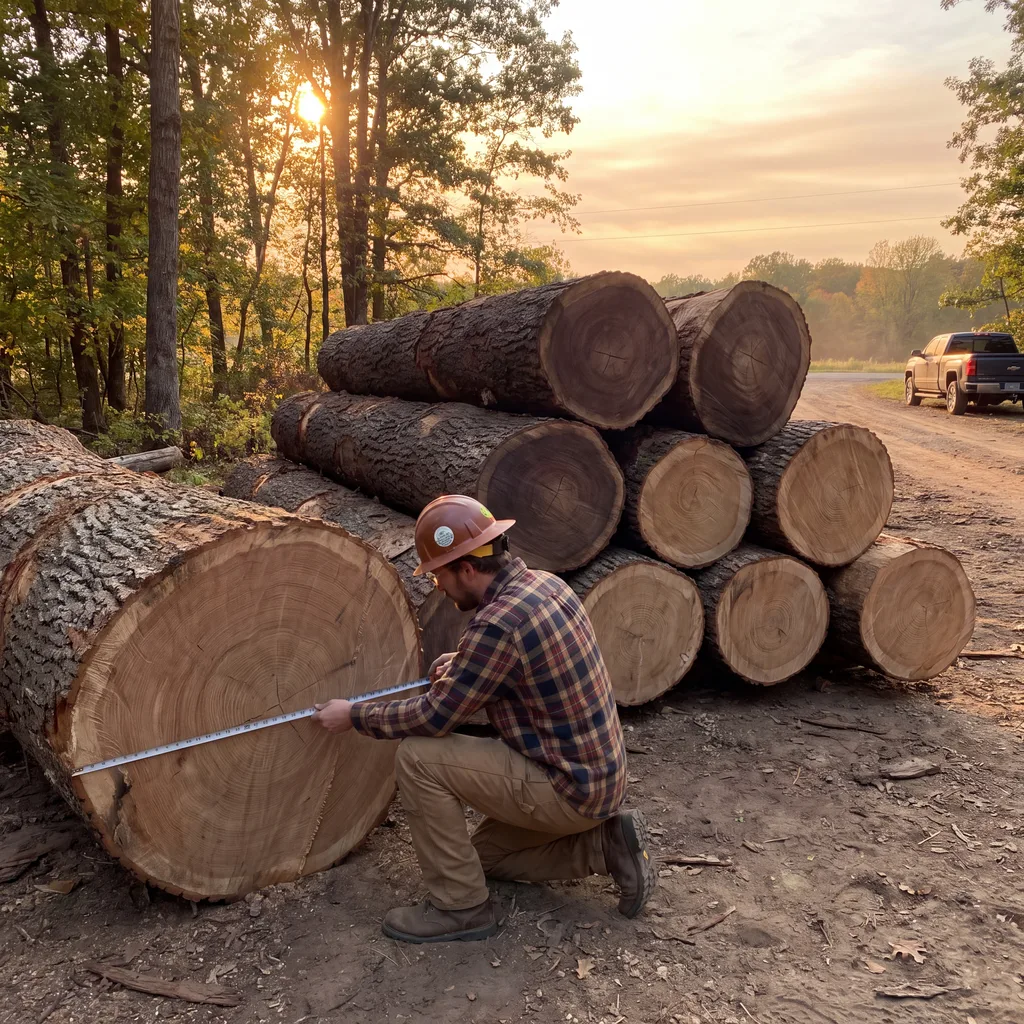
Trees carry two completely different dollar values, and confusing them costs people real money. Timber value — what a mill pays for the wood — ranges from nothing (most yard trees) to $4,000–$40,000+ for a veneer-grade black walnut. Landscape value — what the tree contributes to your property, the number used in insurance claims and lawsuits — runs $5,000–$50,000+ for mature specimens and is calculated by the CTLA Trunk Formula Method. The same 24-inch white oak can be worth $15,000 as landscape and $200 as stumpage. This guide covers the timber side — species tiers, veneer thresholds, who buys, and the honest single-yard-tree answer — with the bridge table below so you always know which number you're talking about.
One Tree, Two Values: The Bridge Table
| Question you're answering | Valuation system | Typical range (mature 24" white oak) | Where to get the number |
|---|---|---|---|
| "What's my tree worth to my property / in a lawsuit / insurance claim?" | Landscape (CTLA) | $13,000–$20,000 | Trunk Formula Calculator → formal appraisal ($300–$800) |
| "What would a mill pay for the wood?" | Timber (stumpage) | $150–$400 | Consulting forester bid process |
| "What did losing it cost me at tax time?" | FMV decline (declared disasters) | Case-specific | Casualty-loss rules |
| "What does removing it cost?" | Removal market | $600–$3,000 | Removal calculator |
The asymmetry surprises everyone: landscape value usually dwarfs timber value for yard trees, because you're paid for shade, screening, and property contribution — not board feet. The exception tier is walnut and veneer-grade white oak, where the wood itself becomes the asset.
Timber Value by Species Tier (2026 Stumpage Reality)
Stumpage = what a buyer pays for standing trees, before harvest costs. Per thousand board feet (MBF):
| Tier | Species | Stumpage / log value | Notes |
|---|---|---|---|
| Premium | Black walnut | Sawlogs $800–$1,500/MBF; veneer $2,000–$5,000+/MBF | Single mature veneer trees: $4,000–$40,000+ |
| Strong | White oak, black cherry | $400–$800+/MBF sawlog; veneer premiums above | Stave-quality white oak (bourbon barrels) has run hot for years |
| Mid | Red oak, hard maple, ash, hickory | $200–$500/MBF | Solid in volume; rarely exciting alone |
| Commodity | Pine, poplar, soft maple, gum | $50–$250/MBF | Pays only at acreage scale |
| Near-zero | Most yard/ornamental species | Firewood value at best | Bradford pear, silver maple, willow, most conifers |
What creates the premium tiers: diameter (value starts around 18–20" DBH; veneer premiums at 24"+), stem quality (a clear, straight, defect-free butt log — the first 8–10 ft — carries most of the tree's value), and grade (veneer logs must be nearly flawless; one bad face demotes a $3,000 log to a $400 log).
Why Your Single Yard Tree Probably Isn't Sellable (The Honest Section)
The "loggers will pay for my tree" dream dies on four rocks, and knowing them saves you weeks of unreturned calls:
1. Volume minimums: mills and loggers mobilize for 15–20+ trees or full acreage — one tree can't amortize equipment transport.
2. The metal presumption: yard trees are assumed to contain nails, fence wire, and clothesline hooks. One hidden nail destroys a $500 sawmill blade, so many mills flatly refuse "yard trees" regardless of species.
3. Access economics: extraction needs skidders or cranes plus log-truck access; a backyard walnut behind a pool costs more to extract than its log value.
4. The felling-cost flip: even when the wood has value, you often still pay for the removal — the buyer takes logs from the ground, not from the sky.
Realistic outcomes for one good tree: a partial credit against removal cost (crew hauls the saw-logs to a contact mill), a hobby-sawyer sale (portable-mill owners pay modestly for clean walnut/cherry logs delivered or roadside), or firewood barter that erases the hauling line. The full free-removal landscape — including when wood-exchange offers are legitimate — is in the free tree removal guide.
When You Actually Have a Timber Sale (Wooded Acreage)
Five-plus wooded acres with premium-tier species changes everything — and the process protects you if you run it correctly:
1. Hire a consulting forester (fee: ~10% of sale, or hourly). They cruise the timber, mark the harvest, and — critically — run a sealed-bid sale to multiple buyers. USDA and state extension data consistently show forester-run sales net more even after the fee.
2. Get the buyer list free: every state forestry agency maintains registered timber-buyer and mill lists.
3. Contract the details: payment before harvest (lump-sum preferred), bonded performance, road/landing locations, wet-ground restrictions, and cleanup standards.
4. Mind the law and the taxes: boundary-line harvests trigger the same treble-damage timber-trespass statutes that protect you from poachers; sale proceeds are generally capital gains with basis rules worth a call to a tax professional (adjacent rules in our tax guide).
Red flag worth its own sentence: the door-knocker offering to "buy your timber" today at a flat price is running the same play as the storm-chaser — the entire value of the forester process is competitive bidding.
Protecting Value You Didn't Know You Had
- Before removing any large walnut, cherry, or white oak, get a second opinion on the wood — a removal crew's chipper doesn't care what it eats, and neither does their quote.
- Before a neighbor dispute goes legal, appraise: a boundary walnut is simultaneously a CTLA landscape asset and a timber asset, and courts award the higher defensible number — tripled in treble-damage states.
- Before storm season, document premium trees (photos, DBH measurements). Post-loss, both the insurance claim and the appraisal get easier with a paper trail.
Frequently Asked Questions
How much is my tree worth?
Two numbers: as landscape (property contribution — the insurance/legal number), a mature healthy tree appraises at $5,000–$50,000+ via the CTLA Trunk Formula Method; as timber (what a mill pays), most yard trees are worth little, while premium species at commercial size run $150–$1,500 — and veneer-grade black walnut $4,000–$40,000+. Always identify which number the situation calls for.
How much is a black walnut tree worth?
A mature black walnut runs $4,000–$40,000+ when it reaches veneer quality: 18–20"+ DBH (premiums above 24"), with a clear, straight, defect-free lower trunk. Veneer logs bring $2,000–$5,000+ per thousand board feet versus $800–$1,500 for sawlogs — grade, not just size, makes the price. A small cluster of quality stems can be worth $10,000–$25,000.
Who buys standing trees?
Sawmills, loggers, timber brokers, and industry foresters — and every state forestry agency publishes a registered-buyer list free. For acreage, hire a consulting forester (~10% fee) to run a sealed-bid sale among multiple buyers; for single yard trees, realistic buyers shrink to hobby sawyers and partial-credit arrangements with your removal crew.
Will a logging company remove my tree for free if the wood is valuable?
For one yard tree, rarely — volume minimums, metal-in-wood presumption, and extraction access defeat the economics. What's realistic: a credit against removal cost for a clean, accessible premium-species trunk. For wooded acreage with walnut, white oak, or cherry, the equation flips entirely and the trees can pay you.
Is timber sale income taxable?
Yes — generally as capital gains for most landowners, with cost-basis and depletion rules that materially change the bill. Get the sale documented (forester's cruise, contract, payment records) and involve a tax professional before filing; this article is educational, not tax advice.
Methodology & Sources
Stumpage tiers synthesized from 2026 published mill and stumpage market data, state extension timber-sale guidance, and forestry-sector price reporting; landscape-value comparisons use this site's CTLA implementation. Ranges are planning benchmarks — actual sales run on cruised volume and competitive bids.
Sources:
- State forestry agencies — timber-buyer registries and landowner sale guides (e.g., Virginia DOF)
- USDA Forest Service — timber sale and stumpage resources — fs.usda.gov
- University extension forestry programs — stumpage price reports
- CTLA — Guide for Plant Appraisal (landscape-value contrast)
Related Cost Resources
Trunk Formula Method Calculator — The landscape-value number, interactively.
Specimen Tree Valuation Guide — The full CTLA appraisal playbook.
Free Tree Removal Guide — Where wood-exchange offers are real and fake.
Tree Removal Cost Calculator — The cost side of the sell-vs-remove math.
Neighbor Tree Law & Property Rules — Timber trespass and treble damages.
Is Tree Removal Tax Deductible? — The tax side of tree losses and sales.