
Quick Answer
Free tree removal exists, but only in seven specific situations — utility line conflicts, municipal street-tree programs, disease-eradication campaigns, assistance programs (senior/veteran/disability/low-income), genuine timber value, wood-exchange deals, and firewood barter. Each has real qualification rules and real odds, listed honestly below. For everyone else, "free" is a mirage that ends in a liability claim — and the better play is cutting the paid price 30–50% with the levers at the end. Know your real number first: the tree removal cost calculator tells you exactly what you're trying to avoid paying.
The 7 Legitimate Routes to Free (or Nearly Free) Removal
| Route | Who qualifies | Realistic odds |
|---|---|---|
| 1. Utility company | Tree in conflict with power lines | High if genuine line contact |
| 2. City/municipal program | Street trees, right-of-way, city-owned | High for city trees; zero for yard trees |
| 3. Disease/pest campaign | EAB, oak wilt, spotted lanternfly zones | Moderate — program- and county-dependent |
| 4. Assistance programs | Seniors, veterans, disabled, low-income | Low–moderate — spotty coverage, waitlists |
| 5. Timber sale | 15–20+ valuable trees (walnut, white oak) | Low for yards; real for wooded acreage |
| 6. Wood-exchange ("free removal for wood") | Valuable species, easy access, volume | Low — mostly myth for single trees |
| 7. Firewood barter | Already-felled hardwood, easy pickup | Moderate — for hauling only, not felling |
Route 1: The Utility Company (The Best Odds in the List)
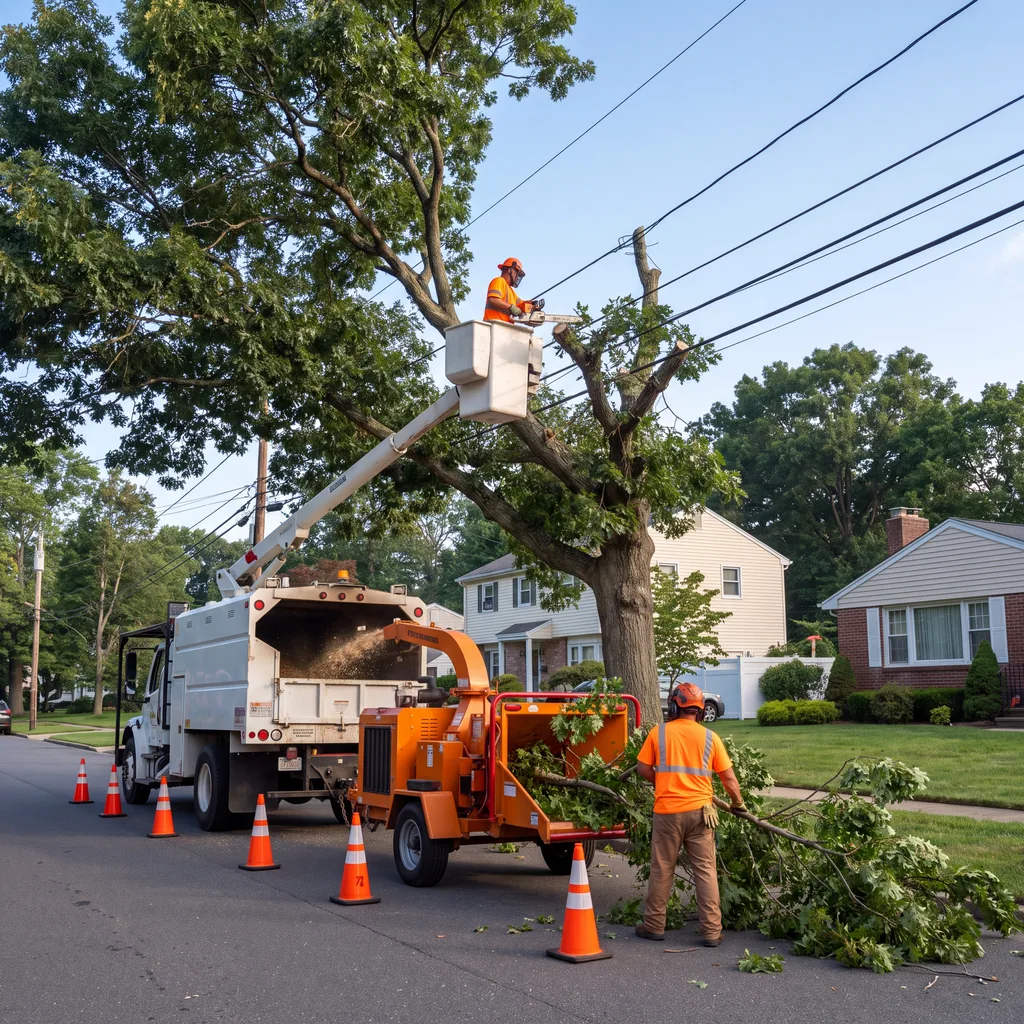
If any part of the tree is growing into, leaning over, or threatening primary power lines, the utility (or its line-clearance contractor) is responsible — trimming and often full removal, free. Call the utility's vegetation-management line with photos. Two catches: they act on line risk, not your landscaping goals — they may prune the conflict and leave the tree; and the line from the pole to your house (the service drop) is usually your responsibility, though utilities will often drop and re-attach it free while your paid crew works. Never let a private crew — or yourself — touch a line-entangled tree; that rule is absolute, as covered in the storm guide.
Routes 2–3: City Programs & Disease Campaigns
Cities remove their own trees — street trees, right-of-way, parks — and many run sidewalk-damage programs that also fix the root damage. Report via 311 with photos; queues are long but the price is zero. Disease campaigns are the interesting one for private yards: during active emerald ash borer, oak wilt, and spotted lanternfly pushes, counties and state ag departments have funded private-property removals to slow spread. Search your county + the pest name, and check the state department of agriculture. A confirmed-diagnosis letter helps — the disease guide shows what the programs look for, and an arborist letter formalizes it.
Route 4: Assistance Programs (Real, but Patchy)
Nonprofits, churches, veteran-service groups, and some Area Agencies on Aging periodically run free or subsidized hazardous-tree removal for seniors, veterans, and disabled or low-income homeowners. Coverage is inconsistent and demand outruns supply. Practical path: call 211 (community services hotline), your county Office on Aging, and local church volunteer networks; ask specifically about "hazardous tree" or storm-recovery programs. After federally declared disasters, add FEMA and state emergency-management debris programs to the list — and note the casualty-loss deduction may recover part of what you do end up paying.
Routes 5–6: Timber Value & the Wood-Exchange Myth
The internet's favorite promise — "loggers will remove your tree free for the wood!" — is mostly false for single yard trees, and here's the honest math: mills buy in volume (typically 15–20+ trees minimum), yard trees are presumed to contain metal (nails, clotheslines — sawyers reject them), and street-side access plus lawn protection makes urban extraction expensive. What IS real: wooded-acreage timber sales (walnut, white oak, cherry at commercial diameters can pay YOU — sometimes thousands), and occasional partial-credit deals where a crew discounts removal for a genuinely valuable, accessible trunk. The species tiers, veneer thresholds, and how to run a real timber sale through a consulting forester are in the timber value guide — read it before believing any "free for the wood" pitch, in either direction.
Route 7: Firewood Barter (Free Hauling, Not Free Felling)
Post positions matter: "free oak firewood, you haul" on local marketplaces reliably clears already-felled, bucked hardwood from your yard — saving the $75–$500 hauling line item. What it does not do is get the tree felled free: letting an uninsured stranger run a chainsaw on your property to earn firewood is the single worst deal in this article, for the reason below. Softwoods (pine, fir) barter poorly; hardwoods move fast in fall.
The Liability Trap (Read This Before Any "Free" Deal)
Every free route involving private individuals shares one failure mode: an uninsured person gets hurt cutting your tree, and your homeowners policy becomes the payer — or denier — of their medical bills. Craigslist wood scavengers, the neighbor with a chainsaw, the "guy who does side jobs" — none carry the general liability and workers' comp that make professional pricing look expensive. The contractor verification guide exists precisely because tree work is among the most dangerous jobs in America. The rule: free hauling of downed wood is fine; free cutting by anyone uninsured is a liability you're accepting, not a discount you're getting. If a tree service offers "free removal" unprompted, that's a sales tactic — verify the COI and get the written scope like any paid job.
When Free Fails: Cutting the Paid Price 30–50%
Most trees don't qualify for any of the seven routes. The consolation levers are real:
1. Know the fair number — walk in with the calculator's range.
2. Off-season scheduling (late fall–winter): 10–25% off.
3. Bundle trees and neighbors into one mobilization: 15–25% per tree.
4. Keep the wood on site (rounds left, you split): $100–$300 off hauling.
5. Skip the stump, then decide later — grinding is separable, and renting works at 4+ stumps.
6. Three itemized bids on the estimate template — comparability is leverage.
Frequently Asked Questions
How can I get a tree removed for free?
Seven real routes: utility companies (line-conflict trees), city programs (street/right-of-way trees), disease-eradication campaigns (EAB, oak wilt zones), assistance programs for seniors/veterans/low-income homeowners, timber sales (wooded acreage with valuable species), wood-exchange deals (rare, needs value + access), and firewood barter (clears felled wood free). Yard trees most often qualify via the utility or disease routes.
Will loggers remove trees for free in exchange for wood?
Rarely for single yard trees — mills need volume (15–20+ trees), presume yard trees contain metal, and urban extraction is expensive. It's real for wooded acreage with walnut, white oak, or cherry at commercial diameters, where a proper timber sale can actually pay you. Single-tree "free for wood" offers deserve skepticism and an insurance certificate.
Does the power company remove trees for free?
Yes, when the tree genuinely conflicts with primary power lines — utilities and their line-clearance contractors trim or remove such trees at no cost. Call the vegetation-management line with photos. They act on line risk, not aesthetics, and the service drop to your house usually remains your responsibility.
Is there free tree removal for seniors?
Sometimes — through local nonprofits, veteran organizations, Area Agencies on Aging, and church volunteer networks rather than any national program. Call 211 and your county Office on Aging, and ask specifically about hazardous-tree or storm-recovery assistance. Coverage is patchy and waitlisted, so pair the search with the cost-cutting levers for a paid fallback.
Why is "free" tree cutting risky?
Because uninsured cutters make you the insurer: if a wood scavenger or handyman is injured felling your tree, your homeowners policy — not theirs — is where the claim lands, and unpermitted work can void coverage entirely. Free hauling of already-downed wood is safe; free cutting by anyone without verified general liability and workers' comp is a transferred risk, not a saving.
Methodology & Sources
Program landscape compiled from utility vegetation-management practices, municipal forestry program norms, state agriculture pest-campaign structures, and 2026 market surveys; wood-exchange economics cross-checked against timber-market data in our timber value guide.
Sources:
- Arbor Day Foundation / municipal forestry program resources — arborday.org
- USDA APHIS — pest quarantine and eradication programs — aphis.usda.gov
- 211.org — community assistance directory — 211.org
Related Cost Resources
Tree Removal Cost Calculator — The number you're trying to avoid; know it first.
Are My Trees Worth Money? — The honest version of the wood-value pitch.
Contractor Insurance Verification — The COI check that separates deals from traps.
Dead Tree Removal Cost — Why hazard trees rarely wait for a free program.
Storm & Emergency Removal Costs — Insurance-paid isn't free, but it's close.
Tree Removal Estimate Guide — Three itemized bids beat one "free" promise.